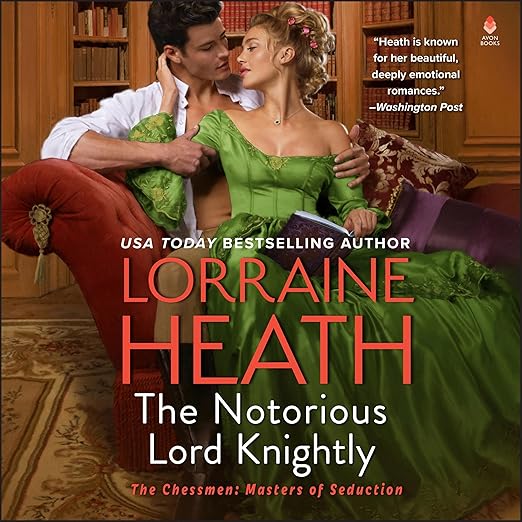
Quick Take
- Narration: Kate Reading is the definitive voice for Lorraine Heath’s Victorian world, her authority and warmth carry the emotional weight that second-chance romance demands.
- Themes: Reputational warfare in Regency society, the power of women’s anonymous authorship, second chances earned rather than given
- Mood: Elegant and emotionally invested, the pleasures are in the slow rebuilding of trust rather than the initial attraction
- Verdict: Heath at her reliable best, a second-chance Regency romance that honors both its genre and its characters, with Kate Reading elevating the already-strong material.
There is a particular pleasure in returning to a writer you trust with the knowledge that they have never yet disappointed you. That was the position I occupied when I loaded up The Notorious Lord Knightly, I had heard Kate Reading narrate Lorraine Heath before, I knew broadly what the emotional territory would look like, and I was entirely at peace with that. I settled in on a Friday afternoon with tea and no particular plans, and finished the eleven-hour audiobook over the course of the weekend. Heath delivered. Reading delivered. The book earns its emotional payoffs, and the anonymous-authorship conceit that drives the plot is more interesting than most of the promotional framing suggests.
The setup is elegant in its historical grounding. Miss Regina Leyland, jilted five years earlier when the Earl of Knightly called off their engagement on the morning of the wedding, has channeled her heartbreak into a scandalous anonymous novel whose villainous ‘Lord K’ is recognizable to all of London. Knightly, furious to find himself the subject of gossip and innuendo, confronts the woman he suspects of authorship, only to discover that the naive innocent he left at the altar has become someone considerably more formidable. The social arithmetic of what follows, the fabricated reconciliation, the gradual real entanglement, the eventual confrontation with the truth Knightly withheld, is handled with the confidence of a writer who has been working this territory for decades.
The Anonymous Novelist and What Her Book Actually Does
What makes The Notorious Lord Knightly more interesting than a standard second-chance Regency is the precision with which Heath thinks about what Regina’s novel does to the social ecosystem of London’s ton. Regina wrote to expose Knightly, impulsively and from genuine pain, and the book’s unexpected success brings consequences she did not calculate, not just enemies at her door but a shift in her own social position that she cannot fully control. Heath is attentive to the economics of female authorship in the period: the necessity of anonymity, the vulnerability that revelation would create, and the particular irony of a woman’s most intimate act of self-expression becoming a public object over which she has no legal or social claim.
The reviewers who note that the book was inspired by an actual anonymous erotic novel of the period, and who point out that the fictional London’s reception of Regina’s work is somewhat more benign than the real history would suggest, are identifying a genuine liberty Heath takes with verisimilitude. The ton in this novel is somewhat more forgiving than period accuracy might warrant, which is a feature of Heath’s craft rather than an oversight, she is building a world where the emotional logic can work, not a documentary of Regency social reality.
Knightly’s Explanation and the Second-Chance Problem
Second-chance romances live or die by the quality of the explanation for the initial split. If the reason the hero left is insufficient, readers feel cheated. If it is melodramatic, it strains credulity. Heath’s handling of Knightly’s reason for calling off the wedding, something he was forced to conceal at the time, something that implicates his honor without making him simply a villain, is well-calibrated. He is not absolved easily. Regina does not forgive him because she misunderstood; she forgives him because she understands fully and decides he has earned it. That distinction is what separates Heath’s better work from genre mechanics, and it is fully present here.
One reviewer who generally dislikes second-chance romances because ‘the characters are so mean to each other for most of the book’ flagged that this entry avoided that trap, and they are right. The hostility between Knightly and Regina is present but controlled, emerging from genuine hurt rather than sustained antagonism. Heath builds the relationship’s reconstruction carefully, allowing attraction to coexist with unresolved grievance in ways that feel adult and true.
Kate Reading and Eleven Hours of Georgian London
Kate Reading is one of the most experienced narrators working in historical romance, and The Notorious Lord Knightly benefits from every dimension of that experience. Her Knightly has authority without coldness, and her Regina has conviction without shrillness, two characters who could easily become types in less skilled hands. Reading is particularly strong in the scenes where the false reconciliation is beginning to slip toward the real thing: she holds the irony and the genuine feeling simultaneously in a way that requires technical precision to execute without collapsing one into the other.
The secondary cast, the ton, the various antagonists who come to threaten Regina’s anonymity, the ensemble of figures who populate the fabricated reconciliation, are handled with the economy that eleven hours of single-narrative audio demands. Reading does not overindividuate the supporting players, which is the right call for a novel whose emotional weight is entirely in the central relationship.
Series Context and Standalone Accessibility
The Notorious Lord Knightly is book two in The Chessmen: Masters of Seduction series, but functions effectively as a standalone. The world is consistent across entries but the central love story is complete, and listeners who have not read book one will not find themselves missing essential context. For established Heath readers, the familiar pleasures are all present. For listeners new to Lorraine Heath, this is a perfectly good entry point into a body of work that is consistently among the most emotionally intelligent in the Regency romance genre.
Frequently Asked Questions
Does The Notorious Lord Knightly need to be listened to after book one of The Chessmen series?
No. While it is part of a series, the central romance between Knightly and Regina is complete in this volume and does not depend on prior knowledge of the series. Listeners can begin here without confusion.
How explicit is this historical romance in terms of sensual content?
The book includes intimate scenes characteristic of Lorraine Heath’s historical romance work, warm and emotionally integrated rather than graphic. Readers familiar with her other novels will know the register; those new to her work can expect sensual content handled with craft and emotional context.
Kate Reading narrates, how does she handle the dual dynamic of a hero and heroine who are genuinely hostile to each other at the start?
Reading gives Knightly and Regina distinct vocal registers that make their emotional states legible without requiring dramatic overplaying. She is particularly strong in the scenes where false hostility is beginning to give way to genuine reconnection, holding both emotional states credibly in the same scene.
The anonymous-author premise, does the novel feel historically accurate in how it depicts Regency London’s reception of the book?
Heath takes some liberties with how forgiving the ton is toward Regina’s authorship once revealed. The social consequences are real but milder than strict period accuracy might suggest. This is a deliberate choice that allows the emotional logic to work; readers seeking documentary Regency authenticity should calibrate accordingly.