Quick Take
- Narration: Neva Nevarre brings warmth and a light comedic touch to Madison’s voice, carrying the banter through the rougher patches of the prose.
- Themes: Starting over after betrayal, workplace slow burn, Cuban-American family dynamics
- Mood: Breezy, clean, and cozy
- Verdict: A feel-good closed-door romance with charm in its premise and genuine cultural specificity, though the writing execution is uneven.
I was in the mood for something light on a Friday night when a colleague recommended the It’s Amor Rom-Com series. She described it as exactly the right kind of uncomplicated, which is a recommendation style I respect because it sets accurate expectations. I downloaded The Nice Guy and settled in with some tea, and I can confirm it is, in fact, uncomplicated. Whether that’s enough depends on what you’re after.
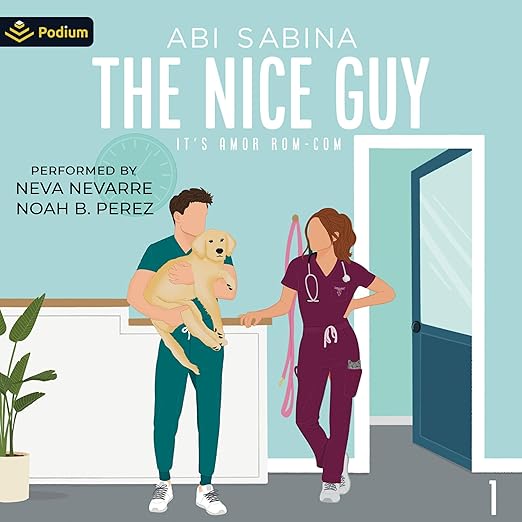
The premise is charming. Madison is a veterinarian who moves to Sunshine Falls after discovering her boyfriend cheated on her. Her uncle, a local vet who’s ready to retire, has long dreamed of Madison taking over his practice. The wrinkle: the cute stranger she met at a coffee shop turns out to be Ivan, her new business partner. They clash professionally while managing a steady stream of unexpected exotic animal patients, and Madison has to navigate her no-new-relationships rule while her feelings for Ivan refuse to cooperate. The meddling Cuban family in the background supplies the comedic interference. The turtle-shelled glasses Ivan apparently wears are, according to Madison, her undoing. I found this detail oddly endearing.
Our Take on The Nice Guy
Abi Sabina’s book has genuine strengths that her writing craft has not yet fully caught up with. The cultural specificity of the Cuban-American family dynamics feels authentic and warm rather than decorative. The exotic animal patients, including a cat named Boots who clearly made an impression on multiple reviewers, give the veterinary setting a comedic texture that most workplace romances lack. The slow burn between Madison and Ivan has real sweetness to it, particularly in the scenes where Ivan begins to open up and Madison’s resistance starts to crack.
The craft issues are real, though. Multiple reviewers noted that the romance’s progression feels rushed in critical places, jumping from antagonism to affection without fully earning the transitions. One reader described it as suddenly announcing they were dating without sufficient emotional buildup, and that assessment rings true in the audio. The editing is uneven, with details repeated in ways that suggest the manuscript would have benefited from another pass. Sabina’s prose occasionally stumbles over itself, particularly in the middle section where several subplots are being juggled simultaneously.
Why Listen to The Nice Guy
The closed-door approach to the romance is one of the book’s defining features, and it delivers on that promise without apology. Readers who are tired of heat-level disclaimers and want a genuine sweet romance without graphic content will find The Nice Guy reliable on this front. The It’s Amor branding is accurate: this is culturally specific, warmly rendered, and genuinely clean.
Neva Nevarre’s narration is a significant asset. She handles Madison’s voice with a light comic timing that smooths over the rougher prose transitions, and the banter scenes in particular land better in audio than they likely would on the page. Nevarre commits to the comedic moments without undercutting the genuine emotion in the quieter scenes, which is a balance that this kind of material needs and often doesn’t get.
What to Watch For in The Nice Guy
The book positions itself as the first in the It’s Amor Rom-Com series following Cuban-American cousins, so there are setup elements here that will presumably pay off in later installments. If you are coming to this as a standalone, some of the secondary character introductions feel incomplete. That’s an inherent tension in series openers, but it’s worth knowing the book is partly laying groundwork.
The exotic animal subplot is mostly comedic texture rather than developed narrative, but the animals are handled with enough specificity that the veterinary setting feels grounded rather than incidental. Boots the cat is, as advertised, a delight.
Who Should Listen to The Nice Guy
This is exactly right for romance listeners who want clean, warm, culturally specific contemporary love stories without explicit content. It suits commutes and background listening well. Readers who require tight plotting and emotionally rigorous character development in their romance will find the execution frustrating. Those who simply want a good-natured slow burn with Cuban family energy and a veterinary setting will likely enjoy themselves as much as Madison enjoys those turtle-shelled glasses.
Frequently Asked Questions
Is The Nice Guy completely closed-door, or does it have some heat?
The Nice Guy is a closed-door romance with no explicit content. The synopsis describes it explicitly as delivering sizzling chemistry without the spice, and the book delivers on that promise. Physical intimacy is present but not depicted graphically.
Do I need to read the It’s Amor Rom-Com series in order, or is this a standalone?
The Nice Guy is the first book in the It’s Amor series and functions as a standalone romance with a complete arc. However, some secondary characters appear to set up future installments, so reading in order will likely give you more context for those threads.
How does Neva Nevarre handle the comedic elements of the narration?
Nevarre brings natural comedic timing to Madison’s voice without playing the humor too broadly. The banter scenes and the moments of animal-related chaos land particularly well in audio, benefiting from her delivery in ways that balance the lighter prose against the more earnest romantic beats.
Is the Cuban-American cultural representation authentic and central to the story?
Yes, the Cuban family dynamic is integral rather than decorative. The meddling relatives, the cultural expectations around family business, and the specific warmth of that community are woven into the plot rather than simply used as color. Multiple reviewers cite it as one of the book’s genuine strengths.