Quick Take
- Narration: Tara Sands matches Pearl’s voice with exactly the right combination of scrappiness and warmth, keeping the silent film adventure sequences kinetic without losing the humor.
- Themes: Female courage, early Hollywood history, family and secret-keeping
- Mood: Sunny, fast-moving, and faintly anarchic
- Verdict: A historical middle-grade adventure that moves like a silent film itself, fast, funny, and propelled by a heroine who earns her title.
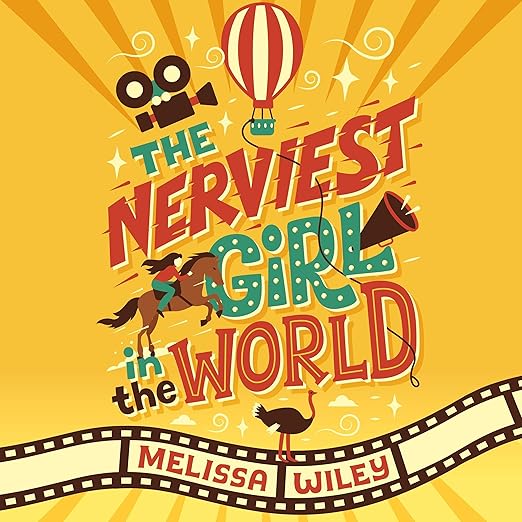
I finished The Nerviest Girl in the World on a Sunday afternoon after starting it somewhere around mid-morning, and the feeling it left me with was the particular satisfaction of a book that knows exactly what it is and does not waste a single word trying to be anything else. Melissa Wiley is writing a historical comedy-adventure about a ranch girl who accidentally becomes a stunt performer for early silent pictures, and every narrative choice in this book is calibrated to serve that premise with maximum entertainment and minimum fat.
Pearl lives on a California ranch. Her chores include collecting eggs and dealing with ostriches that the synopsis accurately describes as ornery, and it is the ostriches that convinced me this book was something special. A less confident author would have given Pearl horses as her animal foils, because horses are romantic and legible. Wiley gives her ostriches, because ostriches are genuinely ridiculous, and Pearl’s matter-of-fact relationship with these absurd birds establishes her character more efficiently than ten pages of backstory could.
When Moving Pictures Were New
Wiley’s decision to set this story in the earliest days of silent film is both historically interesting and narratively smart. The Daredevil Donnelly Brothers, Pearl’s three older brothers, are cowboy stuntmen for this nascent industry, and Pearl stumbles into being a stunt girl through a combination of competence and circumstance that feels organic rather than contrived. For children who have never thought about the pre-Hollywood history of film, this book opens a genuinely fascinating window. The stunt sequences are appropriately dangerous in description without tipping into territory that would alarm younger readers, and Wiley plays the physical comedy of the situations with the kind of timing you associate with the films being made.
Tara Sands and the Voice Pearl Needs
Tara Sands is a prolific middle-grade narrator with a range that allows her to differentiate Pearl’s three brothers, her mother, and the various film personalities they encounter without ever losing track of whose story this is. Pearl’s voice in Sands’ rendering is characterized by a kind of cheerful stubbornness: she is not reckless, she is practical in the way of someone who grew up around ostriches and therefore knows that danger is negotiable. The ranch sequences and the film set sequences have different energies, and Sands manages the tonal shifts between them cleanly.
The Secret-Keeping Subplot
The narrative tension that sustains the book across its three-hour-and-forty-six-minute runtime is largely about Pearl’s mother not knowing what Pearl is doing. This is a structure as old as children’s literature, but Wiley deploys it with more moral honesty than usual: Pearl’s secret-keeping is not presented as wholly virtuous, and her eventual reckoning with her mother carries genuine weight. The book does not moralize, but it also does not pretend that jumping out of burning buildings and not telling your parents is simply fine. The comedy and the consequence live alongside each other, which is a harder thing to balance than it looks.
Who This Adventure Belongs To
The Nerviest Girl in the World is best suited for readers aged eight to twelve, with particular appeal for children who love historical fiction, adventure stories with strong female protagonists, and comedy that trusts its audience. The comparison in the synopsis to Wild Hearts Can’t Be Broken is apt for adult readers who know that film, though children encountering this book will not need the reference. Tara Sands’ narration makes this a stronger audio experience than a silent read, which is the best thing that can be said about any children’s audiobook.
Frequently Asked Questions
What historical period is The Nerviest Girl in the World set in, and how accurate is the silent film background?
The story is set in the early days of silent film, roughly the 1910s, when itinerant film crews traveled California making cowboy pictures with real stunt performers. Wiley’s depiction of the period has been praised for its specificity and the details of early film production feel researched rather than generic.
Is the book a standalone or part of a series?
It is a standalone novel. Pearl’s story is complete within this single volume, with no sequel or series continuation.
How does Tara Sands handle the wide cast of characters, is it easy to follow who is speaking?
Sands differentiates Pearl’s three brothers, her mother, and the film world characters clearly enough that following dialogue is not a problem. Pearl’s voice remains the dominant and most distinctive throughout.
Is the content age-appropriate for the younger end of the middle-grade range, or does it skew older?
The stunt sequences involve situations like jumping from burning buildings, which are presented humorously rather than graphically. The book is suitable for ages eight to twelve, and nothing in the content would concern parents of readers at the younger end of that range.