Quick Take
- Narration: Savanah Peachwood handles the three distinct heroines with good differentiation and keeps the romantic tension audible throughout 22-plus hours.
- Themes: Family loyalty, second chances at love, forbidden attraction across professional lines
- Mood: Warm and flirtatious with occasional dramatic heat, binge-friendly by design
- Verdict: Three interconnected romances that stand alone comfortably but reward reading together, offering character continuity and a cohesive family world that fans of the genre will find genuinely satisfying.
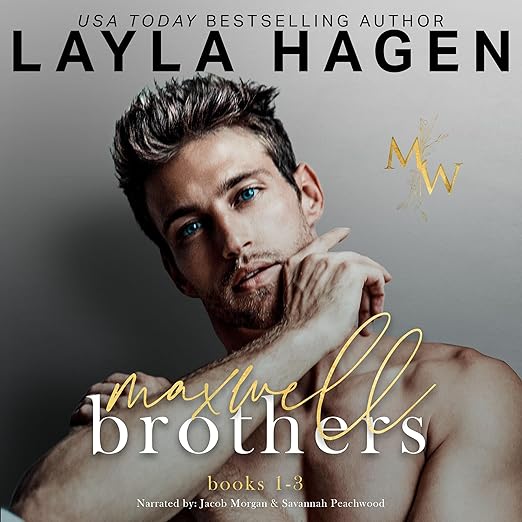
I started this one on a Sunday with no particular intention and came up for air sometime around Tuesday. Layla Hagen has a gift for engineering that specific kind of readability, the page just turns, the hour just passes. The Maxwell Brothers boxset collects the first three entries in her Maxwell Brothers series, each featuring a different brother finding his way to love through a premise that is distinct enough to carry its own weight while sharing enough family infrastructure to feel cohesive.
The series is built around six Maxwell brothers, which means the first three books function as both complete stories and an extended setup for what comes after. That dual role is managed deftly. By the end of book three, you know the Maxwell family well enough that book four’s arrival would feel like a reunion rather than an introduction.
Our Take on the Maxwell Brothers Boxset
The three premises are usefully differentiated. Promise Me Forever puts Tate, a divorced single father committed to his daughter Paisley above all else, against the professional boundary of falling for Paisley’s nanny Lexi. Hold Me Forever puts Tyler, hockey’s bad boy, in the hands of a PR rep hired to rehabilitate his image, a professional friction setup that the genre has used before, but which Hagen handles with enough character specificity to feel fresh. Show Me Forever gives Declan, described as moody and unreasonable, a baker named for whom his guesthouse provides shelter and proximity. Of the three, the landlord-tenant setup has the most comic potential, and Hagen uses it well.
A reviewer noted these books offer a slightly different type of story progression from typical romance, and while they are coy about specifics to avoid spoilers, the observation holds. Hagen’s couples tend to arrive at their relationship complications through character logic rather than manufactured misunderstanding, which makes the obstacles feel more earned and the resolutions more satisfying.
Why Listen to This Rather Than Read It
Savanah Peachwood carries more than twenty-two hours without the performance ever feeling mechanical. The three heroines, Lexi, the PR rep whose name is not given, and the baker, each have a distinct conversational register, and Peachwood maintains those distinctions reliably across the runtime. The Maxwell brothers themselves are differentiated mainly through their relationships and profession rather than dramatic vocal performance, but that is consistent with how Hagen writes them.
At over twenty-two hours for three complete novels, the price-per-story ratio in audio is strong. One reviewer noted some graphic steamy scenes but mentioned they are easy to navigate past if that is not your preference, in audio, that requires a brief fast-forward rather than a page flip, but the same principle applies.
What to Watch For in the Family Dynamics
Gran is the invisible structural center of the Maxwell family, the matriarch whose influence shaped six brothers into the loyal, protective unit they are. She does not appear frequently in the narrative present, but her influence surfaces constantly in how the brothers relate to one another and to the new women entering the family. That kind of off-page character gravity is harder to build than it looks, and Hagen does it well.
The family interconnection is managed carefully enough that each book functions as a standalone. You do not need to have read the others to understand what is at stake in the one you are in. But listening to all three consecutively, as this boxset is designed to encourage, produces a cumulative warmth that individual entry-points cannot replicate.
Who Should Listen to This Recording
Contemporary romance readers who enjoy family-based series where each book follows a different sibling will be in comfortable territory. The series rewards listeners who like knowing there is more world to explore after each story ends. Those who prefer tighter, contained romantic arcs may find the setup-for-sequels element slightly distracting. The graphic content is notable but not relentless, one reviewer described it as easy to navigate, which in the context of contemporary romance signals moderately steamy rather than explicitly eroticized.
Frequently Asked Questions
Can each of the three Maxwell Brothers books be listened to as a standalone, or do they need to be experienced in order?
Each of the three books resolves its own romantic arc completely and can be understood independently. However, Hagen seeds family dynamics and secondary character development across all three that reward listening in order. Most reviewers recommend starting with book one for the fullest experience.
How does Savanah Peachwood handle the multiple heroines and their distinct voices across 22-plus hours?
Peachwood differentiates the three heroines reliably without making the distinctions feel exaggerated. The performance is consistent throughout the long runtime. The Maxwell brothers are less vocally differentiated, but their characterization in the writing provides enough context that this is not disorienting.
How explicit is the content in this boxset, and is it consistent across all three books?
The series is contemporary romance with steamy scenes. The content is explicit enough that one reviewer mentioned skipping those sections, but another described the pacing as a welcome change from more gratuitous examples of the genre. The level is broadly consistent across all three books.
If I have already read books one through three in print, does the audio version offer anything different?
Savanah Peachwood’s narration adds a layer of warmth and playfulness to the dialogue that audio generally enhances in banter-heavy contemporary romance. If you found the books engaging on the page, the audio version is a worthwhile revisit, particularly for Hold Me Forever, where the PR rep and hockey player dynamic translates well to performed dialogue.