Quick Take
- Narration: Mike Ferreri brings warmth and measured energy to the Little Blue Engine’s famous refrain, appropriate for the youngest listeners without overperforming the material.
- Themes: Perseverance, self-belief, kindness to others in need
- Mood: Warm and encouraging, with a quiet emotional payoff
- Verdict: A seven-minute audiobook of one of the most recognizable children’s stories ever published, its brevity is its strength, and the narration delivers the classic text with affectionate simplicity.
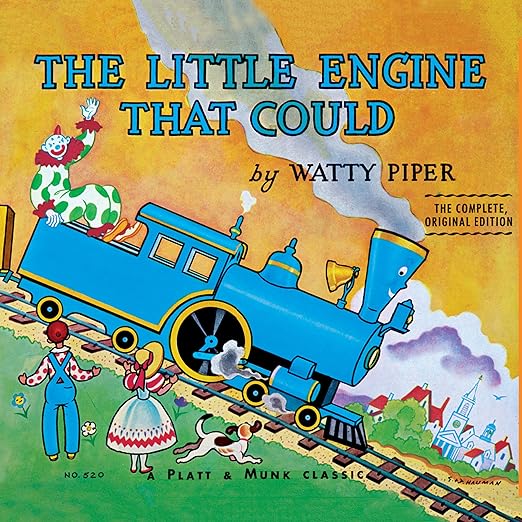
There are books that every generation inherits without quite knowing when they first heard them. The Little Engine That Could is one of those. First published in 1930 under the Watty Piper pen name, it has been read at bedsides and in classrooms for nearly a century, and the phrase “I think I can” has become cultural shorthand for a particular kind of determined optimism. When I put on this audiobook, I was partly curious how a seven-minute performance handles material this compressed and this familiar.
The answer is: cleanly and warmly. Mike Ferreri’s narration doesn’t try to reinvent the story or find new angles in it. The text is the text, the message is the message, and the job here is to deliver both with enough warmth and pacing that the climactic climb over the mountain lands the way it’s supposed to. Ferreri does that. The rhythm of the famous refrain, “I think I can, I think I can, I think I can”, builds appropriately, and the resolution feels earned even at this brevity.
Seven Minutes and a Century of Accumulated Trust
What makes this story so durable is partly its structural economy. The Little Blue Engine is not the biggest, most powerful, or most prestigious engine. She is asked to take on a task that larger engines refused. She accepts not out of certainty but out of willingness. And she succeeds. That is the whole story, and it is a very good story, because it puts the moral not in the words characters say to each other but in the action the story enacts. Young listeners understand this intuitively, which is why reviewer after reviewer describes the book’s timeless message being incorporated into daily life. A grandmother mentioned she grew up with it; her grandchild is growing up with it too. That continuity is real.
An Audiobook Built for Shared Listening
At seven minutes, this works best as a shared experience rather than an independent listening session. The story is short enough that it invites response, a child and an adult can talk about it immediately after, and the material generates genuine conversation about giving up versus trying. Several reviewers mention this as a gift at baby showers and early birthdays, and as an audiobook it functions similarly: something to play during a car ride, a bedtime wind-down, or as a prelude to a longer reading session. The audio format does not add much that a read-aloud parent cannot provide, but it offers a consistent, warm performance for moments when a parent isn’t available.
Honest About What It Is
This is not a complex audiobook. It is not trying to be. The story has no subplot, no character arc in the contemporary sense, no ambiguity. It makes a single argument and makes it with enough conviction that nearly a century of readers have found it worth keeping. The audiobook is a faithful delivery of that argument at a length children can hold in their attention without fidgeting. Mike Ferreri’s performance is honest and unadorned, which suits material this foundational. There is nothing here that will surprise a parent who knows the story, and nothing that will disappoint a child hearing it for the first time.
Who Should Listen
Best for children ages two through six who are being introduced to the Little Blue Engine for the first time, or who are already fans and want to hear the story told to them. Parents and grandparents who want a reliably positive, culturally familiar audiobook for short sessions will find this serves that purpose well. Those looking for more narratively complex or longer audiobooks in the same spirit of perseverance will want to look elsewhere after introducing this classic.
Frequently Asked Questions
Is the text in this audiobook the original 1930 version of The Little Engine That Could?
The story as published under the Watty Piper name has been through multiple editions with some variations over the decades. This audiobook edition reflects the widely recognized text, though listeners interested in the historical first edition may want to verify against a specific publication.
At seven minutes, is this audiobook long enough to be worth purchasing on its own?
The value depends on how you plan to use it. As a standalone listen it is very brief, but for families who want a consistent, on-demand performance of this specific story during car rides, bedtime, or quiet time, it serves that purpose reliably. It is one of several short picture-book audiobooks best evaluated as part of a library rather than a one-time purchase.
Is this appropriate for children who are just being introduced to the concept of perseverance?
Yes. The story is among the most age-appropriate introductions to perseverance available, with a narrative simple enough for toddlers and a message clear enough that even very young listeners grasp it intuitively. Multiple reviewers describe it working for children as young as two or three.
Does Mike Ferreri’s narration do anything distinctive with the famous refrain?
Ferreri handles the refrain with a building pace that honors the original text’s cumulative energy. The performance is warm rather than theatrical, it delivers the climax with conviction without overplaying it, which is the right call for material this familiar and beloved.