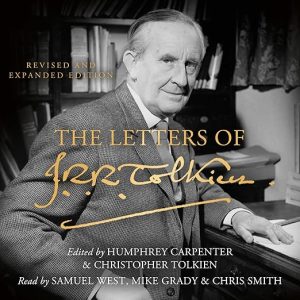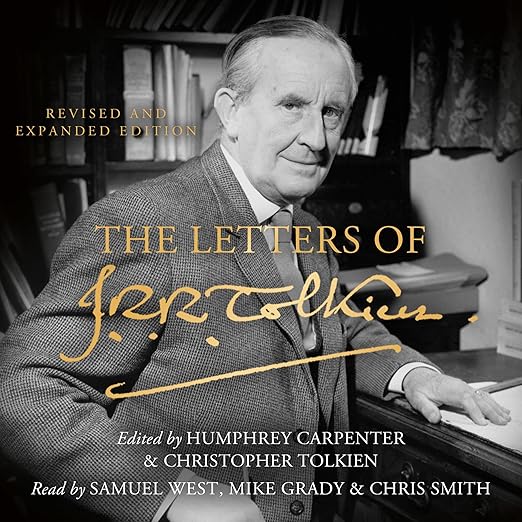
I have spent a significant portion of my reading life in and around Tolkien, the texts themselves, the biography by Humphrey Carpenter, the posthumous volumes Christopher Tolkien assembled from his father's notes across decades. I mention this not to establish credentials but to give context for how surprised I was by the experience of listening to The Letters of J.R.R. Tolkien in this revised and expanded edition. I expected something I largely knew. What I found was a version of Tolkien I had not fully encountered before: more self-aware, more uncertain, more warmly funny, and more philosophically searching than the summary version that academic and fan discourse tends to produce.
This expanded edition, which restores more than 150 letters that were cut from the 1981 Carpenter collection purely for length, is the book as Tolkien's editors originally intended it to be. I began it one evening intending to listen for an hour and was still going two hours later, absorbed in a letter to his publisher about the correct pronunciation of Elvish names that turned, somehow, into a meditation on the nature of invented language and its relationship to the primary world.
150 Restored Letters Include Tolkien's Own Synopsis
What makes this collection extraordinary is that Tolkien was a genuinely exceptional letter-writer, not just fluent and learned, which academics often are, but attentive to his correspondents in a way that shapes each letter to its recipient. His letters to publishers are measured and precise. His letters to family are warmly domestic and occasionally wry. His letters to fans, including detailed responses to questions about Middle-earth that amount to mini-essays in world-building theory, are generous and illuminating in equal measure. The Tolkien who emerges across twenty-nine hours of correspondence is a substantially fuller human being than the monolithic figure of the biography.
The restored letters include, crucially, Tolkien's own plot summary of the entirety of The Lord of the Rings and a vision for what he called the "Tales of the Three Ages." For anyone who has spent time with Middle-earth, encountering Tolkien's own account of what he was doing in those books, his intentions, his doubts, his explanations of what the narrative choices meant, is a qualitatively different experience from reading critical interpretation. It is the primary source, and primary sources are always more complicated and more rewarding than the summaries derived from them.
Samuel West Restores the Intimacy of Letters
Samuel West is an exceptional narrator for this material. His voice carries the weight and warmth of someone for whom the English literary tradition is natural territory, which matters here because Tolkien's prose, even in his informal correspondence, is shaped by that tradition in ways that a less attuned narrator might flatten. West's pacing is thoughtful rather than efficient, which is the right choice for letters that are themselves thoughtful and that reward careful attention. At twenty-nine hours, the runtime asks for a substantial commitment, and West makes that commitment feel like time well spent.
The audiobook format has a specific virtue for this kind of epistolary material. Letters are meant to be heard as well as read, they are addressed, they are spoken to someone, and West's performance restores something of that intended intimacy. Tolkien writing to his son Christopher during the Second World War, or to a young reader in America asking detailed questions about the Ents, sounds different read aloud than it does on the page, and the difference is meaningful.
Letters as Mosaic, Not as Chronology
This is not a chronological narrative. The letters are organized in sequence, but they are not a story in the conventional sense, they are a mosaic, and some periods of Tolkien's life are represented more fully than others depending on what correspondence survived. Listeners who want a comprehensive account of Tolkien's life will find Carpenter's biography the more appropriate companion; the letters work alongside that rather than replacing it.
The theological and Catholic dimensions of Tolkien's thinking are present throughout and become increasingly central as the correspondence deepens. Tolkien was explicit about the relationship between his faith and his fiction, the concept of sub-creation, the idea that human world-making reflects a divine capacity, and those arguments run through many of the most revealing letters. Listeners who find that dimension of his thinking either irrelevant or unwelcome should know it is not an occasional theme but a persistent one.
Primary Sources Beat Critical Commentary Here
The most obvious audience is Tolkien readers who want to understand the creative processes and intentions behind Middle-earth from Tolkien himself rather than through critical mediation. For that audience, this is the essential document, more revealing than any commentary, more specific than any biography. The restored 150 letters make this expanded edition the version to seek out rather than the 1981 collection.
Beyond Tolkien readers, this works as a model for anyone interested in the relationship between a writer's life, beliefs, and creative output. It is also, quietly, a record of mid-twentieth-century English literary culture, full of exchanges with publishers, colleagues, and readers that illuminate how the publishing world operated and how a book like The Lord of the Rings moved from manuscript to cultural phenomenon. Samuel West's narration makes the full twenty-nine hours feel less like a reference work and more like an experience.
Frequently Asked Questions
How does this expanded 2024 edition differ from the 1981 Letters of J.R.R. Tolkien?
This edition restores more than 150 letters that were cut from the 1981 Carpenter collection purely to achieve what was then considered a publishable length. It includes Tolkien's own plot summary of The Lord of the Rings, his vision for the Tales of the Three Ages, and substantial additional correspondence with family, publishers, and fans. The editors returned to original typescripts and notes to present the collection as it was originally intended.
Do Samuel West's 29 hours of narration sustain interest across such varied correspondence, publisher letters, family letters, fan responses?
Yes, and this is one of the primary achievements of the audiobook. West modulates his delivery appropriately across the different registers of Tolkien's correspondence, more formal with publishers, warmer with family, generous and precise with fans. Reviewers who have listened to the full collection consistently describe the experience as absorbing rather than fatiguing, which is a non-trivial accomplishment at this length.
Is this collection useful for understanding Tolkien's creative process, or is it primarily biographical?
Both, and the intertwining is part of its value. Tolkien's letters to publishers and fans about Middle-earth amount to extended essays on his world-building intentions, the relationship between his invented languages and the mythology, and his thinking about narrative and subcreation. These sections are primary source material that no critical study can fully replace, while the personal and family correspondence builds the biographical context within which that creative work happened.
Do I need to have read The Lord of the Rings and The Hobbit before engaging with this collection?
Not strictly, but the letters will be significantly more rewarding with that reading behind you. Tolkien's correspondence frequently references specific decisions, characters, and moments from his published work, and his explanations of his intentions assume familiarity with the texts. The collection also contains spoilers for readers who have not yet experienced Middle-earth. Coming to the letters after reading the fiction is the intended sequence.