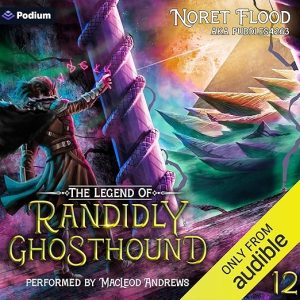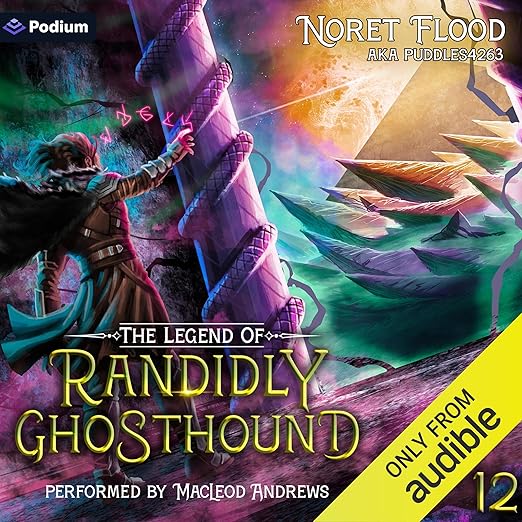
Randidly Ghosthound has, across eleven previous volumes, progressed from a stranded player in a suddenly system-governed world to something considerably harder to classify - and this audiobook, the twelfth in Noret Flood's series, opens at that higher altitude and stays there. MacLeod Andrews narrates, as he has throughout this series, and the familiarity of his voice is itself part of what makes book twelve accessible. The Legend of Randidly Ghosthound is a LitRPG series with over fifty million views on Royal Road, which tells you something about the scale of its readership and the level of investment those readers bring to each new volume.
This is emphatically not a starting point. The synopsis establishes the central situation without ceremony: Randidly understands the Nexus and its Tribulations, he's preparing his planet to function without him, and he's ascending toward the source of the threats that have shaped every previous book. That sentence assumes you know what the Nexus is, who Kaan Swaac is, what Kharon the walking city represents, and why a casual glance from a truly powerful being is a significant event in this world's power hierarchy. If you don't have that context, this volume will be opaque from the first chapter.
What Flood does particularly well at this point in the series is sustaining the tension between Randidly's accumulating power and the continued evidence that he remains genuinely outmatched by higher-tier entities. The moment cited in the synopsis - the damage done by a casual glance from a being of real power - is the kind of detail that keeps LitRPG series from collapsing into power-fantasy monotony. Randidly is stronger than almost anything on Earth; he is still, in the larger context of the Nexus, a relatively minor figure. That gap is the engine of the series' ongoing tension, and book twelve maintains it while advancing toward what feels like genuine reckoning.
The political consolidation thread - rooting out unstable elements, empowering Kharon, hunting Kaan Swaac - is less kinetically exciting than the ascent narrative but arguably more interesting structurally. Flood is sketching a world that has to function after its most powerful protector departs, and the question of whether the institutions Randidly has shaped will hold is one the series has been building toward. Readers who engage with LitRPG primarily for the stat systems and combat scaling may find this thread slower than they'd like; readers who are also interested in Flood's world-building will find it one of the more rewarding sections of the volume.
Highlights
Andrews's contribution to this series over twelve volumes cannot be overstated. The Legend of Randidly Ghosthound is, in written form, a web serial with all the structural irregularities that implies - some readers have noted grammar and consistency issues in the source text, and the skill descriptions have grown complex enough that following them in prose form requires sustained attention. Andrews navigates these rough edges with the assurance of someone who knows the material cold. He doesn't flatten Randidly's interiority or rush through the stat mechanics; he gives both the meditative sections and the combat sequences the pacing they require.
At twenty-eight and a half hours, this is one of the longer volumes in the series. The extended fight sequences that some readers find overlong in text form are handled by Andrews with enough modulation to keep them from becoming sonically monotonous, though listeners who are already fatigued by detailed combat narration should calibrate their session length accordingly. This is a volume best absorbed across several sessions rather than in a single long push. Andrews's stamina across that runtime is itself a performance achievement; the voice never loses its clarity or its grounding in Randidly's specific register.
Before You Commit to The Legend of Randidly Ghosthound
The skill complexity that one reviewer flagged - the observation that the ability trees have grown nearly impossible to follow - is worth taking seriously as a practical listening note. Flood has built a detailed system across twelve volumes, and the interactions between Randidly's skills at this tier are genuinely complex. Andrews reads them with precision, but listeners who are not tracking the cumulative system across the series may find some of the combat mechanics opaque without a reference to the earlier volumes' skill lists. The series rewards completionists who have followed every volume; dipping into book twelve cold is genuinely not recommended.
The tree-rooting-on-the-third-floor error flagged by a reader in the reviews is the kind of continuity slip that surfaces occasionally in serialized fiction at this length. It won't interrupt the listening experience materially, but it's representative of the rough-edge quality that readers who come from traditionally edited fiction may find occasionally jarring. Flood's strengths lie in the scope and ambition of the world he has constructed rather than in line-level precision, and Andrews's narration tends to smooth those rough edges through confident delivery.
Is This One for You?
This audiobook is for listeners who have followed the series from the beginning and are current through book eleven. That audience will find exactly what they came for: an extended, detailed installment that advances the series' central arc and resolves several of the political and personal threads Flood has been developing. It is one of the more substantive entries in the later series precisely because Flood is now dealing with the world he's built rather than establishing it.
Readers new to LitRPG who are curious about the genre should start with volume one of this series or another gateway title. The Legend of Randidly Ghosthound at book twelve is not an introduction to anything; it's a payoff for readers who have already made a considerable investment in this world and Randidly's place within it.
How does MacLeod Andrews handle the LitRPG stat and skill content in this audiobook?
Andrews navigates the system mechanics with precision and without rushing. He has narrated the series across twelve volumes and handles the technical content naturally, though the skill interactions at book twelve's power level are complex enough that listeners not tracking the cumulative system may find some combat sections difficult to follow.
Is this audiobook based on the Royal Road web serial version or an edited standalone release?
The Legend of Randidly Ghosthound originates as a Royal Road web serial with over fifty million views. The audiobook editions represent that serialized fiction in audio form, which means some of the rough-edge qualities associated with serialized web fiction - occasional continuity slips, complex skill accumulation - are present in the audio as well.
At twenty-eight-plus hours, is this audiobook one of the longer entries in the series?
It is on the longer end of the series' installments. Twenty-eight and a half hours is a substantial commitment and works best spread across multiple sessions, particularly given the density of the combat and system content in the later chapters.