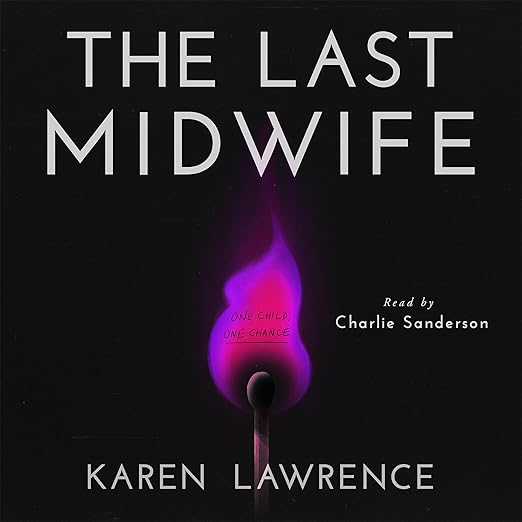
At a Glance
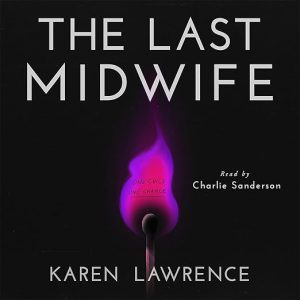
- Performance: Charlie Sanderson handles a large cast of voices across the book's multiple POVs, reviewer praise for performing 'a LOT of voices and doing them all with excellence' is specific and well-earned.
- What it covers: Bodily autonomy and state control, underground resistance, the cost of complicity versus the cost of defiance
- Feel: Propulsive and unsettling, with the creeping dread of dystopian fiction that has learned too much from the present
- Our call: A feminist dystopian thriller that earns its comparisons to both The Handmaid's Tale and Call the Midwife, more emotionally immediate than you might expect from its genre framing.
I started The Last Midwife on a Sunday afternoon with the vague intention of listening to a chapter or two before making dinner. I made dinner much later than planned. Karen Lawrence has written a book that generates the particular forward momentum that comes not from plot mechanics alone but from genuine investment in what happens to specific people in a specific impossible situation, and that combination is harder to achieve than the thriller genre sometimes makes it look.
The premise is one of those that feels recognizable in a way that the best dystopian fiction always manages. Childbirth in England has become a state-controlled procedure. Midwives have been outlawed for decades. A small underground network remains, risking everything to allow mothers to give birth outside the institutional system. The question is not just whether they will survive but whether the idea of autonomous birth, and by extension, autonomous life, can survive with them.
The Verdict, Briefly
Lawrence gives us two leads whose paths converge from opposite directions, which is the most efficient structural choice for the kind of worldbuilding this story requires. Chiara arrives from Sicily as a young nurse with ideals intact and discovers what is happening behind the Genesis Centre's pristine walls. Rava is already inside the system as a government official's privileged wife, a position that has shielded her from the conditions others live with until her own pregnancy stops conforming to requirements. Their collision is the book's engine, and Lawrence handles their different registers of ignorance and knowledge without making either character feel like a device.
The comparison to The Handmaid's Tale in listener reviews is apt in structure, both books use female complicity and resistance as parallel registers, but The Last Midwife has a different emotional texture. Where Atwood's work operates at a slower, more ruminative pace, Lawrence writes with the momentum of thriller fiction. Scenes develop and escalate quickly. The institutional horror is shown rather than implied. One reviewer called it "very well written with an imaginative story that keeps your interest" and described it as hard to put down, which is accurate, this is a book that moves.
The Best Parts of The Last Midwife
Charlie Sanderson's narration is the other half of why this works as an audiobook. The cast of characters across multiple storylines, the underground midwife network, the government apparatus, Chiara's perspective as newcomer, Rava's perspective as insider, requires clear differentiation that Sanderson provides consistently. One reviewer specifically noted that Sanderson performed many voices with excellence, and that assessment holds through the full runtime. Thirteen hours is a significant commitment for a thriller, but the pacing does not drag, and the narration keeps the ensemble legible throughout.
The dystopian setting deserves credit for specificity. Lawrence has imagined not just the horror of state-controlled childbirth but the bureaucratic texture of how it would be administered, the institutions, the language, the hierarchies of compliance and surveillance. That level of detail is what lifts the book above generic dystopian fiction into something that feels considered.
Points to Consider
The book's emotional register is intense throughout, and it does not shy away from the violence and grief that the premise requires. This is not a comfortable listen in the way that cozy or light dystopian fiction can be. The proximity of the premise to current debates about reproductive rights and state intervention in women's bodies is not incidental, one reviewer noted that it is "something you could see happening in years from now," and that is part of what Lawrence is clearly doing.
Readers who find feminist dystopian fiction too close to current anxieties to be recreational should know that this book does not create much distance from those themes. That is its strength as a serious work of fiction; it may also be a limitation depending on what a given listener needs from their reading at a particular moment.
Should You Listen to The Last Midwife?
Readers who engaged seriously with The Handmaid's Tale or Louise Erdrich's The Sentence, who follow the Call the Midwife BBC series and its emotional register, or who generally find themselves drawn to fiction that takes reproductive rights and institutional power seriously as subjects will find this a compelling listen. It is also a strong recommendation for thriller readers who want genuine emotional stakes alongside forward momentum.
Listeners who prefer dystopian fiction at a greater remove from current political reality, or who find this subject matter too emotionally proximate to engage with recreationally, should be honest with themselves about whether this is the right moment to pick it up. The book is doing something real, and it does not apologize for that.