Quick Take
- Narration: No narrator is listed in the metadata, which warrants caution; the production quality of this Brilliance Audio title is unconfirmed from available data.
- Themes: Time travel romance, the transformative power of music, hidden history of women composers
- Mood: Lush and propulsive, with a slightly breathless romantic undercurrent
- Verdict: An imaginative time-travel romance that layers music history, Arthurian mythology, and a Regency setting into something genuinely unusual, though the ending divides readers sharply.
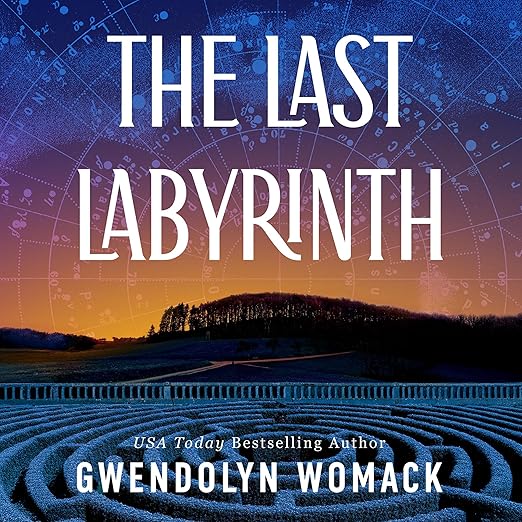
I picked up The Last Labyrinth on an April evening when I wanted something that felt nothing like contemporary realism. I had been doing a lot of reading in that direction, and I needed the kind of book where someone falls through time while playing an organ and lands in 1829 next to a brooding earl. Gwendolyn Womack has made a career of exactly this kind of ambitious genre layering, and this novel is her most ambitious construction yet: a time-travel romance, a musical history, an Arthurian mythology piece, and an apocalypse narrative, all running simultaneously.
Magellan Brighton is a musical prodigy in a world on the brink of a catastrophic polar shift. While playing an ancient organ, she vanishes and wakes up in 1829 in the middle of a labyrinth on the estate of Rhys Sherwood, the Earl of Liron. The earl is haunted by his father’s death in a scientific experiment gone wrong. Between them is a diary belonging to Gwynedd, described as Merlin’s forgotten twin sister. Unlocking that diary, they discover, is somehow connected to preventing the polar shift in the present day. That is quite a lot of plot to hold together, and Womack’s willingness to take on that structural ambition is both the novel’s greatest strength and its most visible risk.
Our Take on The Last Labyrinth
What distinguishes Womack’s work from standard paranormal romance is her genuine investment in the historical and musical detail. Readers and reviewers have praised the embedded history of women composers throughout the centuries, figures who were genuinely overlooked or suppressed, and that layer gives the novel a scholarly texture that readers who enjoyed something like The Secret Chord or Katherine Howe’s colonial fiction will appreciate. The romance between Magellan and Rhys is warm and convincing. She is a fish-out-of-water protagonist done well: resourceful rather than helpless, and the dynamic of her trying to navigate Regency social expectations while also decoding an apocalyptic diary is genuinely fun.
Why Listen to The Last Labyrinth
The plot mechanics of the time travel are treated with the internal consistency that this kind of novel requires. Womack ties the mechanism specifically to sound and vibration, which gives Magellan’s musicianship a structural role rather than just a character-building one. The labyrinth of the title is also more than a metaphorical gesture: it appears literally and functions as a spatial key in the narrative. For listeners who enjoyed Womack’s previous novel The Memory Painter or Diana Gabaldon’s time-slip architecture, there is genuine pleasure in watching the interconnected systems reveal themselves across the eleven hours of the audiobook.
What to Watch For in The Last Labyrinth
The ending is the most contested element of this book, and it deserves honest mention. Multiple reviewers describe it as abrupt or incomplete. One specifically notes that the final chapter feels missing, as if the narrative stops without a proper resolution. Another says she hated and appreciated the ending simultaneously. Womack’s endings tend to be intentionally open in ways that honor the scale of her premise, which for some readers feels earned and for others feels evasive. If you need closure in a conventional sense, this is genuinely risky territory. There are also a handful of historical inaccuracies early in the book, including glass windows in sixth-century Britain, that may pull careful readers out of the flow.
Who Should Listen to The Last Labyrinth
This is aimed squarely at readers who enjoy genre-crossing historical romance, particularly those who have already found Diana Gabaldon or Sarah Addison Allen and want something with more explicit science-fiction machinery under the hood. The musical history woven through makes it especially appealing for listeners who enjoy fiction that teaches something real alongside its invented world. Skip it if you need tight, satisfying plot resolution or if historical inaccuracies in early scenes disrupt your engagement. Come to it if you are genuinely curious about women composers of past centuries and want that history delivered through an entertaining adventure.
Frequently Asked Questions
Is The Last Labyrinth a standalone novel or part of a series?
It is published as a standalone. Gwendolyn Womack’s other novels such as The Memory Painter and The Fortune Teller share thematic DNA but are not connected by characters or plot.
How does music function in the time-travel mechanics of the plot?
The time travel is directly tied to sound and vibration, specifically to Magellan’s musical gift and to particular instruments, including an ancient organ. Music is not just character flavor; it is the structural mechanism through which she moves between centuries.
Who narrates The Last Labyrinth audiobook?
No narrator is confirmed in the available metadata for this release. Brilliance Audio published it, so checking their site or the Audible product page before purchasing is advisable to confirm the narration quality.
Is the ending of The Last Labyrinth satisfying?
Reader responses are genuinely split. Some found the ending earned and emotionally resonant; others felt it cut off too abruptly without sufficient resolution. If you are a reader who needs conventional closure, this is worth flagging before you commit eleven hours to the experience.