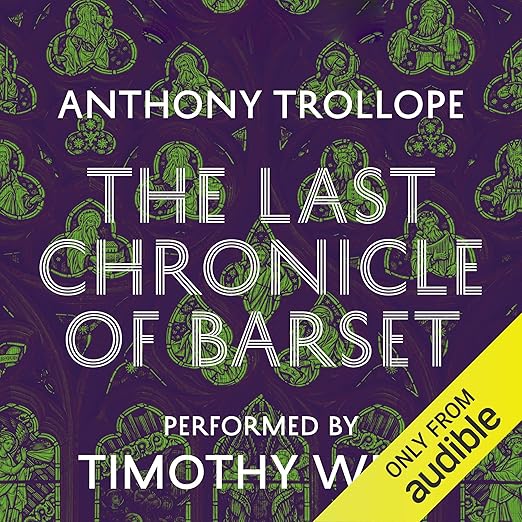
At a Glance
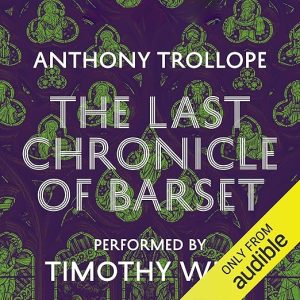
- Narration: Timothy West is the definitive Trollope narrator for this generation, bringing Barsetshire's full social world to life with tonal precision across a 30-hour performance.
- Themes: Social reputation and its destruction, stubborn pride, the slow grinding of institutional power against individual dignity
- Mood: Autumnal and unhurried, with a darkness the earlier Barsetshire volumes did not reach
- Verdict: The most ambitious of the six Barsetshire novels in audio, and the most rewarding for listeners who have made the full journey with Timothy West.
There is something almost elegiac about arriving at the end of a long series in audiobook form. I had spent several months with Timothy West and Anthony Trollope's Barsetshire, and by the time I started The Last Chronicle I was listening the way you read a letter from a close friend: with attention, with the accumulated knowledge of everything that came before, and with a quiet reluctance for it to end. The thirty-hour runtime that might deter a new listener felt to me like a gift.
Trollope himself called this his best work, and by the end of it I am not inclined to argue, though I would note that the competition within his own catalog is fierce. The Last Chronicle is the darkest and most morally complex of the Barsetshire novels, and it shows Trollope in full command of what he does better than almost any Victorian novelist: the slow, patient excavation of how social reputation functions as both armor and weapon, and what happens when the machinery of community turns against an individual who is, in all ways that matter, innocent.
A Closer Look at The Last Chronicle of Barset
The Reverend Josiah Crawley, whom listeners will remember from Framley Parsonage, stands accused of stealing a twenty-pound check. He cannot explain how it came into his possession, and his poverty and pride have made him enemies. That is the plot's engine, but Trollope is less interested in the mystery of the check than in what the accusation reveals about everyone around Crawley: the ambitious, the sanctimonious, the self-serving, and the genuinely compassionate. The Bishop's wife Mrs. Proudie, a figure of comic menace in earlier volumes, finally meets her match here, and Trollope's treatment of her is among the most psychologically acute things in the series.
The parallel romantic plots, Henry Grantly's love for Grace Crawley against his father the Archdeacon's social objections, and Johnny Eames's long pursuit of Lily Dale, are handled with the lightness Trollope brings to these stories when he is at his best. They do not overshadow the central drama; they provide counterpoint to it, and they carry the returning characters who have threaded through all six volumes. As one reviewer puts it, Trollope delights here in bringing together "most of the major characters of his series in a satisfying stew."
What Makes The Last Chronicle of Barset Worth Hearing
Timothy West has narrated all six Barsetshire novels for Audible Studios, and the consistency of that collaboration is one of the great gifts of this audio series. West's Trollope is warm without being sentimental, authoritative without condescension. He differentiates characters with subtle shifts in register rather than pronounced character voices, which suits the social realism of the material far better than a more theatrical approach would. Thirty hours in his company does not feel like thirty hours; it feels like a long visit to a place you know well.
The recording itself, an Audible Studios exclusive, is clean and consistent in quality throughout. There are no production anomalies across the considerable runtime, which speaks well of how the project was handled.
Things to Know Before Starting The Last Chronicle of Barset
One reviewer with some experience of Trollope notes that this novel "calls more than most on things from the past," and that is accurate. Characters whose histories span earlier volumes are referenced with a familiarity that assumes shared memory, and a listener coming to this novel without the preceding five will miss resonances that matter. The emotional weight of Septimus Harding's final appearances, for instance, depends almost entirely on what you have carried forward from The Warden and its successors. This is emphatically a series finale, not a standalone.
The plot's resolution, as another reviewer observes, is "the weakest" element of an otherwise strong novel. Trollope is not a mystery writer, and the solution to the check question arrives less as revelation than as procedure. If you come to this expecting a tightly wound thriller ending, you will be disappointed. If you come expecting Trollope, you will be satisfied.
Who Anthony Trollope Is Writing For
Anyone who has completed or is completing the Barsetshire series should consider this audiobook essential. Timothy West's performance across all six novels is one of the finest sustained narrator-author partnerships in the audiobook catalog, and this final volume is his most nuanced. New listeners should begin with The Warden. Readers who find Trollope's pace too measured for their taste will not be converted here, but those already persuaded will find thirty hours well spent.
Good to Know
Can The Last Chronicle of Barset be listened to without the previous Barsetshire novels?
Technically yes, but you will lose a substantial amount of the emotional weight. Characters whose arcs span all six novels are referenced as if the listener knows them, because Trollope expected his readers did. Starting with The Warden is strongly recommended.
How does Timothy West's narration compare across the Barsetshire series?
West is widely considered the definitive Trollope narrator, and his performance deepens across the series as the characters accumulate history. The Last Chronicle benefits most from his approach because the material is the most emotionally and tonally complex.
Is this a mystery novel, given that the plot centers on an accusation of theft?
Not in any genre sense. Trollope is interested in the social and psychological consequences of the accusation, not in constructing a puzzle for the reader to solve. The resolution of the check mystery arrives procedurally rather than dramatically.
At 30 hours, does the runtime feel justified, or does the novel overstay its welcome?
For listeners already invested in Barsetshire, the runtime feels earned. Trollope uses the length to weave together character threads from across the entire series, and the cumulative effect is substantial. Listeners new to Trollope may find the pacing demanding before the emotional investment builds.