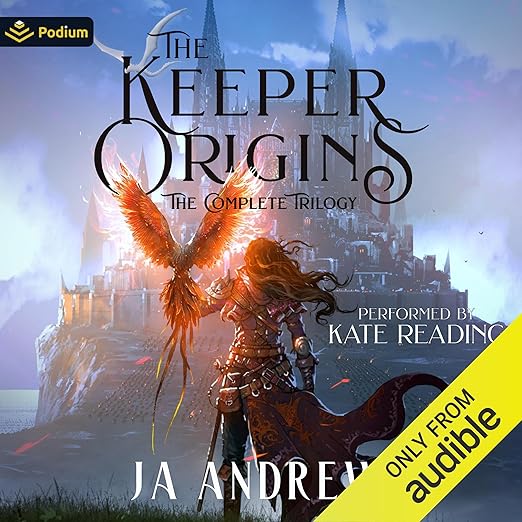
Quick Take
- Narration: Kate Reading brings JA Andrews’ world to life with distinctive character voices and an emotional warmth that suits the trilogy’s optimistic tone perfectly.
- Themes: Truth as a source of power, found family, corruption and moral courage
- Mood: Cozy and epic at once, like a large fire in a cold castle
- Verdict: Seventy-five hours of noblebright fantasy done with genuine craft, anchored by a protagonist whose growth feels earned rather than scripted.
I started the first book on a quiet Sunday afternoon and came up for air sometime around Tuesday. That is not a complaint. The Keeper Origins: The Complete Trilogy is the kind of fantasy that creates its own weather system, the sort of reading experience where the real world starts to feel slightly thin by comparison. JA Andrews has built something rare here: a story that is unmistakably optimistic about human nature without being naive about how power and corruption actually work.
The premise centers on Sable, a young woman trapped in debt to a gang boss and desperately trying to protect her younger sister before her magical ability, the capacity to sense truth in people’s words, is discovered and used against her. Her escape route leads her to Atticus, a playwright, and his traveling theater troupe. The setup sounds almost pastoral, but Andrews uses the theater world as a genuinely clever vehicle for examining how stories shape political reality. Sable’s power becomes more than personal: truth-sensing in a world of institutional deception turns out to have stakes well beyond one woman’s survival.
Our Take on The Keeper Origins: The Complete Trilogy
The trilogy is structured as a clear arc: Dragon’s Reach establishes Sable and builds the found family at the center of the story; Raven’s Ruin widens the political scope as she becomes entangled in the scheming of the priories; Phoenix Rising escalates to full-scale war, with an invading Empire on one side and internal corruption on the other. This kind of three-act structure can feel mechanical, but Andrews manages the pacing well enough that the transition between books feels organic rather than formulaic.
What sets this series apart from a lot of epic fantasy is described perfectly by one reviewer: this is “noblebright” fantasy, meaning the story believes in the possibility of goodness without pretending that evil does not exist. Good and evil are defined, but characters carry a genuine mix of both in their motivations. Sable’s journey from trapped thief to “burning symbol of truth” could easily tip into messianic hokiness in less careful hands. Andrews earns the transformation.
Why Listen to The Keeper Origins: The Complete Trilogy
Kate Reading is one of the most respected names in fantasy narration, and this performance justifies that reputation. She has been voicing fantasy characters for Wheel of Time and other major series long enough that her range is simply excellent. The ensemble cast of the theater troupe, each character with distinct personality and register, comes across clearly without the narration feeling like a performance exercise. Reading understands that the emotional warmth of this world is its defining feature and pitches her narration accordingly.
At seventy-five hours and forty-eight minutes, this is a serious time investment. But the box-set format makes it easy to treat as one long novel rather than three separate commitments. Several reviewers reported reading all three books within days of each other, which suggests the pacing sustains across the full length. One reader counted 63 highlights across the trilogy. Another noted she stayed up two hours past her bedtime to finish the final book. These are the data points that matter.
What to Watch For in The Keeper Origins: The Complete Trilogy
This is a prequel series to Andrews’ Keeper Chronicles, and readers who arrive from that series will have context that shapes how they experience some of the relationships and reveals. If you have not read the Chronicles, start here: the trilogy is fully self-contained and functions as a complete story. One reviewer was pleasantly surprised by how well it works independently. Another was entertained but mildly disappointed by how a secondary character (specifically an underutilized unicorn) resolved, which is the kind of complaint that tells you exactly what kind of reader is likely to have objections.
The standard fantasy races are present, elves, dwarves, fae folk, and magic users, which will feel familiar to genre readers. Andrews does not subvert genre conventions so much as execute them with unusual care. This is comfort fantasy at a high level of craft, not experimental or formally challenging work.
Who Should Listen to The Keeper Origins: The Complete Trilogy
Fantasy readers who have grown tired of grimdark but still want stakes and genuine conflict will find this trilogy a welcome counterbalance. It is also well-suited to listeners who prioritize character relationships and emotional arcs over intricate magic system mechanics. Fans of Kate Reading’s other work should not hesitate. Those who prefer their fantasy sparse and unsentimental may find the optimistic tone too warm for their taste, but they would be in the minority. If you have seventy-five hours and want to spend them somewhere that feels worth inhabiting, this is a trustworthy destination.
Frequently Asked Questions
Should listeners start with the Keeper Chronicles or with this trilogy?
Start with this trilogy. The Keeper Origins is a prequel, and Andrews clearly intended it to function as a standalone entry point. Reading the Chronicles first gives you some backstory that makes certain reveals less surprising, but the trilogy works fully on its own terms.
How does Kate Reading handle the ensemble cast of the theater troupe?
Exceptionally well. Reading gives each character a distinct vocal signature without making any performance feel like a caricature. Her familiarity with long-form fantasy narration means she sustains clarity across a 75-hour runtime, which is not a trivial feat.
Is the trilogy appropriate for younger fantasy readers or is it aimed at adults?
The content is appropriate for older teen readers and up. The themes involve political corruption, war, and moral compromise, but there is no graphic violence or adult content. The tone is hopeful enough that it lands closer to high-YA than adult grimdark.
Does Sable’s magic system around truth-sensing feel well-developed and consistent?
Yes. Andrews treats the truth-sensing ability with care, establishing its limits and costs early and then using those constraints as genuine plot mechanisms. It is not a get-out-of-jail-free power; it comes with vulnerabilities that matter throughout all three books.