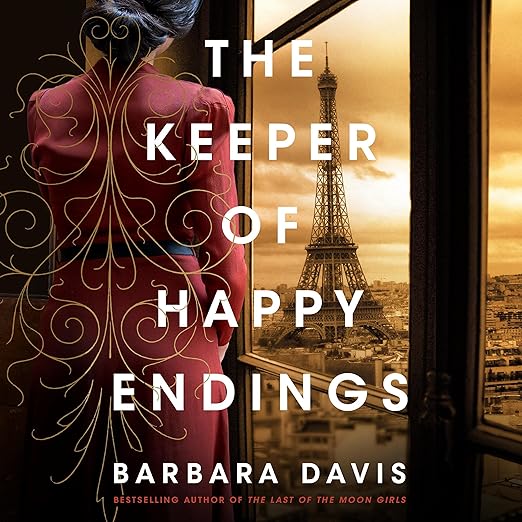
Quick Take
- Narration: Robin Siegerman handles the dual-timeline structure with steady distinction between Soline’s voice and Rory’s, the period voice for the WWII sections lands with quiet gravity.
- Themes: Grief and second chances, the magic threaded through female craft and inheritance, war’s long shadow on love
- Mood: Tender, melancholic, and ultimately hopeful, the kind of historical fiction that prioritizes feeling over spectacle
- Verdict: A carefully constructed dual-timeline novel about what it costs to stop believing in love and what it takes to begin again.
I came to this one in the middle of a reading stretch heavy with bleaker material, and The Keeper of Happy Endings landed at exactly the right moment. There is genuine craft in the way Barbara Davis constructs her dual timelines, the Paris of World War II, where Soline Roussel watches her world narrow to grief, and the Boston of 1985, where a young woman named Rory Grant stumbles into a stranger’s old life through a box found in a leased property. Neither timeline overshadows the other, and the echoes between them are handled with enough restraint that the symmetry feels discovered rather than engineered.
Davis is the author of The Last of the Moon Girls and The Echo of Old Books, and the same instinct for emotionally grounded women’s fiction with a thread of the uncanny runs through this work. The Roussel family bridal salon, where generations of dressmakers have sewn not just gowns but something harder to name into their work, is the novel’s most fully realized element. One reviewer described it well: historical fiction, family drama, and a love story, with two plot twists that reward patience.
Our Take on The Keeper of Happy Endings
The magic in this novel operates at a whisper rather than a shout. Davis never fully explains the charm that the Roussel women believe protects their brides, and that ambiguity is exactly right. What matters is that Soline believed in it, and that the war broke not just her relationships but her capacity for that belief. The loss of faith in love as a story outcome, rather than love itself, is what the novel is really about.
Rory Grant functions as both detective and mirror. She is coping with her own loss when she finds Soline’s things, and the parallel between their situations, what one reviewer called eerie, is handled without overstatement. Davis lets readers see the resonance before the characters do, which is a more respectful approach to the reader’s intelligence than the alternative.
Why Listen to This Novel
Robin Siegerman’s narration sustains the fifteen-hour running time without strain. The dual timeline requires voice work precise enough that listeners can locate themselves in the time period from tone alone, and Siegerman manages this cleanly. The WWII material has an appropriate weight to it without melodrama; the 1985 Boston sections carry something lighter, more tentative.
Multiple reviewers praised Davis’s ability to hold reader attention across the full length without the experience of a long book feeling effortful. One noted reading every word as though it were food for the soul, which is the kind of response that emerges from tight structural control working in harmony with emotional sincerity. Davis earns her tender passages by not taking shortcuts with the darker ones.
What to Watch For in This Story
The vintage wedding dress that Rory discovers, never worn, boxed with letters, forty years undisturbed, is the novel’s most effective physical object. Davis uses it carefully, neither over-symbolizing it nor dismissing it as mere plot mechanism. Its presence in the box is the question that opens the second timeline’s investigation, and its significance by the end has been earned through patient accumulation rather than easy revelation.
The ending has been described by reviewers as sweet, and it is, but Davis does not reach for the sweet ending cheaply. The forty-year wrong that Rory helps to right involves real stakes and real loss, and the resolution, when it comes, feels proportionate to the grief that preceded it.
Who Should Listen to The Keeper of Happy Endings
Ideal for: readers of historical women’s fiction with dual timelines, listeners who responded to Davis’s other novels, anyone who wants emotionally substantive storytelling without graphic content.
Less suited to: listeners who prefer their historical fiction focused on political or military event rather than intimate personal consequence, or those who find any element of magical realism jarring in otherwise realistic fiction.
Frequently Asked Questions
Is it necessary to have read Barbara Davis’s other novels, like The Last of the Moon Girls, before this one?
No. Each of Davis’s novels stands alone. However, reviewers who have read multiple books of hers note consistent quality and a recognizable sensibility, so if you like The Keeper of Happy Endings, the others are worth exploring.
How much of this novel is set during World War II versus the 1985 Boston timeline?
The two timelines are roughly balanced, with the WWII Paris sections following Soline’s youth and losses, and the 1985 sections following Rory’s discovery and investigation. The chapters alternate with enough regularity that neither period feels like a secondary concern.
Is the magical element in the story, the protective power of the Roussel gowns, treated literally or metaphorically?
Davis deliberately leaves this ambiguous. The novel neither confirms nor dismisses the Roussel family’s belief in their craft. The effect is that the magic functions emotionally and thematically without requiring the reader to accept it as factual.
How does Robin Siegerman’s narration distinguish between the two main voices, Soline and Rory?
Siegerman uses tonal and pacing distinctions effectively, Soline’s sections carry a more formal, weighted quality reflecting both her age and the period, while Rory’s voice is more contemporary and tentative. The distinction is clear enough to orient listeners within the first sentences of each chapter.