Key Details
- Read by: David Suchet brings a depth and reverence to Sally Lloyd-Jones's text that elevates the audiobook from a children's reading to an intergenerational listening experience with genuine emotional weight.
- At its heart: Grace and unconditional love, biblical narrative for children, the through-line of redemption
- Vibe: Warm, reverent, and genuinely moving
- Short version: An audiobook that works as well for adults as for children, anchored by one of the most distinctive narrator-text pairings in the children's faith category.
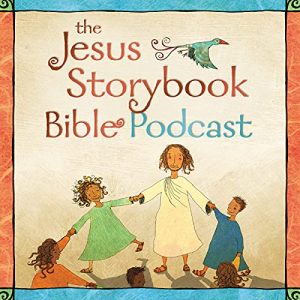
Fifteen years after Sally Lloyd-Jones published the original book, the specific phenomenon of The Jesus Storybook Bible is still worth examining. What began as a retelling of biblical stories for young children, framed around the idea that every story whispers the name of Jesus, has accumulated a readership that extends far beyond its initial demographic. This audiobook, narrated by David Suchet, is a primary reason. Suchet, whose decades of stage and screen work include his definitive portrayal of Agatha Christie's Hercule Poirot, brings to Lloyd-Jones's text a quality of reading that makes three hours and twenty-three minutes pass with the particular swiftness that characterizes genuinely great narration: you notice only when it ends.
The synopsis that accompanies this specific listing reflects what appears to be podcast-origin content where Lloyd-Jones invites guests to share stories of personal transformation, built on the fifteen-year legacy of the original book. Whether the listener is encountering the core storybook text, the podcast extension, or a combination of both, the foundational material from Lloyd-Jones is the constant. Her prose style is distinctive: she writes for children in a register that does not condescend to them, using language that is concrete and image-rich without being simplified to the point of flatness. She describes the Bible's central narrative as a Never Stopping, Never Giving Up, Unbreaking, Always and Forever Love story, and that phrase, in Suchet's voice, carries a weight that the same words in print cannot fully replicate.
A Professing Christian Narrator, Genuinely Engaged
David Suchet is a professing Christian, and that biographical detail, while not required context for appreciating the narration, explains the quality of investment he brings to Lloyd-Jones's text. He is not performing devotional material at arm's length; he is reading it as someone who finds it personally meaningful, and that quality of genuine engagement is audible in a way that a technically skilled but emotionally neutral narrator would not produce. The result is an audiobook that crosses the usual demographic boundaries of children's faith content with unusual ease. Adults who report returning to the audiobook describe it less as a children's product they are revisiting and more as a listening experience that happens to be derived from a children's book.
Lloyd-Jones's theological framing throughout is oriented toward grace rather than law, which makes the content accessible to a wide range of Christian traditions and, to some degree, to listeners whose interest is literary or cultural rather than devotional. The stories are rendered with narrative specificity rather than as moral abstractions, which is the source of the book's enduring appeal across its fifteen-year publication history. Children understand it because it tells stories; adults find it moving because the stories are told without protective irony.
Suchet's Narration Drives a 4.8 Rating
The practical use case for this audiobook extends across several different listening contexts. For families with young children being introduced to biblical stories, Suchet's narration provides a model of engaged, unhurried reading that makes the content memorable rather than routine. For adults, particularly those navigating a return to faith or processing their relationship with Christianity, the audiobook offers a stripping-away of accumulated theological complexity in favor of the foundational narrative presented with directness and warmth.
The 4.8 rating across 1,906 reviews is exceptional and reflects a listener base that has found the audiobook genuinely transformative rather than merely satisfactory. At that rating level across that volume of reviews, the audience consensus is functionally unanimous. The specific quality that drives the reviews across demographic groups is consistently the narration: listeners who might be ambivalent about the content find themselves moved by Suchet's delivery, which speaks to the power of well-matched narrator and text.
This Listing May Describe Podcast Content Instead
The synopsis attached to this listing appears to describe supplementary podcast material rather than the full storybook text, which creates some ambiguity about exactly what a listener purchasing this audiobook will encounter. If the core storybook narration by Suchet is what you are seeking, it is worth verifying that the specific listing you are purchasing includes the full text rather than an extended version with podcast-origin content. The original audiobook narrated by Suchet is the product that the 4.8 rating reflects, and that is the product that has generated the wide cross-demographic response.
The audiobook is, at its foundation, a Christian faith product designed for young children. Listeners who are not Christian and who are not approaching the material with openness to its theological premises will find the content devotional in ways that may not land. The quality of Lloyd-Jones's writing and Suchet's narration is genuinely exceptional by any literary standard, but the content is not secular, and listeners should know that going in.
A Reason to Listen Beyond the Children's Shelf
This audiobook is for Christian families looking for a children's scripture audiobook that will hold adult attention as well as children's, and for individual adult listeners who want a gentle, grace-oriented re-engagement with biblical narrative. David Suchet's narration is itself a reason to listen regardless of prior familiarity with the source material. The 4.8 rating across nearly two thousand reviews is a meaningful signal of how broadly and consistently the audiobook lands across its intended audience.
Skip it if you are looking for devotional content with theological depth appropriate for adult study, or if you need a strictly children's product without the cross-demographic quality that makes this audiobook unusual. For its intended audience, and for the much wider audience it has found organically over fifteen years, this is a listening experience that earns its exceptional reputation.
Frequently Asked Questions
Is this audiobook appropriate for both very young children and older kids, or is it pitched at a specific age range?
Lloyd-Jones wrote the original storybook for young children, roughly ages four through ten, but the audiobook's image-rich, non-condescending language holds the attention of older children as well. Numerous adult reviewers describe returning to it independently. The material is age-appropriate for all ages within a family, and Suchet's narration quality ensures it does not talk down to any listener.
Does this audiobook work well for bedtime listening with children?
Yes, and many families report using it exactly that way. The stories are complete in themselves and relatively brief, making them well-suited to bedtime listening where attention may be winding down. Suchet's unhurried pacing and warm register are particularly well-matched to that listening context.
What makes David Suchet's narration of this audiobook distinctive compared to other children's Bible audiobooks?
Suchet brings genuine personal investment to the material as a professing Christian, which produces a quality of authentic engagement rather than professional neutrality. His decades of stage and screen work give him a dynamic range that keeps the narration from settling into the flat instructional register that often characterizes children's religious audiobooks. The combination of his specific voice and his personal connection to the content produces a narration that listeners across age groups describe as genuinely moving.
Is this audiobook a complete version of the Jesus Storybook Bible text, or does it include supplementary podcast material?
The listing synopsis describes content that appears to include podcast-origin material where Lloyd-Jones invites guests to share personal stories connected to the book's legacy. The widely reviewed and highly rated audiobook associated with Suchet's narration of Lloyd-Jones's original storybook is the product that built the 4.8 rating, and listeners should verify what the specific listing they are purchasing includes before buying.