Quick Take
- Narration: Summer Morton handles Gwenna’s guarded interiority well, keeping the emotional temperature controlled even when the plot spikes, a good fit for a protagonist who refuses to perform vulnerability.
- Themes: Betrayal and earned forgiveness, dark academia secrets, reverse harem dynamics
- Mood: Intense, brooding, with sharp peaks of tension and heat
- Verdict: A strong sequel that rewards readers who committed to book one, the redemption arcs land, though occasional dialogue stiffness and copyediting gaps keep it from being seamless.
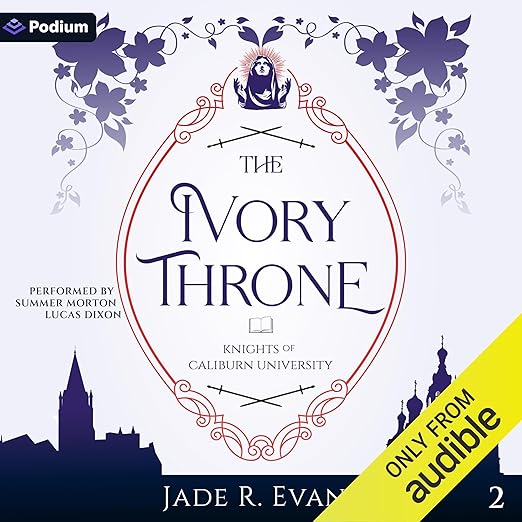
I picked up The Ivory Throne on a Tuesday evening when I had nothing scheduled and a low tolerance for anything requiring patience. Book two of a series is often where dark academia romance either justifies its setup or reveals it was all atmosphere and no structure. Jade R. Evans earns her second outing, mostly. By the time Summer Morton was deep into Gwenna’s return to Caliburn, mentally exhausted, abandoned by her mother, brought back by four knights demanding forgiveness they have not yet deserved, I was fully committed to finding out whether Evans could close what she opened.
The Ivory Throne picks up after Gwenna has spent weeks in what one reviewer describes as a mental hospital, her mother having moved on to a new relationship and stopped visiting. The four Caliburn Knights arrive wanting reconciliation. Gwenna leaves with them not because she has forgiven them but because she has no other options, and that distinction matters enormously to how this book works. Evans is careful to let Gwenna’s anger stay intact for most of the runtime, which is rarer in reverse harem fiction than it should be. Her return to her books and studies, under the mandatory protection of six-hour guard shifts maintained by four boys with swords, gives the campus setting a new kind of claustrophobic intimacy.
Our Take on The Ivory Throne
The core pleasure here is the grovel, or more precisely, four separate grovels at different emotional registers. Kingston, Kai, Lanz, and Callahan each have distinct approaches to winning back Gwenna’s trust, and Evans structures the book so none of them converge at the same pace. Lanz in particular attracted attention from reviewers; one described a specific scene involving the three of them with the phrase that Lanz played the role of a director in a play, which is the kind of line that earns a book a devoted following. The relationship development does kick up significantly from book one, and the integration of Holy Grail mythology and fencing culture gives the campus setting more texture than most dark academia romance attempts.
Why Listen to The Ivory Throne
Summer Morton is a quiet asset here. She does not overdramatize Gwenna’s emotional state, which is the right call for a character who has learned to protect herself through restraint. The ten-plus hours pass more quickly than expected, and Morton calibrates the pacing well through the longer research-and-discovery sections that dominate the middle of the book. The audiobook format actually helps smooth over some of the dialogue stiffness that print readers flagged, Morton’s delivery normalizes exchanges that look clunky on the page, giving them a more natural conversational rhythm than the written version sometimes achieves.
What to Watch For in The Ivory Throne
Several reviewers noted grammatical and spelling errors in the source text, and a few found the dialogue stilted, specifically that the main characters occasionally speak in a register that does not match their stated ages or circumstances. The Christian-heavy thematic layer and the fencing terminology also prompted one listener to admit they had to look up terms repeatedly. Some will find this enriching; others will find it exhausting. This is book two of a series; starting here without having listened to book one will leave meaningful emotional and plot context gaps that undermine the book’s strongest moments.
Who Should Listen to The Ivory Throne
Listeners who finished book one of the Knights of Caliburn University series and wanted more will find this a satisfying step forward. If you enjoy dark academia settings with genuine romantic tension, layered group dynamics, and a heroine who does not quickly forgive, this delivers on its premises. The Grail mythology and fencing culture that colour the Caliburn setting give it a texture that sets it apart from more generic campus romance. Skip it if copyediting polish matters to you, if you are new to the series, or if reverse harem fiction is not a genre you engage with, the romantic structure is central to everything here and the book does not work without it.
Frequently Asked Questions
Do I need to have listened to book one before starting The Ivory Throne?
Yes, strongly. The Ivory Throne begins immediately after the events of book one and assumes familiarity with Gwenna’s history, the four knights, and the Caliburn University setting. Starting here will leave significant emotional and plot context missing.
How explicit is the romantic content in this audiobook?
The synopsis flags it as being for mature listeners. The romantic and intimate scenes are more explicit than standard fantasy romance, consistent with the series overall. Reviewers describe the content as having kicked up significantly from book one.
Does Summer Morton differentiate between the four male leads in her narration?
Morton gives each knight a distinct enough vocal quality to track who is speaking without confusion, though the differentiations are subtle rather than theatrical. Listeners who found the characters hard to distinguish in print may find the audio slightly clearer.
Is the Grail mythology and fencing terminology explained well enough for listeners unfamiliar with either?
Some is contextualized through dialogue and exposition, but the series assumes a growing familiarity with both. Several reviewers mentioned needing to look up fencing terms, and the Arthurian mythology is woven in rather than fully explained. Treating both as texture rather than requiring mastery helps.