At a Glance
- Narrator: Leslie Howard delivers McFadden's dual-timeline thriller with the pacing precision the genre demands, keeping Brooke's past and present in clear tonal register without telegraphing the reveals.
- Subjects: Past trauma resurfacing in present danger, the psychology of a toxic relationship, institutional setting as pressure cooker
- Tone: Fast-paced and tense with an undertow of dread - McFadden keeps the listener off-balance in the best way
- Bottom line: A compulsively paced thriller that works better if you resist trying to solve it early and let McFadden's careful plotting work on you.
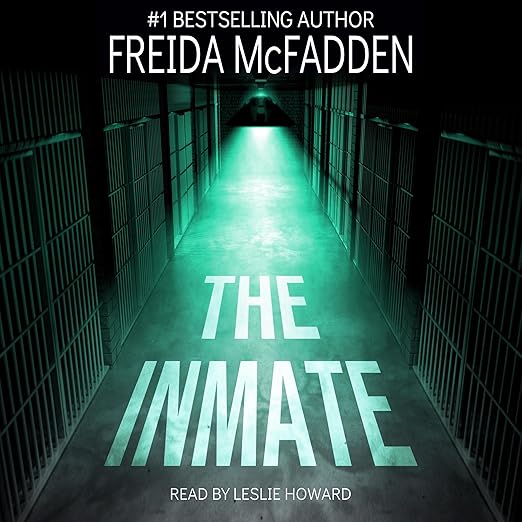
Freida McFadden builds The Inmate audiobook from a premise that sounds simple until you sit with it: Brooke Sullivan arrives as a new nurse practitioner at a men's maximum-security prison and discovers that one of its most dangerous inmates is Shane Nelson, her high school sweetheart and the man she testified against in a murder trial. The three rules the prison lays out for Brooke at the start - treat all prisoners with respect, never reveal any personal information, never become too friendly with inmates - function as a structural setup that McFadden spends eight hours systematically dismantling. Brooke has already broken all three before the story begins. She knows Shane. She knows what he's capable of. And he knows she's there now too.
Leslie Howard narrates this eight-hour thriller, and the setup she inherits is the kind that earns its reputation through execution rather than premise alone. McFadden's skill lies in what she does with the situation once she has you inside it - in the specific details of the prison environment, in the way other staff members read Brooke without knowing her history, in the texture of professional proximity to someone you are simultaneously afraid of and connected to by the kind of intimacy that doesn't simply dissolve because a relationship ended badly. The institutional setting is underused in thriller fiction, and McFadden exploits it with genuine thought.
Howard's Two Timelines and One Divisive Twist
Howard's narration handles the dual-timeline structure - past, when Brooke and Shane were in high school together, and present, inside the prison - with clean tonal differentiation that keeps the chronologies distinct without being heavy-handed about the transition. The past timeline provides the emotional architecture: who Shane was before, what drew Brooke to him, what changed, what she saw that put him in prison. The present timeline provides the thriller mechanics: proximity, threat, the institutional constraints on what Brooke can do with what she knows and what she fears. Howard manages both registers consistently across the full runtime, making the structure work.
McFadden's plotting is genuinely careful. One reviewer praises the unexpected twist and the ending. Another notes the mystery felt predictable and describes it as the kind of book you can fly through in a few sittings. Both reactions are fair, and they describe a novel working on different registers for different readers. The twist that lands as unexpected for readers who've let the narrative control their attention will feel telegraphed to readers who've been actively trying to outmaneuver the plot. McFadden's best move is keeping Brooke's full motivation obscured long enough that you're working with incomplete information right up to the point where you aren't.
The Prison Setting and a Tight Eight-Hour Pace
The audio format serves this kind of thriller particularly well. Howard's pacing - tight where the tension is highest, slightly more expansive in the past-timeline sequences where the story needs room to establish what Brooke and Shane were to each other - controls the listening experience in ways that print leaves to the reader's own speed. The eight-hour runtime is short enough to consume across two sessions, which is actually the ideal format for a thriller that depends on sustained atmospheric pressure rather than chapter-by-chapter revelation that loses its power if you're returning days later.
The prison setting gives McFadden something real to work with. Brooke's daily professional proximity to Shane, the institutional constraints on both of their behavior, the way the hierarchy of a maximum-security prison shapes every interaction between staff and inmates - all of this creates a texture that elevates the thriller beyond its core hide-and-reveal structure. Shane's dangerousness is established through environment and implication rather than just stated, which makes the threat feel genuine rather than theoretical throughout the audiobook's runtime.
Shane Stays Frightening, Brooke's Choices Take Time
The grisly murders that put Shane in prison are referenced from the outset, and McFadden doesn't soften Shane into a sympathetic figure whose conviction is meant to seem ambiguous. He is genuinely frightening, and the tension between Brooke's past intimacy with him and her present fear of him is the book's most consistent source of dread. This isn't a thriller where the dangerous character eventually turns out to be misunderstood; the danger is real, and the audiobook earns its tension because McFadden maintains that reality rather than deflating it.
Readers who need their protagonists to make consistently rational decisions will find some of Brooke's choices frustrating. She returns to situations that any outside observer would advise against, and her reasoning - developed over the course of the book - takes time to fully emerge. Sitting with that frustration rather than judging Brooke too quickly will produce a more satisfying final experience. The reviewer who found the reveal unexpected did not, presumably, spend the audiobook second-guessing every choice Brooke made before the logic behind her decisions became visible.
McFadden Fans and Newcomers Both Find Their Footing
McFadden fans will find this consistent with her catalog's particular strengths - fast pacing, domestic and institutional tension, carefully rationed information. Thriller listeners who enjoy books that balance emotional stakes with genuine plot momentum will find the combination of past-relationship depth and present physical threat satisfying. Those who prefer their mysteries to reward active genre reasoning over emotional immersion may find the predictable assessment resonant rather than the unexpected twist one - knowing which reader you are will help calibrate expectations appropriately going in. One reviewer arrived here as someone for whom this was not their usual genre and was immediately hooked, which speaks to the audiobook's accessibility beyond dedicated thriller fans.
A Few Questions About The Inmate
Is The Inmate audiobook part of a series or a standalone novel?
The Inmate is a standalone thriller. It does not require prior knowledge of other McFadden books, and it resolves as a complete, self-contained story. Readers who enjoy McFadden's style here will find her other standalone thrillers similarly structured, but there are no character continuations to follow.
How does Leslie Howard handle the dual-timeline structure of this audiobook?
Howard maintains tonal differentiation between the high school past and the prison present without being heavy-handed about the transitions. The past sequences carry a different emotional register - the relationship's history has warmth and damage in equal measure - while the present sequences sustain the thriller's atmospheric pressure. The transitions are clean enough to track without needing chapter markers.
Does the Inmate audiobook have a satisfying resolution or does it leave threads open?
The audiobook delivers a complete resolution. Reviews specifically mention an unexpected twist and an ending that pays off, and the mystery at the heart of the novel - what really happened with Shane, and what Brooke actually knows and why she came back - is resolved rather than left open for a sequel.
Is The Inmate suitable for listeners who don't usually read thrillers?
The novel's emotional core - a woman confronting her high school relationship with a man she helped put in prison - gives it an accessible dramatic hook beyond pure genre mechanics. The pacing is fast enough to keep thriller non-readers engaged, and the character psychology is developed enough to satisfy readers who need more than plot momentum. One reviewer describes arriving from outside the genre and being immediately hooked from the audiobook's opening.