Quick Take
- Narration: Dominic Hoffman brings a measured, ceremonial gravity to the verse, his pacing gives the tercets room to breathe without becoming funereal.
- Themes: Moral accountability, divine justice, the journey through darkness toward self-knowledge
- Mood: Solemn and awe-striking, with moments of surprising narrative momentum
- Verdict: If you have ever tried Dante and found the poem impenetrable, the Hollander translation with Hoffman’s narration is the version that finally makes it click.
I came back to Dante after a long detour. I had first attempted the Inferno in college with a prose translation that drained all the music from it, and I remember setting it down somewhere around the fifth circle, unconvinced. When I finally loaded up this Hollander edition narrated by Dominic Hoffman, it was a rainy Tuesday evening with nothing particular demanding my attention, and I told myself I would give it thirty minutes. Four hours later I was still listening, somewhere in the ice of the ninth circle, completely absorbed.
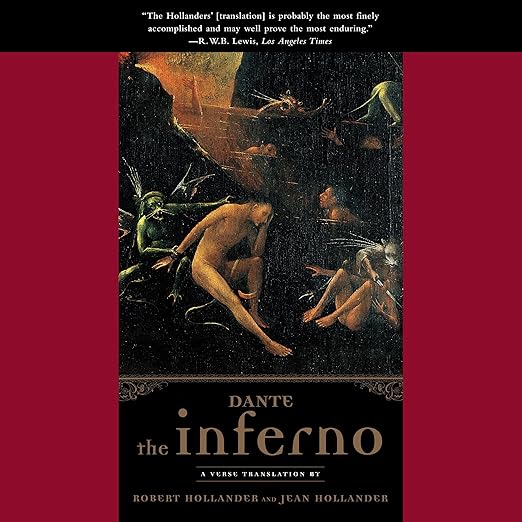
The Hollanders, Robert and Jean, have produced what the Los Angeles Times Book Review called probably the most finely accomplished and enduring translation in English, and after spending time with this edition I understand why that claim has held. This is not a translation that smooths Dante into contemporary ease. It preserves the strangeness, the architecture, the deliberate density of a poem written for readers who were expected to work. But it does so without making the English feel like a literal crib. There is vigor here, as one reviewer noted, where other translations go bland. What matters for audio listeners is that this vigor translates into verse that can be followed by ear without a dictionary on hand.
What the Facing-Page Italian Actually Does
One of the more unusual features of the Hollander edition is its facing-page Italian text, and while that may sound like an academic affectation, it changes the listening experience in a real way. Even without fluency in Italian, hearing Hoffman read a tercet while knowing the original is sitting there on the page creates a kind of double awareness. You begin to feel where the rhyme scheme would have been, where the music Dante built is necessarily lost in translation. One longtime reader of multiple Inferno translations wrote that reading the Italian made clear why the poem is genuinely untranslatable, why every English version is an approximation of an achievement that the original simply surpasses. That honesty about the limits of translation is built into the Hollander approach, and it makes you trust the English more, not less. The commentary tradition attached to this edition draws on centuries of scholarship alongside Robert Hollander’s own decades of teaching at Princeton, and even the audio version benefits from that scholarly pressure behind the translation choices.
Hoffman’s Narration and the Problem of Verse in Audio
Poetry on audio presents a specific challenge that prose never does. Read too flatly and the verse collapses into rhythmic monotony; read too theatrically and the listener starts tracking the performance rather than the poem. Hoffman navigates this with real skill. He does not hammer the meter, but he does not erase it either. There is a formal quality to his delivery that suits a poet who believed in the moral seriousness of every line. The canto-by-canto structure gives the audio natural stopping points, and Hoffman marks these transitions without making the poem feel episodic. The cantos of the lower circles, where Dante’s moral taxonomy becomes most elaborate and the sinners most famous, gain particular force in audio because Hoffman’s pacing gives each encounter its individual weight. What listeners get is closer to the sustained reading experience that Dante intended than most audio productions of classical poetry manage to provide.
The Theological Friction and Why It Matters
One reviewer raised an honest concern worth acknowledging: the Inferno is a deeply Christian poem, and readers who do not share that framework may find its moral geography puzzling or even alienating. The poem’s architecture of sin is specific to Dante’s late medieval Catholic worldview, and the punishments he devises reflect theological distinctions that secular listeners may find arbitrary or strange. That is a real friction, and no translation resolves it. What the Hollanders do provide is an extensive introduction and commentary tradition that contextualizes those choices historically and philosophically. The poem itself remains what it is: a vision of divine justice constructed by a man who believed absolutely in the justice of the God he was describing. One reviewer taking a Georgetown online course noted that this edition works well with academic scaffolding, and that is true. But the audio stands on its own for listeners willing to engage with the framework on its own terms, even from outside it.
Listeners Who Will Find Their Way and Those Who Will Not
This edition works best for readers who want their first serious encounter with Dante, or their first encounter that actually lands. It is also the right choice for anyone who has read other translations and wants the version that scholars and serious readers return to. It is less suited to listeners looking for light literary entertainment or those who find classical poetry a chore regardless of translation. The four hours and forty-one minutes runtime is compact for the scope of what Dante attempts, and the audio moves at a pace that never feels padded. If you have access to the print edition alongside the audio, the experience becomes considerably richer, but the audio stands on its own and rewards the attention you give it fully. What audio gives you is the poem itself, spoken well, which is not nothing. It is, in fact, the essential thing. Whether you approach the poem as a Catholic believer, a secular literary reader, or somewhere in between, the Hollanders give you enough grounding to find your way through all thirty-four cantos without losing the thread, and Hoffman gives you a performance that honors the gravity of what Dante was attempting across every step of that descent.
Frequently Asked Questions
Does the audiobook include the Hollander commentary and canto synopses, or just the verse?
The audio edition focuses on the verse translation itself. The full scholarly apparatus, including the extensive canto-by-canto commentaries that reviewers praise as more detailed than any other edition, is primarily a feature of the print and e-book versions. The audio includes the translation with Hoffman’s narration, which is substantial on its own.
Is the facing-page Italian text relevant for an audio listener?
Not directly, since you cannot see the page while listening. However, knowing the Italian text exists in the print edition may encourage you to read alongside the audio, which multiple reviewers describe as transformative for understanding what makes Dante’s original so extraordinary and why it resists translation.
How does this translation compare to Longfellow’s for audio purposes?
Longfellow’s Victorian translation, while historically important, carries archaic diction that can feel distancing in audio. The Hollanders’ version is more direct and modern without sacrificing precision, making it better suited to sustained listening. Reviewers who have read the Comedy in multiple translations consistently single out the Hollander version for restoring the poem’s momentum.
Do I need background knowledge of medieval theology to follow the Inferno?
Some familiarity with Catholic moral theology helps, but it is not required. The Hollander translation includes accessible introductory material in the print edition, and Dante’s moral logic is internally consistent enough that attentive listeners can follow the poem’s architecture even without prior theological study.