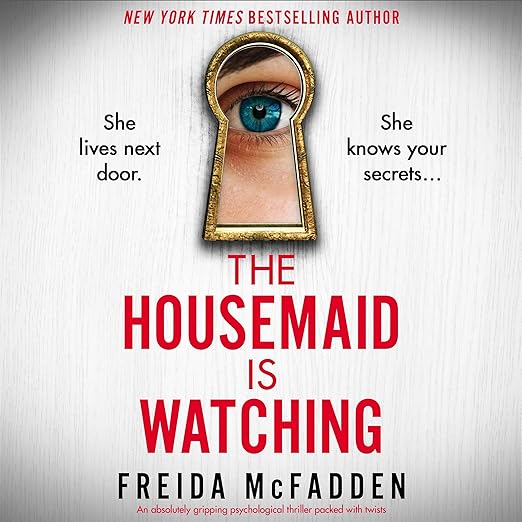
I started The Housemaid Is Watching on a Sunday morning with the plan to read just a chapter or two before switching to something else. I was still listening at midnight. That is not a claim about literary transcendence. It is a description of what McFadden does specifically well, the calibration of pacing and revelation that makes stopping feel genuinely difficult even when you can feel the machinery working.
The Housemaid Is Watching is the third book in Freida McFadden's Housemaid series. Millie, former housemaid and woman with a complicated past, has finally achieved what she spent the previous two books trying to reach: a home of her own, a quiet cul-de-sac, children, a husband. The arrival on the street immediately unsettles that stability. A neighbor whose maid gives Millie an inexplicable chill. A shadowy figure watching the house. A woman across the way who says, with the weight of experience behind it, be careful of your neighbors. And then the real complications begin.
McFadden Jokes About Her Own Third Book
McFadden does something structurally clever with this installment. She places the acknowledgment that third books in series are usually not that good inside the book itself, as one character's observation, which functions as a kind of preemptive negotiation with the reader's expectations. It is either a confidence move or a hedge, and honestly it is probably both. The book earns the confidence more than it requires the hedge. The twist mechanism that has defined this series is still functional here, and the addition of Millie's children Ada and Nico in meaningful roles gives the stakes a texture that pure thriller plotting cannot manufacture.
Lauryn Allman's narration has been a consistent asset across the series. She delivers Millie's first-person perspective with an undercurrent of vigilance that never tips into paranoia, which is precisely what the character requires. Millie is someone who has learned to expect the worst while hoping to be wrong, and Allman holds that balance across nearly twelve hours without losing it in the quieter passages.
Allman Turns Normalcy into the Threat
The suburban setting works better in audio than it might on the page. McFadden's cul-de-sac is rendered in the kind of detail that accumulates into genuine unease: the perfect lawns, the dinner invitations, the neighbor who is almost too friendly. Allman's narration gives those textures weight, building the sense that normalcy itself is the threat rather than any single character. One reviewer described the hospital setting of a prior McFadden book as giving off a creepy vibe, and that same skill at environmental mood-setting is present here in a domestic rather than institutional register.
The series format also benefits from audio continuity. Listeners who have heard Allman narrate the earlier Housemaid books will experience this one as a genuine reunion with a voice they trust, which amplifies the narrative irony when that voice's character is once again placed in positions she was supposed to have left behind.
Slow to Start, Quick to Resolve
The book's pacing has divided reviewers, and fairly. The first third is slower than the earlier installments, with McFadden deliberately establishing the domestic normalcy before dismantling it. Several reviewers noted it took time to get going, and that assessment is accurate rather than unfair. The payoff in the final third is more satisfying for having been patient about the setup, but listeners who want immediate momentum should know that this book earns its twists through accumulation rather than early deployment.
Some reviewers also noted that several threads are tied up quickly at the end, faster than the setup warranted. McFadden's endings often prioritize revelation over aftermath, and that preference is more pronounced here than in the earlier books.
New McFadden Readers Should Skip This One
Series loyalists who have followed Millie through the first two books will find this a satisfying conclusion, with the relationship between Millie and the children providing emotional weight that the pure thriller plot could not. New McFadden readers should not start here. The backstory that gives Millie her specific paranoia and competence is earned across the earlier books, and arriving at this one without it reduces the impact considerably. At nearly twelve hours, Allman's narration keeps the investment from feeling like a chore even in the slower passages.
Quick Take
- Narrator: Lauryn Allman handles Millie's perspective with the right note of wary competence, sustaining tension even in the quieter suburban setup chapters.
- Subjects: Suburban paranoia, secrets that follow you, the cost of starting over
- Tone: Slow-burn domestic suspense with a propulsive final act
- Bottom line: A satisfying third chapter for series loyalists, though first-time McFadden readers should begin with the original Housemaid rather than here.