Quick Take
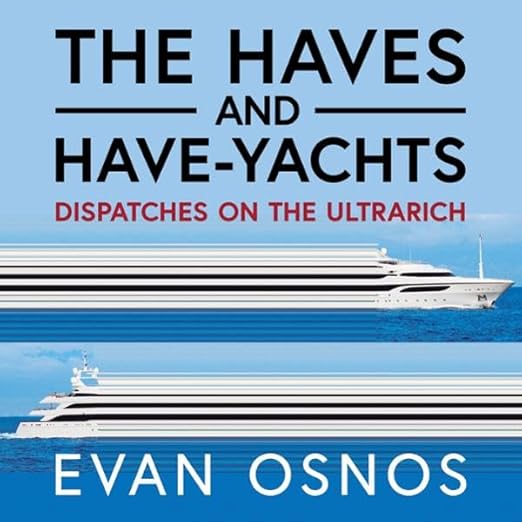
- Narration: Evan Osnos reads his own work with the quiet authority of a veteran reporter; his tone stays dry and observational throughout, which suits the material perfectly.
- Themes: Wealth inequality, political capture, the culture of ultrarich excess
- Mood: Sardonic and unsettling, with flashes of dark comedy
- Verdict: Osnos delivers one of the sharpest essay collections on plutocracy in years, and his own narration gives it an intimacy no hired voice could replicate.
I came to this one on a rainy Tuesday morning, somewhere between finishing my second coffee and trying to convince myself I needed to check the news. I had been circling Evan Osnos’s work for a while. His Age of Ambition about China’s rising middle class was one of those books I kept recommending to people long after I’d read it, and when I saw he had turned his reporter’s eye onto the other end of the wealth spectrum, I downloaded it immediately. I was not prepared for how genuinely funny parts of it would be, or how that humor would make the alarming parts hit harder.
The audiobook runs just over ten hours, which feels exactly right for a collection of essays. Osnos has been writing about the ultrarich for The New Yorker for years, and these pieces have the density and texture of long-form journalism shaped into something more cohesive. The premise isn’t subtle: the one percent now hold more of America’s wealth than they did during the gilded age of Carnegie and Rockefeller, and the book sets out to show you what that actually looks like from the inside.
The View from the Superyacht Deck
What makes Osnos an unusual guide to this world is that he is neither envious nor sycophantic. He simply watches. The sections on superyachts, luxury bunkers, and private concerts are written with the same deadpan attention he brings to political reporting, which is part of what makes them so effective. One reviewer called it a “prestige romp,” and that phrase captures something real. The book never loses its sense that these are ultimately absurd arrangements, even when the people inside them are entirely sincere.
The chapter-by-chapter structure works especially well in audio. Osnos narrates his own essays, and his voice carries the exact register you want from a New Yorker writer reading aloud: measured, slightly world-weary, occasionally letting a single word do the work of an entire paragraph. One reviewer specifically noted the writing is “exceptional, ironic and very funny,” and I found myself laughing out loud at several passages about wealth managers and tax strategy sessions, which is either a testament to the prose or a sign I’ve read too much economics journalism.
Where the Private Money Meets the Public Consequences
The essays that linger are the ones about political donations and the mechanics of what Osnos frames as a legal form of corruption. He traces the path from superyacht to Senate committee without turning it into a polemic, which is genuinely hard to do. A reviewer named Carla Barker put it plainly: the book helps readers understand “the vast scale of this phenomenon and why it’s been so difficult to fix.” That’s exactly right. Osnos doesn’t offer easy answers because there aren’t any, but he is rigorous about showing you the architecture of the problem.
The second half received one critical note from a reader who found it slower than the first, and I understand that reaction. The material on white-collar reputational rehabilitation and the sociology of wealthy philanthropists is less immediately vivid than the yacht-and-bunker set pieces. But I’d argue that deceleration is intentional. The flashier material pulls you in; the drier policy sections are where the real argument lives.
Who Gets Blamed and Who Gets to Leave
One of the book’s most persistent threads is the question of accountability, or the absence of it. Osnos keeps returning to the mechanism by which private debt became public debt after 2008, and how the narrative of government profligacy was constructed afterward. This is not a new argument, but he makes it freshly, with specific people and specific decisions rather than abstract systemic critique. The reviewer who called it “essential to understanding our rigged economy” was reaching for a big claim, but I don’t think it’s wrong.
The narration by Osnos himself is worth emphasizing because it matters more than it might seem. There’s a specific quality to hearing a journalist read their own work: you get the cadence they intended, the pauses they built in, the words they are choosing to stress. With essay collections in particular, that directness creates a listening experience closer to a conversation than a performance. I found myself responding out loud at a couple of points, which is either a sign of engagement or a sign that I need to get out more.
Who Should Listen and Who Might Want to Skip It
If you follow economic policy, read long-form journalism, or have found yourself genuinely baffled by how wealth disparities have accelerated over the past two decades, this is sharply relevant listening. It also works for readers who enjoyed works like Michael Lewis’s financial writing or George Packer’s The Unwinding, though Osnos stays cooler in register than either.
If you’re looking for a policy prescription or a how-to guide for reform, this won’t satisfy you. The book is diagnostic, not prescriptive. And if you find the subject matter genuinely depressing rather than fascinating, the dark comedy won’t fully compensate. But for the majority of listeners who want to understand the actual mechanics of how extreme wealth operates in American life right now, this is one of the more useful and readable documents available.
Frequently Asked Questions
Does Evan Osnos narrating his own book affect the listening experience?
Significantly and positively. Osnos brings the exact tone the essays require: dry, measured, and occasionally sardonic. You get the cadence he intended rather than an actor’s interpretation of it, which matters for essay collections where rhythm carries a lot of the meaning.
Is this a collection of separate essays or does it build a single continuous argument?
It’s structurally a collection, but Osnos threads consistent themes throughout: how ultrarich habits shape policy, how political donations operate as a form of legal leverage, and how the narrative about who caused the financial crisis was constructed after the fact. The essays read independently but accumulate into a coherent critique.
Some reviews mention the second half slows down. Is that a serious problem?
It depends on what you’re looking for. The first half covers the more vivid material: superyachts, private concerts, luxury bunkers. The second half goes deeper into political donations and reputational rehabilitation, which is less immediately spectacular but arguably more important. If you’re listening for the argument rather than the set pieces, the second half rewards patience.
How does this compare to other recent books on wealth inequality, like those by Robert Reich or Joseph Stiglitz?
Osnos comes from journalism rather than economics, so the approach is granular and scene-based rather than theoretical. Where Reich and Stiglitz marshal data and policy analysis, Osnos puts you in the room with specific people and specific decisions. Both approaches illuminate the same problem but from different angles; they work well together.