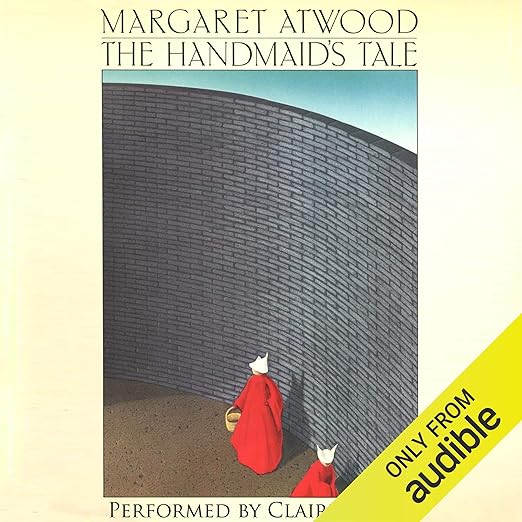
Quick Take
- Narration: Claire Danes gives a performance that earned the Audie Award for Fiction in 2013; her delivery of Offred’s interior life is restrained and precise in a way that amplifies rather than softens the horror.
- Themes: State control of women’s bodies, the fragility of rights, complicity and resistance
- Mood: Suffocating and deliberate; Atwood’s prose does not rush and neither does Danes
- Verdict: One of the definitive pairings of text and narrator in literary audiobook history; Danes makes this the version of the novel to experience.
There are books I come back to in audio specifically because of a narrator, and The Handmaid’s Tale with Claire Danes is one of them. I first read Atwood’s novel in a university course in the early 2000s, in a room full of people who were confident it described a past that could not return. That confidence has since become harder to maintain, which changes the experience of listening to this edition in ways that Danes’s performance seems almost designed to exploit. Her Offred is not hysterical. She is precise. And that precision is, in the end, far more frightening than any more theatrical interpretation would have been.
The novel’s premise is well-known enough by now that summarizing it feels slightly beside the point. After a staged terrorist attack dissolves the US government, the Republic of Gilead rises in its place, constructing a theocratic regime that strips women of property, employment, identity, and reproductive autonomy. Offred, the first-person narrator, serves as a Handmaid in the household of the Commander, recounting events with the lucid, self-interrupting voice of someone who is simultaneously experiencing and documenting her own subjugation. Atwood’s formal achievement is that narrative mode: the way Offred holds two temporal frames together without sentimentality.
Our Take on The Handmaid’s Tale
This is the audiobook edition published by Audible Studios in 2012, and it won the Audie Award for Fiction the following year. The award is deserved. Danes has the vocal control to sustain Atwood’s register across eleven hours without ever pushing for effect. She understands, I think, that Offred’s power comes from restraint, from the moments where the full weight of what she is describing is withheld rather than expressed. There is one passage, roughly mid-book, involving a memory of her daughter, where Danes does almost nothing and it is devastating because of that nothing. That is not a trivial skill. It is the kind of performance choice that requires both courage and precise understanding of the text’s intentions.
Why Listen to The Handmaid’s Tale
Atwood published this novel in 1985, and the first thing that strikes any reader in 2025 is how specific the world-building is in ways that still feel unsettlingly proximate. Gilead’s architecture of control is detailed at the level of costume, ritual, domestic arrangement, and language. The regime’s internal divisions, between Wives, Marthas, Aunts, Econowives, and Handmaids, create a social landscape in which women enforce each other’s subordination, which remains one of Atwood’s most uncomfortable observations. This is speculative fiction that operates as political analysis, and the audio format, which forces you to receive the text at Atwood’s pace rather than your own, enforces a kind of attention that works in the novel’s favor.
What to Watch For in The Handmaid’s Tale
The novel is demanding. It does not relieve tension with action sequences or narrative speed. Several reviewers note that parts of it feel slow, and that is a fair description rather than a flaw. Atwood is interested in the texture of subjugation rather than the mechanics of escape, and the pace reflects that. Some listeners also find the ambiguity of the ending unsatisfying, though the subsequent novel and television adaptation have since provided additional context. The international review sample in the available data, with reactions in Portuguese, Spanish, and Turkish, suggests the novel’s reach is genuinely global, which speaks to something about the universality of what Atwood is describing that transcends any single national context.
Who Should Listen to The Handmaid’s Tale
Anyone who has not yet encountered this novel in any form should start with the audio edition simply because Danes’s performance is now part of how most listeners receive the text. Those who read it years ago and want to return will find the audio version adds a new dimension. This is not comfort listening; it is rigorous and, at this particular cultural moment, acutely uncomfortable in the way that good speculative fiction is meant to be. Listeners who struggle with slow-paced literary fiction or who prefer action-driven narratives will find it challenging. Everyone else should make the time.
Frequently Asked Questions
Is this the same recording used for the Hulu television adaptation, or is it a separate production?
This is the 2012 Audible Studios production narrated by Claire Danes, which predates the Hulu series. It is an independent audiobook production and won the Audie Award for Fiction in 2013.
How does Claire Danes’s narration handle Offred’s dual temporal perspective?
Danes maintains Offred’s characteristic restraint throughout, using vocal precision rather than emotional amplification to convey the weight of the narrative. Her performance works with Atwood’s prose rather than against it, keeping the interior monologue credible without melodrama.
Do I need to listen to The Testaments afterward, and does this audiobook function as a complete standalone?
This audiobook is complete as a standalone. The Testaments, Atwood’s 2019 sequel, expands the world and addresses the ambiguous ending of the original, but The Handmaid’s Tale has its own integrity that does not require the sequel to be meaningful.
The novel was published in 1985. Does it feel dated, or does the world-building hold up?
Multiple reviewers across decades note that the novel’s prescience, if anything, has increased rather than diminished. The mechanisms of control Atwood describes are detailed enough to feel structurally relevant regardless of the specific political moment in which you encounter them.