Quick Take
- Narration: Claire Danes delivers a genuinely remarkable performance, restrained where restraint is required, quietly devastating in Offred’s interior monologue. The full cast enriches the production without overshadowing her.
- Themes: Totalitarianism and bodily autonomy, female resistance under surveillance, the archive as survival
- Mood: Measured dread that builds to something close to suffocation, then releases unexpectedly
- Verdict: The definitive audio version of a canonical text, with additional material that earns its place rather than padding the original.
I have read The Handmaid’s Tale in print three times over the years, and I had always assumed I knew it. Listening to Claire Danes perform it over twelve hours on a series of late-winter evenings taught me I was wrong. The novel’s rhythm, the repetitions, the way Offred circles back to the same details with slightly different weight each time, works differently in a reader’s ear than in a reader’s eye. Atwood’s prose has a hypnotic, incantatory quality that Danes understands completely and renders with a precision that felt like hearing the book for the first time.
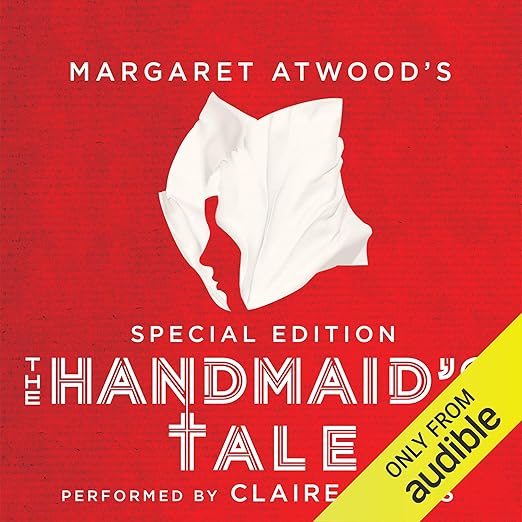
This Special Edition is not simply the novel in audio form. It is a full Audible Original production that adds an interview with the fictional Professor Piexoto, written by Atwood and performed by a cast that includes Ray Porter, Tim Gerard Reynolds, and several other skilled audiobook performers. There is also a brand-new afterword from Atwood herself and an essay by Valerie Martin. These additions are not filler. The Piexoto interview, which answers the famous final question of the novel, Are there any questions?, is clever and politically pointed in ways that feel continuous with the book’s intelligence rather than supplementary to it.
Our Take on The Handmaid’s Tale: Special Edition
The rating of 4.3 across 175 reviews reflects the book’s canonical status more than any listener ambivalence about this specific production. One reviewer noted that Atwood will be well known in a hundred years, and that feels true, The Handmaid’s Tale has aged from dystopian speculation into something more uncomfortably close to the present, and the Special Edition production seems aware of this. The rich sound design noted in the production materials is present without being intrusive: this is a restrained production, not a theatrical one, which is the right call. Offred’s world is most frightening when it sounds almost normal.
Why Listen to The Handmaid’s Tale: Special Edition
The argument for this version over print or a standard audio recording is Danes. Her performance captures something essential about Offred’s narrative strategy: the way she tells her story as if to an imagined future listener, performing both witness and archivist. Danes keeps that dual register present throughout without making it feel like a dramatic choice, it simply exists in the voice, the way it exists in Atwood’s sentences. The full cast in the supplementary material is used well; Ray Porter’s appearance in the Piexoto interview is a small detail that rewards fans of the production across multiple Audible titles. The Valerie Martin essay is the weakest addition, more academic than evocative, but even it adds context that frames the novel usefully for listeners encountering it for the first time.
What to Watch For in The Handmaid’s Tale: Special Edition
Reviews in Portuguese and Spanish in the data signal the book’s global reach and point toward a truth this English-language review can only gesture at: Atwood’s novel has been translated and received across cultures in ways that complicate any single reading. The dystopia of Gilead lands differently depending on your current political geography. For some listeners, the book’s warning feels historical or hypothetical; for others, it does not. That variability is part of what keeps the novel alive and relevant. The Special Edition does not impose a single interpretive frame, which is right. It trusts the listener.
Who Should Listen to The Handmaid’s Tale: Special Edition
This version is for anyone encountering the novel for the first time and wanting the richest available audio experience. It is also for those who have read it in print but never heard it performed, that experience is genuinely different and worth having. Fans of the television adaptation who want to encounter the source material will find this production serves as both the novel and a set of thoughtful supplementary materials. The only listeners for whom a standard text might serve better are those who want to move through the book at their own pace without the additional interview and essays extending the runtime.
Frequently Asked Questions
What does the Special Edition include beyond the original Handmaid’s Tale text?
The Special Edition includes an all-new interview with the fictional Professor Piexoto written by Atwood and performed by a full cast, a brand-new afterword from Atwood, and an essay by author Valerie Martin. It also features rich sound design throughout the main text.
How does Claire Danes handle Offred’s interior voice across twelve hours?
Danes maintains the dual register of Offred’s narration, both present witness and future archivist, with remarkable consistency. Her restraint in the most harrowing moments is particularly effective; the performance earns its devastation rather than performing it.
Is this production suitable for listeners who have already read the book in print?
Yes. Several reviewers who knew the book found the audio production revealed new qualities in Atwood’s prose. The rhythm and repetition of Offred’s voice works differently heard than read, and the supplementary material adds genuine context.
Who else appears in the full cast beyond Claire Danes?
The cast includes Ray Porter, Tim Gerard Reynolds, Emily Bauer, Allyson Johnson, Gabra Zackman, Suzanne Toren, Jennifer Van Dyck, Emily Cox, Lauren Fortgang, Dan Reiss, Prentice Onayemi, Therese Plummer, and Mark Boyett.