Quick Take
- Narration: Christian Rummel handles the desk clerk narrator’s wry, sinister voice with real polish, maintaining the necessary ambiguity about who, or what, is actually telling this story.
- Themes: The nature of evil, stories as containment and revelation, the hotel as liminal space
- Mood: Atmospheric and unsettling, with the rhythm of a campfire anthology told by someone who enjoys your discomfort
- Verdict: An inventive horror anthology with a wraparound story that is more interesting than its parts, and a final chapter that earns the entire preceding runtime.
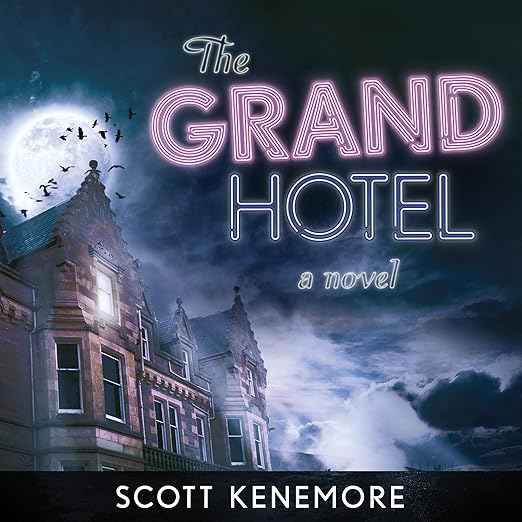
I encountered The Grand Hotel by Scott Kenemore at a point when I was specifically looking for horror that took its structural ambitions seriously. I had been reading a lot of Shirley Jackson, a lot of Thomas Ligotti, and I wanted something that understood horror as a formal problem as much as an atmospheric one. Kenemore’s setup, a desk clerk of uncertain ontological status narrates a tour of his crumbling hotel while the stories of its permanent residents unfold one by one, is exactly that kind of formal proposition. A hotel where nobody checks out is both a very old premise and a very specific anxiety about what it means to be trapped.
Christian Rummel narrates, and his casting is one of the book’s genuine strengths. The desk clerk needs a voice that is simultaneously welcoming, erudite, and faintly menacing, the register of someone who is offering you hospitality while knowing something about you that you do not know about yourself. Rummel hits that register consistently, and his voice gives the wraparound story a coherence that holds the anthology structure together through its weaker sections.
Our Take on The Grand Hotel
The novel works as an anthology with what genre readers call a wraparound frame, a narrative device in which a host tells or introduces the individual stories, and that host’s own story provides context and consequence for everything told within it. Kenemore’s desk clerk is the best element of the book. The individual stories vary in quality, as they do in most anthologies, and several reviewers noted that the middle sections were overlong and uneven. What they consistently praised was the desk clerk’s perspective and the gradual deepening of his relationship with the lone girl on the tour who may hold the key to the hotel’s ancient mystery.
The structure is explicitly indebted to anthology horror films, one reviewer named it in the tradition of Tales from the Crypt and Creepshow, and that lineage is accurate. Kenemore understands that an anthology’s power is cumulative rather than consistent; it does not need every story to be equally strong, but it needs the frame to give each story’s addition to the larger mystery a weight it would not have in isolation. The Grand Hotel largely succeeds at that, though it asks some patience through the middle two quarters.
Why Listen to The Grand Hotel
Because the ending rewards the investment. Multiple reviewers noted that the final chapter is where the book fully delivers on its promise, where the desk clerk’s ambiguity resolves into something specific and strange and genuinely disturbing. One described docking three stars from the middle and awarding an additional star for the ending, which is an unusual but apt critical formulation. Horror anthologies that earn their conclusions are rarer than the format would suggest, and this one does.
The audio format suits the material unusually well. Being told stories by a desk clerk of uncertain nature through a medium that is itself a voice speaking to you alone creates an effect that a page turns more deliberately. Rummel’s narration leans into that intimacy, and the effect in the final chapters is something that would be harder to achieve in print.
What to Watch For in The Grand Hotel
The middle is genuinely slower than the opening and the close. Kenemore’s prose style occasionally becomes what one reviewer diplomatically called overwritten in the individual story sections, the author searching for the precise sinister image and landing, more than once, on one that reads as filler. Patience with this section is rewarded, but it is worth knowing that the experience is uneven rather than uniformly atmospheric.
There is also a structural feature that divides readers: the girl whose presence disrupts the hotel’s order is interesting but underwritten compared to the desk clerk. Her interiority is largely withheld, which works as a mystery device but can make her feel more like a catalyst than a character. Readers who want strongly developed secondary characters alongside their anthology host may find this imbalanced.
Who Should Listen to The Grand Hotel
Horror listeners who enjoy anthology structures, short stories contained within a frame narrative, and who are patient with uneven middle sections. Fans of Kenemore’s zombie-themed work will find this a thematic departure that shows his range. Listeners who specifically enjoy audio horror, where a voice in your ear can carry menace more effectively than text on a page, will find Rummel’s narration a particularly good match for the material. Those who require consistent pacing throughout a ten-hour listen will be better served by more uniformly constructed horror.
Frequently Asked Questions
Is it necessary to have read Scott Kenemore’s earlier zombie novels to appreciate The Grand Hotel?
No. The Grand Hotel is a standalone novel with no connection to the zombie series beyond Kenemore’s authorship. The horror tradition and tone differ significantly, and new readers can approach it without prior context.
How much of the narrative is the wraparound story versus the individual anthology stories?
The desk clerk’s frame story and the tour interludes run throughout, with individual ghost and horror stories interspersed. The framing is present enough that it never disappears between stories, the desk clerk comments on each and builds his own story in the gaps.
Does Christian Rummel differentiate the individual story characters from the desk clerk narration?
Yes. Rummel maintains the desk clerk’s voice as the primary register while shifting into the individual stories with appropriate tonal distinctions. His strength is in the desk clerk’s voice, and the consistency of that performance gives the anthology its cohesion.
Is the horror in The Grand Hotel supernatural, psychological, or both?
Both. The horror operates on a supernatural level, the hotel’s residents are not living in any conventional sense, but the underlying anxieties are psychological: about being trapped, about the relationship between storytelling and power, about what it means to be seen by something ancient. The book uses the supernatural as a vehicle for the psychological rather than an end in itself.