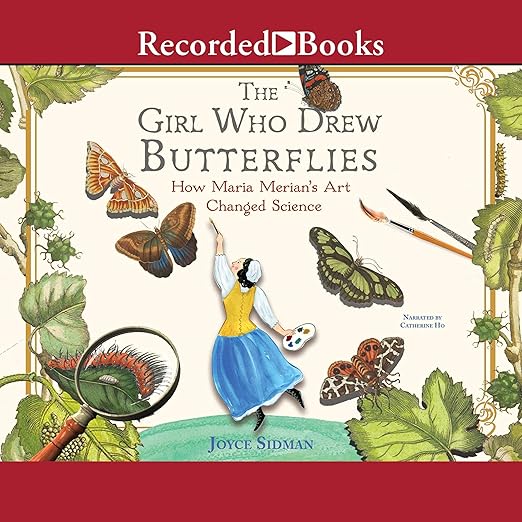
- Voice: Catherine Ho delivers the biographical narrative with clarity and genuine enthusiasm for the subject, making Maria Merian's story feel immediate without over-dramatizing it.
- Big ideas: Women in science history, observation and curiosity as tools, metamorphosis as metaphor
- Atmosphere: Quietly inspiring, intellectually curious, historically grounded
- Worth it?: An exceptional middle-grade audiobook biography that treats its young audience as capable of handling real complexity, both scientific and historical.
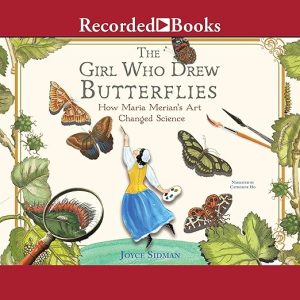
Certain books earn their place in a child's education not through entertainment alone but through genuine revelation, the kind that expands what the listener understands to be possible. The Girl Who Drew Butterflies by Joyce Sidman, narrated by Catherine Ho, belongs in that category. This audiobook tells the story of Maria Merian, a 17th-century German-born naturalist who drew insects with scientific precision at a time when women were barred from formal education and when natural history as a discipline barely existed in its modern form. For young listeners who have never encountered this name, the experience of meeting Merian is the experience of discovering that the history of science has been substantially edited.
Sidman, a Newbery Honor-winning author and poet, brings a literary sensibility to what could have been a straightforward historical account. The biography does not simply list Merian's accomplishments; it reconstructs the texture of her curiosity, her careful observation of caterpillars and moths and the dazzling intricate beauty of butterflies she rendered with a skilled hand, and the intellectual courage it took to pursue that curiosity in a world that had specific ideas about what women were supposed to be interested in and deeply suspicious of those who deviated from those expectations.
An Honest Picture, Never a Sanitized Triumph
The scientific content of this audiobook is genuinely educational in a way that does not patronize its audience. Merian's work on metamorphosis, the connection between caterpillar and butterfly that now seems obvious but was contested and poorly understood in the 17th century, is presented in enough detail to teach the actual science rather than just gesture at it. Sidman explains what Merian observed, what it meant, and why it changed the course of natural history. Catherine Ho's narration gives the explanations the right pacing: measured and precise, allowing listeners to absorb the information without feeling rushed through it.
The historical context is handled equally well. Sidman does not soften the reality of Merian's situation. She was operating in a period when unusual intellectual interests in women could lead to accusations of witchcraft, when fieldwork and direct observation were considered inappropriate for her gender, and when formal scientific institutions were entirely closed to her. The book names these constraints directly, which gives young listeners an honest picture of the obstacles Merian worked around rather than a sanitized story of triumph uncomplicated by adversity. That honesty is one of the book's most important qualities as an educational resource.
The Newbery Honor designation and the Kirkus recognition are both relevant here because they speak to a consistent community evaluation of what Sidman has accomplished: a book that is simultaneously a great read and a genuine contribution to how young people understand the history of science and the history of women within it. Both judgments depend on the writing being more than competent, and Sidman's prose is.
Genuinely Beautiful Without Ever Being Ornate
The audio format works particularly well for this biography because the narrative structure is driven by scene-setting and sequential revelation rather than complex branching argument. Ho builds the atmosphere of Merian's world from the ground up, and the listening experience moves at a pace that invites the imagination to fill in the visual details, particularly for the illustrations that Merian made, which are described in language precise enough to conjure them without requiring the listener to see them directly.
Sidman's background as a poet means the prose has a quality that is rare in children's nonfiction: it is genuinely beautiful without being ornate. Sentences like her description of Merian's attention to the soft green caterpillars, papery-winged moths, and the dazzling, intricate beauty of the butterflies carry their own pleasures independently of the information they convey. For young listeners who are already inclined toward language, this audiobook models what good science writing can look like when the writer takes both the science and the craft seriously.
Ho Compensates, Only Partially, for the Drawings
At 1 hour and 51 minutes, this audiobook is calibrated for its young audience in ways that adult listeners might find insufficient. The biography covers Merian's life and work in broad strokes rather than comprehensive detail, and adult readers interested in Maria Merian as a historical figure will want to supplement with sources written for a general audience. The runtime and narrative scope are appropriate for middle-grade listeners but will feel sketchy for adults approaching it as a primary source on Merian's scientific contributions.
The audiobook also does not include the visual materials that make the print edition particularly striking. Several reviewers of the print book specifically mention the illustrations and physical production quality, none of which translate to audio. Ho's narrations of Merian's drawings compensate partially, but listeners who want the full experience will find value in accessing both formats, particularly for children who are themselves interested in art and illustration and will want to see the images that the audio describes.
An Exceptional Introduction to an Extraordinary Woman
This audiobook is ideal for middle-grade listeners, roughly ages 8 to 12, with an interest in science, history, art, or stories about people who did extraordinary things under difficult circumstances. It works particularly well for children who are beginning to develop an interest in natural history or who have heard of Darwin and Linnaeus and wonder who else contributed to our understanding of the living world. Parents and educators looking for audiobook biography content that is both scientifically accurate and genuinely literary will find it a reliable choice.
Adult listeners who enjoy children's nonfiction as a genre will find this rewarding but brief. Anyone approaching it expecting the depth of a full adult biography of Merian should look for alternative sources. The audiobook is exactly what it presents itself as: an exceptional introduction to an extraordinary woman, designed for young listeners who deserve to know her name.