Quick Take
- Narration: Julia Whelan is simply one of the best narrators working in literary fiction audio, her Elsa is indelible, and the Dust Bowl sequences gain almost unbearable weight through her performance.
- Themes: Survival and maternal sacrifice, the American promise tested by catastrophe, class and the myth of self-reliance
- Mood: Devastating and ultimately galvanizing
- Verdict: Kristin Hannah at the height of her powers, with Julia Whelan delivering a performance that makes this the definitive way to experience the novel.
I finished The Four Winds on a Sunday evening in winter, sitting in a car in a parking lot because I could not make myself stop listening when I reached the last hour. That kind of surrender is rare enough that I take it seriously when it happens. Kristin Hannah has a particular gift for making you feel that the people you are reading about are real, not in the sense of documentary realism, but in the sense that their suffering and their choices carry genuine moral weight, and you find yourself caring about them in ways that outlast the listening.
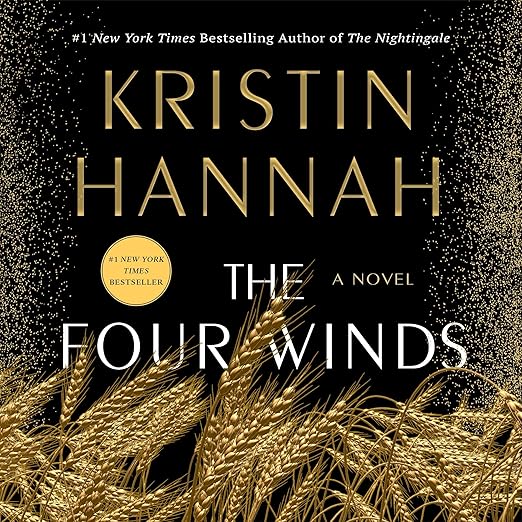
The Four Winds is set during the Great Depression, following Elsa Wolcott from a Texas panhandle farm in the 1930s through the dust storms, the failed crops, and eventually the agonizing migration west to California. It is the kind of historical fiction that uses its period not as backdrop but as argument, about what Americans have always asked of the most vulnerable among them, and what has always been asked in return.
Our Take on The Four Winds
Elsa begins the novel as someone who has accepted the terms of her own diminishment. Too old to marry at twenty-five in 1920s Texas, she enters a marriage of necessity and spends years learning what it means to belong to a piece of land, and what it costs when that land turns against you. Hannah is most powerful in the scenes where Elsa is forced to choose between fighting for what she has built and accepting the unacceptable logic of survival. The novel does not romanticize poverty or the Dust Bowl, the physical conditions are rendered in specific, unsparing detail, but it also does not strip its characters of agency. Elsa is not a passive sufferer. She is someone learning, under the worst possible conditions, that she is more than she was told. A reviewer who compared it to The Nightingale noted that both books share this quality: readers will be transported into the story and literally become one with the environment. That is, I think, accurate.
Julia Whelan and the Weight of the Dust Bowl
Julia Whelan’s narration is the specific reason to choose audio for this novel, and it is not a close comparison. Whelan has a particular mastery of characters in extremity, her Elsa captures the quiet dignity of a woman who has been told she is not enough and is slowly, painfully, discovering otherwise. The Dust Bowl sequences, where the black clouds roll across the plains and Elsa must decide whether to stay or leave, carry a physical dread in audio that the prose alone does not fully convey. Hannah’s prose is, as one reviewer put it, not great literature but captivating storytelling, and Whelan’s narration meets that storytelling exactly where it lives, in the emotional rather than the literary register. The bonus author interview included in the production is a genuine addition, providing context for Hannah’s research and her own connection to the material.
What to Watch For in The Four Winds
The novel’s ending divided readers. One described it as feeling forced and unrealistic after an otherwise devastating journey. That is a reasonable response to what Hannah does in the final chapters, she makes a choice that lands differently depending on what you wanted the book to ultimately say about survival and sacrifice. I found it earned, but I held my breath through it. There is also a structural asymmetry between the Texas section and the California section; the latter, while emotionally powerful, compresses some of its political and historical content, the labor movement, the treatment of Okies in California, in ways that readers familiar with Steinbeck’s parallel territory may find thin.
Who Should Listen to The Four Winds
Essential for listeners who responded to The Nightingale or The Great Alone, this belongs to the same lineage of Hannah novels that use historical catastrophe to illuminate what endurance actually demands of women. Also recommended for readers interested in Depression-era America, the Dust Bowl migration, and the labor history of 1930s California. Less suited to readers who prefer distance in their historical fiction; Hannah puts you inside the suffering and expects you to stay there. Julia Whelan’s performance makes that ask feel worth accepting.
Frequently Asked Questions
How does Julia Whelan’s performance compare to the print reading experience?
The consensus among listeners who have experienced both is that Whelan’s narration is transformative, particularly for the Dust Bowl sequences, where her delivery adds a physical dread that the prose describes but audio embodies. This is one of those audiobooks that most who try it prefer over print.
Does The Four Winds pair well with The Nightingale as a companion listen?
Very well, both novels center a woman learning the limits and costs of endurance under historical catastrophe, and Hannah uses similar structural instincts in both. The Nightingale covers WWII France; The Four Winds covers Depression-era America. They share thematic DNA without being repetitive.
Is the ending satisfying or does it feel manipulative given the emotional investment the novel demands?
Readers divided on this, some found it earned and devastating in the right way; others felt it was forced after everything that preceded it. Hannah makes a specific choice about what The Four Winds ultimately says about maternal sacrifice, and whether that lands depends on what you came to the novel hoping to find. Whelan’s narration gives it as much weight as it can carry.
Does the novel cover the labor movement and California Okie history in depth, or is this primarily Elsa’s personal story?
Primarily Elsa’s story, with the labor movement and anti-Okie prejudice as context rather than subject. Readers wanting detailed social history of the period should pair this with Steinbeck’s The Grapes of Wrath. Hannah uses the historical conditions to illuminate character rather than to document them.