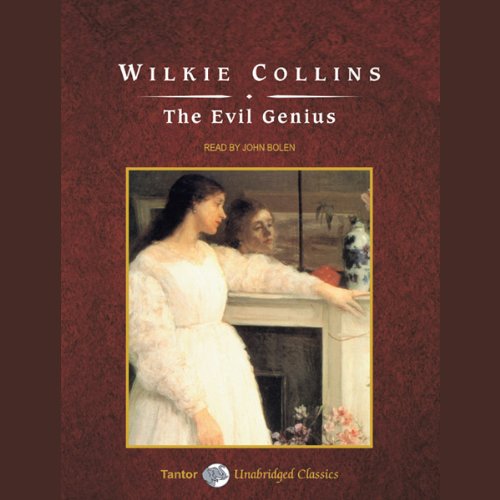
Quick Take
- Narration: John Bolen delivers a steady Victorian-register performance that keeps the drawing-room drama moving without overplaying the melodrama.
- Themes: Adultery and its consequences, the social cruelty of Victorian divorce law, moral accountability and ambiguity
- Mood: Slow-burning domestic drama with a satirical edge, closer to Trollope than to Collins at his most gothic
- Verdict: A lesser-known Collins title that rewards patient listeners interested in Victorian social criticism, even if the mystery trappings of the opening largely give way to moral anatomy.
I came to The Evil Genius with the wrong expectations, and I suspect many listeners do. The title suggests sensation fiction, something in the vein of The Woman in White or The Moonstone, and Collins deliberately opens with a courtroom scene and a jury deliberating a diamond theft, which reads like a promise of the same. It is not that kind of book, and the sooner you know that, the more clearly you can appreciate what it actually is: a searching examination of how Victorian marriage law, social convention, and personal moral failure combine to destroy a family from the inside.
I finished this one on a quiet weekday evening after a stretch of fast-paced thriller audiobooks, and the tonal shift was jarring in a productive way. Collins, writing in 1886, was at the tail end of his career, and The Evil Genius has a wearier, more morally complex texture than his earlier sensation work. It is, as one reviewer accurately described it, a story about morality, not mystery. The prologue with the sea captain and the diamond jury is essentially a red herring in terms of genre expectation, a satirical framing device that introduces the young orphan Sydney Westerfield, who will grow up to become the governess at the center of the Linley family’s dissolution.
Our Take on Collins as Social Critic
What distinguishes The Evil Genius from most Victorian domestic fiction is Collins’s refusal to settle blame neatly. Sydney, the governess and mistress, receives genuine empathy rather than the punishment the genre conventions of the era demanded. The wife, Catherine Linley, is portrayed with psychological honesty, neither sainted victim nor shrew. The husband, Herbert Linley, is the one who initiates the betrayal, and yet Collins takes some pains to understand how he arrived at that choice without fully excusing it. One reviewer noted that the adultery of the husband is somewhat whitewashed, and that is a fair criticism, Collins does not apply equal scrutiny to Herbert’s agency as he does to the women around him. But relative to the fiction of his era, the balance is remarkable.
The title itself becomes a running question the book asks rather than answers definitively: who is the evil genius? Each of the novel’s five principal figures, the governess, the meddling mother-in-law, the brother-in-law who keeps making everything worse, the husband, and even the child caught in the middle, has a plausible claim to the designation at some point. That structural irony is Collins working at a genuinely sophisticated level, even if the prose lacks the pulse of his best-known work.
Why Listen to This Rather Than Skip to The Moonstone
The Moonstone and The Woman in White are the obvious Collins entry points, and they are better novels in several respects. But The Evil Genius offers something those books do not: a direct, sustained engagement with the social mechanics of divorce in Victorian England. Collins had personal reasons to care about this subject, his domestic arrangements were unconventional by any era’s standards, and the book carries the weight of genuine conviction. Listeners interested in how literature negotiates the gap between legal structures and moral reality will find The Evil Genius doing something more interesting than its reputation suggests.
The pacing is slower than Collins’s sensation masterworks. There is no ticking clock, no locked-room mystery driving the narrative forward. The drama is entirely domestic, and for readers not already drawn to that register, it can feel inert in places. The ending, which at least one reviewer found unrealistic, is quietly deflating rather than satisfyingly resolved, another departure from the satisfying mechanisms of Collins’s mystery fiction.
What to Watch For in John Bolen’s Narration
Bolen handles the material with a professionalism that suits a Tantor Audio production of Victorian fiction. He differentiates the key voices, Sydney’s measured vulnerability, the mother-in-law’s well-intentioned intrusions, Herbert’s guilty evasiveness, without resorting to theatrical exaggeration. The 11-hour runtime requires sustained engagement from any narrator, and Bolen’s restraint serves the book’s quieter register. This is not a performance that will dazzle anyone, but it is a trustworthy vehicle for Collins’s prose, which at its best is precise and cutting and deserves clear delivery.
Who Should Listen to This Audiobook
Victorian fiction enthusiasts who have already read Collins’s major sensation novels and want to explore his lesser-known later work will find this genuinely rewarding. It also appeals to listeners interested in how nineteenth-century fiction engaged with legal and moral questions around marriage and divorce. Skip it if you came for the mystery promised by the opening courtroom scene, that thread dissolves quickly. And note that at least one edition’s cover synopsis apparently conflates characters from several other Collins novels entirely, so approach promotional descriptions with some skepticism.
Frequently Asked Questions
Is The Evil Genius a mystery novel like The Woman in White or The Moonstone?
Not really. Despite opening with a jury deliberating a theft case, the book is primarily a domestic drama about adultery, marriage, and divorce in Victorian England. One reviewer described it accurately as more morality than mystery. Listeners expecting Collins’s signature sensation-fiction architecture will need to adjust expectations early.
Who is the evil genius of the title, does the book answer that question?
Deliberately not, which is the novel’s structural strength. The title functions as an ongoing question the book poses about each of its five major characters: the governess, the mother-in-law, the brother-in-law, the husband, and arguably the institution of Victorian marriage law itself. Collins does not assign guilt cleanly, which is unusual for fiction of the era.
How does John Bolen’s narration handle the Victorian register and multiple character voices?
Competently and with appropriate restraint. Bolen differentiates the key characters without overacting the melodramatic moments that Victorian prose can invite. The 11-hour runtime is long for a domestic drama, and his steady delivery makes the sustained listen manageable. Not a dazzling performance, but a trustworthy one.
Is this a good entry point to Wilkie Collins for new readers?
No, start with The Woman in White or The Moonstone. The Evil Genius is better appreciated as a departure from and commentary on Collins’s earlier sensation mode, and that contrast is what gives it much of its interest. Coming to it without the context of his major works means missing the ways in which he is deliberately subverting his own genre expectations.