Quick Take
- Narration: A full cast including Scott Brick, Simon Vance, Edoardo Ballerini, and Jonathan Davis makes 50 hours of Lovecraft feel event-sized rather than exhausting.
- Themes: Cosmic horror, forbidden knowledge, the fragility of human sanity
- Mood: Dense, slow-burning, and deeply strange, requires patience and rewards it
- Verdict: The most ambitious Lovecraft audio collection available, and the full-cast approach transforms stories that can feel repetitive on the page into a listening experience with genuine range.
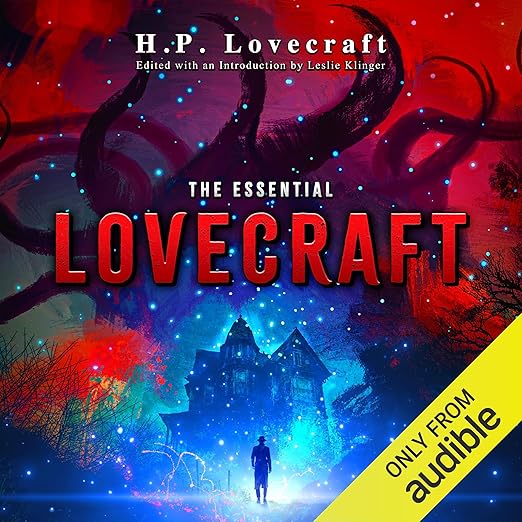
I came to The Essential Lovecraft with mixed feelings about Lovecraft himself. His racism is documented, substantial, and not something literary criticism should sidestep. Leslie S. Klinger, who selected and introduced the forty-eight stories in this Audible-exclusive collection, addresses the context of the work without either apologizing for or excusing it, which is the right approach. What remains after that reckoning is a writer who built something that outlasted him in ways he could never have predicted, a mythos that now shapes horror, science fiction, and fantasy literature so thoroughly that most of its inheritors have never read a single original story.
This collection runs to fifty hours. Forty-eight stories, each assigned to a narrator from a cast that includes Simon Vance, Scott Brick, Edoardo Ballerini, Jonathan Davis, Jay Snyder, and more. That full-cast approach is the defining choice of this production, and it changes everything about how the material lands.
Our Take on The Essential Lovecraft
Lovecraft's prose is notoriously difficult to narrate well. The sentences accumulate adjectives like geological sediment, eldritch, cyclopean, gibbering, non-Euclidean, and if a single narrator reads 48 stories consecutively, the cumulative effect is numbing. A reader who powers through the collected works in print often hits a wall somewhere around At the Mountains of Madness simply from the relentless stylistic sameness. The full-cast production solves this problem with structural elegance: each story arrives with a fresh voice, a slightly different interpretive sensibility, a new pacing rhythm.
Scott Brick handles At the Mountains of Madness, which is the right call, Brick's particular brand of deliberate gravity suits the Antarctic expedition's mounting dread. Edoardo Ballerini takes The Shadow over Innsmouth and The Case of Charles Dexter Ward, the two longest and most novelistic entries in the collection. His work on both is excellent, balancing Lovecraft's academic narrator personas against the escalating horror without ever playing the comedy that lurks at the edge of those personas. Jonathan Davis voices The Nameless City and Under the Pyramids, bringing his characteristic controlled intensity to material that benefits from it.
Why Listen to the Full Collection Rather Than Individual Stories
Klinger's editorial framing matters here. His introductions to individual stories provide historical context, connections between Lovecraft's life and his fiction, and the critical conversation that has grown up around each piece. For listeners who are encountering Lovecraft seriously for the first time, those introductions are invaluable, they locate each story in Lovecraft's development and give you a reason to care about the sequence.
The collection is also, frankly, the only way to encounter some of these stories in a well-produced audio format. Many Lovecraft recordings in the public domain suffer from inconsistent recording quality or narrators who treat the material as camp. This production takes it seriously without taking itself too seriously, there's a distinction between treating horror fiction with craft and treating it with reverence, and this collection consistently finds the former.
What to Watch For Across Fifty Hours
Not every narrator is equally matched to their story. A production this large will have highs and lows. Klinger's selection of 48 stories also means several of Lovecraft's lesser-known efforts are included alongside the canonical works, and some of those early experiments don't fully reward the listening time they require. Newcomers to Lovecraft might consider starting with the stories assigned to narrators they already know, Vance on The Colour Out of Space, Brick on At the Mountains of Madness, Ballerini on The Shadow over Innsmouth, before committing to the full sequence.
There are no listener reviews available for this title yet, which likely reflects its recent release date in September 2024. The 4.4 rating with 160 ratings suggests it has attracted experienced listeners who came in with clear expectations and largely found them met.
Who Should Listen to The Essential Lovecraft
Anyone who has tried to read Lovecraft on the page and found the prose style an obstacle will discover that audio removes that friction almost entirely. The full-cast approach converts a reading experience that can feel like work into something closer to a radio drama anthology. Dedicated horror fiction listeners, students of genre history, and anyone following the Lovecraft-influenced wave of contemporary weird fiction, from Thomas Ligotti to Jeff VanderMeer to Laird Barron, will find this a significant resource. At fifty hours, it's a commitment. It's also the most complete version of the source material available in audio.
Frequently Asked Questions
Is The Essential Lovecraft available anywhere other than Audible, or is it truly exclusive?
The synopsis confirms this collection is available only from Audible. The full-cast production and Leslie Klinger's editorial apparatus appear to be exclusive to this release.
How does Leslie Klinger's editorial framing affect the listening experience?
Klinger provides introductions to individual stories that offer historical and critical context. For newcomers, these are genuinely useful orientations. For experienced Lovecraft readers, they function as a secondary layer of commentary that enriches without interrupting.
Which stories in the collection are considered the essential Lovecraft by most critics?
The canonical works most critics cite include The Call of Cthulhu, At the Mountains of Madness, The Shadow over Innsmouth, The Dunwich Horror, The Colour Out of Space, and The Dreams in the Witch House. All are included here. The collection also covers early and lesser-known works.
Is the full-cast format consistent throughout, or do some stories use the same narrator as others?
Several narrators appear multiple times across the 48 stories, Edoardo Ballerini, Simon Vance, and Raphael Corkhill each take multiple entries. Each story still gets a single dedicated narrator, so the experience remains differentiated even when narrators recur.