Before You Press Play
- Voice: Mike Kraus reads his own series with workmanlike clarity; the performance is functional and keeps the pace moving, though it lacks the range a multi-cast production might bring to six distinct books.
- Big ideas: Family survival under collapse, the contest between cooperative and predatory human instincts, individual versus institutional response to catastrophe
- Atmosphere: Relentless and propulsive, with occasional domestic warmth to balance the destruction
- Worth it?: A complete post-apocalyptic arc spanning 62 hours that rewards listeners who want full immersion in a well-constructed survival world without the frustration of waiting for sequels.
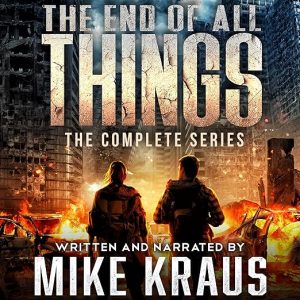
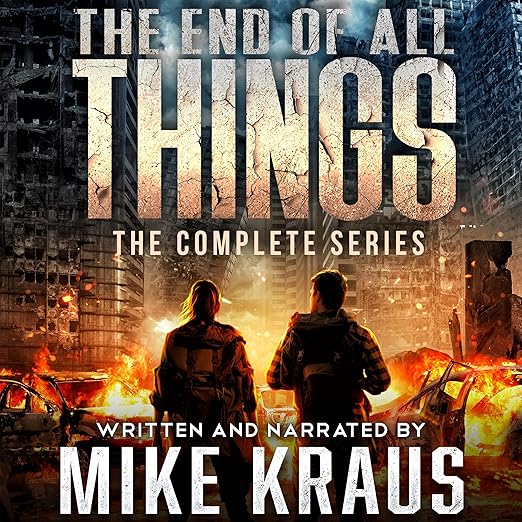
I had a long week ahead of me and wanted something I could sink into without rationing. The End of All Things: The Complete Series, all six books and just over 62 hours of it, seemed like the right gamble. By the third evening I had stopped planning how long I would listen before stopping. That's the practical test for a post-apocalyptic series of this length: not whether the premise is original, but whether the execution sustains investment across enough consecutive hours to qualify as a genuine world rather than an extended premise.
Mike Kraus has sold over four million books in this genre, and the competency that number implies is real and evident. He knows how to build a catastrophe with the kind of physical specificity that makes it feel inhabitable rather than theoretical. The inciting event here, virtually everything that uses fuel spontaneously combusting, is simple and devastating in equal measure. The first twenty-four hours kill billions. The survivors scatter across three simultaneous storylines: Alice Burton and her children stranded on a Florida beach, her husband James hiding under a Denver overpass, and Alice's parents managing their Michigan farm. The geographic separation is functional: it allows Kraus to build three very different survival contexts that eventually converge.
The structural choice to split the Burton family across three locations is both this series' greatest strength and its occasional weakness. At its best, it allows Kraus to explore what collapse looks like differently depending on your resources, your age, and your proximity to infrastructure. Alice's parents, Ryan and Helen, are homesteaders with practical skills that become suddenly valuable; their storyline is where the series is most grounded and, in several passages, most moving. Alice's situation is more conventionally thriller-paced. James's storyline in Denver is the most chaotic and also the most reliant on the kind of close-call action that post-apocalyptic fiction tends to overpopulate.
The reviewer who noted finishing six books in seven days specifically praised the realistic handling of animal behavior, a professional horse and dog trainer's endorsement that speaks to Kraus's research attention. Another reviewer singled out the series' resistance to the convention of universal savagery among survivors, noting that it includes a realistic balance of people trying to cooperate alongside people trying to exploit. That balance is what keeps the series emotionally bearable across a very long listen. A world where everyone turns predatory within forty-eight hours of collapse is easier to disengage from than one where the moral stakes remain genuinely uncertain.
Why The End of All Things: The Complete Series Works as an Audiobook
One significant advantage of the omnibus format is that listeners experience the full dramatic arc: The Collapse, The Desolation, The Ruination, The Darkness, The Devouring, and The Redemption. Those titles are honest about the shape of the journey. The first two books are primarily disaster and displacement. The middle volumes are survival and the discovery of other organized groups, some cooperative and some not. The final volumes move toward resolution in ways that feel earned rather than arbitrary. Kraus is better at endings than many thriller writers in this genre, and The Redemption doesn't betray the investment the earlier volumes demand.
The reviewer who described the series as having it all, love, family, perseverance, and a believable end-of-world scenario, is reaching for the right categories. The emotional engine is the Burton family. Their credibility as people who care about each other, rather than as action figures who happen to share a last name, is what makes 62 hours of catastrophe bearable rather than numbing.
Weak Spots in The End of All Things: The Complete Series
Author-narrated genre fiction is a particular listening experience. Kraus delivers his own prose with evident commitment and at a pace that keeps 62 hours from dragging. He is less effective at differentiating voices across a large cast, and there are moments where the distinction between characters becomes primarily contextual rather than vocally marked. For listeners who are very sensitive to multi-character narration, this is worth noting. For those who primarily follow plot and situation, it is rarely a barrier. The audio production is clean and consistent across all six books, which matters considerably for a series of this length.
Who Should Listen to The End of All Things: The Complete Series
This omnibus is ideal for listeners who want a fully contained post-apocalyptic narrative they can inhabit for weeks without waiting for the next installment. It is also well suited to listeners who prefer survival fiction that keeps human cooperation in the frame alongside human violence. Those who need highly literary prose or complex psychological interiority will find the writing serviceable but not particularly layered. Anyone who finds the genre's conventional reliance on near-constant threat exhausting should know that Kraus does deploy that convention frequently, especially in the middle volumes. But at the series' best, particularly in the Ryan and Helen storyline, it achieves something quieter and more resonant than the thriller packaging suggests.
Before You Listen
Is The End of All Things appropriate for listeners who are sensitive to graphic violence?
The series contains significant violence appropriate to its premise. Deaths are numerous, some are described in detail, and the conditions of post-collapse survival include realistic brutality. It is not gratuitous by genre standards, but listeners who are sensitive to violence should be aware that the subject matter requires a certain amount of darkness to be credible.
Is the complete series available as a free audiobook on Audible?
Yes, The End of All Things: The Complete Series is listed at no cost on Audible for eligible members. At 62 hours, this represents significant value for Audible listeners. Check current membership terms and availability via the link on this page.