Quick Take
- Narration: Virtual Voice AI narration handles the Regency dialogue passably but cannot deliver the emotional nuance this faith-forward romance requires.
- Themes: Marriage of convenience, faith and grace, healing from betrayal
- Mood: Warm and devotional, with slow-burn emotional tension
- Verdict: A well-constructed Christian Regency romance with genuine heart, though the AI narration keeps it from reaching its full emotional potential as an audiobook.
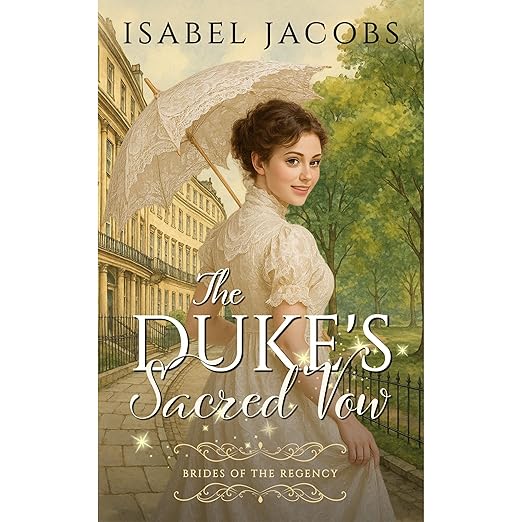
I finished this one on a quiet Sunday afternoon, which turned out to be exactly the right context for it. The Duke’s Sacred Vow is a gentle, faith-threaded Regency romance about two people who come to each other at their most broken and learn, slowly, to trust again. Isabel Jacobs is writing in a subgenre with devoted readers and specific expectations, and she meets those expectations with more craft than most free Regency titles manage.
Before I get into the story, the same disclosure applies here that affects the previous title in this batch: this audiobook uses Virtual Voice AI narration. For a romance that depends on emotional intimacy, whispered confessions, and the specific heat of two people gradually dropping their defenses, AI narration creates a real limitation. The story survives it because the writing is strong enough, but listeners who invest in Regency romance for the felt experience of being inside a love story will find this a lesser version of what a skilled human narrator could deliver.
Our Take on The Duke’s Sacred Vow
Annabel Ridley flees her betrothed after discovering his betrayal and arrives at the door of Philip Markham, Duke of Halmesbury. He is brooding, self-exiled from society, haunted by mistakes the narrative slowly uncovers. He proposes a marriage of convenience to protect her reputation. They are both terrible at communication. They both have wounds the other can see more clearly than they can see themselves. This is exactly the premise the Regency romance genre was built for, and Jacobs executes it with genuine skill.
What separates this from the lower tier of the subgenre is the faith integration. One reviewer who identified as a Christian noted how naturally the scriptural influence manifests in the characters’ thinking. It is not preachy in the sense that it stops the narrative to deliver lessons. Instead, Annabel and Philip’s faith shapes their inner lives, their doubts, and their gradual opening toward each other. The line in the synopsis about grace growing from the ashes of betrayal is not just marketing copy; it describes the actual emotional arc of the book.
Why Listen to The Duke’s Sacred Vow
For readers in the Christian romance space who have been burned by inaccurate Regency detail, one reviewer specifically noted that the customs and forms of address are handled correctly here. That sounds like a small thing but in a subgenre where anachronism is rampant, it matters. The Duke’s Sacred Vow reads like Jacobs did her research, and the period details feel earned rather than decorative.
The secondary characters add warmth without overwhelming the central relationship. The interplay between Mrs. Harris and Clinton drew specific mention in reviews as providing comic relief, and there is a subplot involving a character named Richard whose arc one reader hoped would be resolved in the next book. These details indicate a lived-in world that extends beyond the two leads, which is a sign of a writer thinking about her series rather than just her immediate plot.
What to Watch For in The Duke’s Sacred Vow
This is a closed-door romance, meaning physical intimacy is implied rather than depicted. The synopsis makes this explicit, and readers going in with different genre expectations should adjust accordingly. The emotional tension is entirely built on trust, vulnerability, and the specific courage required to love someone after you have been genuinely hurt. If that is the engine you want driving your romance listening, this delivers it. If you want something more overtly passionate, this is not the book.
The communication failures between Annabel and Philip are intentional and structurally important, but they do extend into the second half in ways that some readers find frustrating. One reviewer mentioned wanting to metaphorically shake the characters and tell them to simply speak to each other. That particular friction is inherent to the marriage-of-convenience trope handled honestly, but it is worth knowing the resolution takes its time.
Who Should Listen to The Duke’s Sacred Vow
Listeners who enjoy Christian historical romance, specifically in the Regency period, and who value emotional depth over physical heat will find this rewarding. Fans of authors like Michelle Griep or Kristi Ann Hunter will recognize the sensibility. The AI narration is the primary caveat: if you are a romance reader who experiences audiobooks through the narrator’s emotional performance, this will feel insufficient. The ebook version would serve this story better. That said, for listeners less sensitive to the narration source, or who want to sample Jacobs’ series before investing in more expensive versions, this is a solid and sincere entry point.
Frequently Asked Questions
Is The Duke’s Sacred Vow appropriate for readers who want clean, faith-forward romance without any explicit content?
Yes, entirely. The book is explicitly closed-door, with no cursing, no explicit physical content, and faith integrated naturally into the characters’ inner lives. Isabel Jacobs is writing squarely in the Christian Regency romance tradition. The emotional tension comes from trust and vulnerability, not physical heat.
How accurate is the Regency historical detail in this book?
More accurate than much of the free-tier Regency market. One reviewer specifically called out the correct handling of nobility forms of address and period customs. It is not an academic exercise, but the historical grounding is solid enough that readers who know the period will not be constantly pulled out of the story by anachronism.
Does the Virtual Voice AI narration significantly affect the romance experience?
It creates a real limitation for an emotionally intimate story. The dialogue and expository passages hold up, but the moments of quiet vulnerability between Annabel and Philip, and the gradual dropping of their defenses, benefit from a human narrator’s emotional range. If the felt experience of being inside a love story matters to you as a listener, the ebook version would serve this particular title better.
Is this a true standalone or does it end on an unresolved note that requires the next book?
The central romance between Annabel and Philip reaches a complete and satisfying resolution. There is a secondary character arc, involving someone named Richard, that one reviewer hoped would be addressed in a future installment, but this is a loose thread rather than a cliffhanger. You can read this as a complete story.