Quick Take
- Narration: Russo reading his own essays is a rare gift, his voice carries the wryness and self-awareness that makes the written version work, without any sense of performance.
- Themes: The writer’s life as vocation and accident, friendship and loyalty across social distance, the function of humor in serious art
- Mood: Warm and reflective, with flashes of genuine wit
- Verdict: Listeners who love Richard Russo’s novels will find this collection illuminates how the fiction was built, and those unfamiliar with him may discover an essayist worth knowing on his own terms.
There is a particular pleasure in hearing a writer read their own nonfiction, and I was reminded of it sharply when I started The Destiny Thief on a rainy Tuesday afternoon. Richard Russo’s voice is exactly what you would expect from someone who has spent forty years writing about the kinds of people who do not often appear in literary fiction, blue-collar, quietly dignified, provincial in the best sense of the word. He sounds like someone who has genuinely thought about everything he is saying.
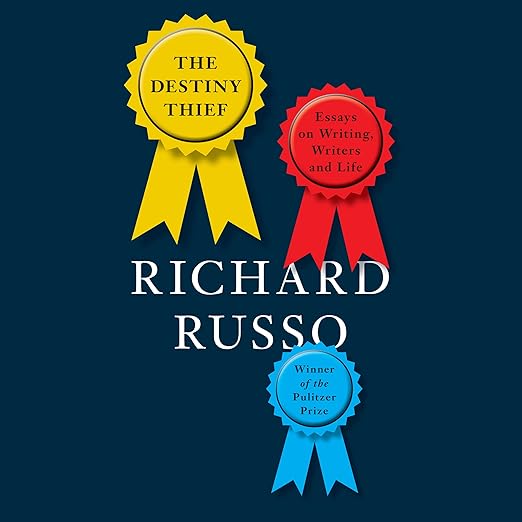
This is Russo’s first essay collection, published in 2018, and the nine pieces range from a commencement address to a long meditation on Mark Twain to a personal account of accompanying a close friend through gender-reassignment surgery. The range is wider than the description suggests, and the essays resist easy categorization as a writing guide, a memoir, or cultural criticism. They are simply the thoughts of a generous and precise mind working through the things that have mattered to it.
Our Take on The Destiny Thief
The book’s title essay is the strongest entry, tracing the diverging paths of Russo and a college classmate in a way that illuminates how much of a writing life is contingency rather than intention. One reviewer described this as a collection that offers a lens through which to see life itself, not just writing, and I think that is accurate. The Dickens and Twain pieces work because Russo reads these canonical figures as a novelist would, interested in what they got away with, how they constructed their effects, what the humor in the work was actually doing. His analysis of Twain in particular feels earned rather than academic.
The essay about the oddly placed toilet, which sounds absurd as a description, is the funniest piece in the collection and functions as an oblique argument about why comedy is not a lesser mode than tragedy. Coming from a novelist who has been dismissed by some critics as too warm and too comic, it carries biographical weight the essay does not explicitly claim. Russo is making a case for himself by making a case for humor in art, and the indirection is elegant.
Why Listen to The Destiny Thief
The author narration is a genuine asset here. Several reviewers noted that the collection reads like Russo’s fiction, that familiar combination of warmth, precision, and self-deprecating wit that has made him one of the most readable American novelists of the past three decades. Hearing him deliver those qualities in his own voice collapses any distance between writer and text. At 7 hours and 35 minutes, the collection is appropriately sized for an audiobook, long enough to feel substantial, short enough that none of the individual essays outstay their welcome. One reviewer compared it favorably to Stephen King’s On Writing and noted the key difference: this is less a craft manual and more a meditation on what it means to become a writer rather than how to do it.
What to Watch For in The Destiny Thief
Listeners hoping for writing advice in the instructional mode will be disappointed. This is not a how-to collection in any conventional sense. The craft observations are embedded in memoir and argument, not laid out as lessons. The final essay, about accompanying a dear friend through gender-reassignment surgery, is the most emotionally direct piece in the collection and requires a different kind of attention than the literary essays. It is also one of the most moving things Russo has published. Be prepared for a significant tonal shift in the book’s closing pages.
Who Should Listen to The Destiny Thief
This is well suited to listeners who already love Russo’s novels and want biographical context for the fiction, and equally suited to general readers who enjoy literary essays that resist the obvious and take the writer’s vocation seriously without self-importance. Those looking for a traditional writing craft book should look elsewhere. Those willing to sit with nine essays that each take a different angle on what it means to read, write, and live will find the collection genuinely rewarding.
Frequently Asked Questions
Is The Destiny Thief a writing advice book or something else entirely?
It is primarily an essay collection about Russo’s life as a reader, writer, and friend. Craft observations appear throughout but are embedded in memoir and argument, not structured as lessons. Think literary essay collection, not writing manual.
Does Russo reading his own work add or detract from the experience?
Adds considerably. Russo’s voice carries the same wry, warm quality as his prose, and hearing him read the more personal essays, particularly the one about accompanying a friend through gender-reassignment surgery, gives the material an immediacy that a third-party narrator would likely dilute.
Do I need to have read Russo’s novels to appreciate this collection?
No, though familiarity with his fiction enriches the essays. Several pieces reference the kinds of characters and settings he has spent his career writing about, and readers who know Empire Falls or Everybody’s Fool will catch resonances that newcomers will not.
How do the Twain and Dickens essays compare to the personal memoir pieces?
The literary criticism pieces are analytical and engaging, reading Twain and Dickens as a practicing novelist would, with attention to technique and effect rather than academic framing. They are less emotionally immediate than the memoir essays but show Russo at his most intellectually playful.