Quick Take
- Narration: Leslie Howard brings Tegan’s vulnerability and mounting dread to life with precision, the confined, snowbound setting suits a single narrator’s tight performance.
- Themes: Survival and motherhood, false sanctuary, psychological entrapment
- Mood: Tense and claustrophobic, with a slow-burn reveal structure
- Verdict: Fans of McFadden’s psychological thrillers will find the snowbound cabin setup one of her more viscerally effective, though seasoned thriller readers may find the trajectory readable earlier than the book intends.
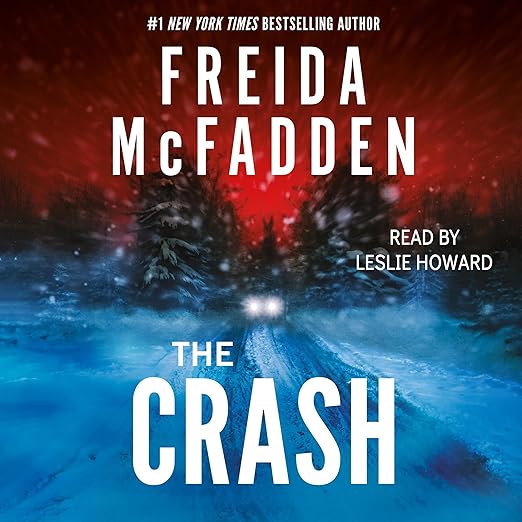
I started The Crash on a January evening when the weather outside was doing its best impression of the book’s setting, which turned out to be either perfect timing or a mistake, depending on how you feel about being made genuinely anxious by a thriller. Freida McFadden has built her reputation on domestic psychological suspense, and this one strips the setup down to its most elemental form: a woman alone, a blizzard, strangers with warm lights on in their window. By the time I realized how wrong the situation was, I had finished three more chapters without noticing the time.
Tegan is eight months pregnant, fleeing a life that has come apart, driving to her brother’s place when the storm catches her in rural Maine. The car is wrecked, her ankle is broken, and she cannot call for help. A couple named Hank and Polly take her in. Polly is a former nurse, warm and attentive. The cabin is clean and safe. Something is profoundly wrong, and Tegan knows it before she can articulate why. That gap between suspicion and evidence is where the book lives.
Our Take on The Crash
McFadden’s most reliable skill is the management of dread, the ability to sustain a reader’s certainty that something terrible is happening while withholding exactly what it is. In The Crash, that skill is applied with particular effectiveness because the setting provides natural reinforcement. Tegan cannot leave. The snow is not clearing. Her broken ankle ensures she cannot run. The physical confinement and the psychological pressure compound each other in ways that feel genuinely crafted rather than coincidental. McFadden is working the physical environment into the thriller architecture in a way she does not always have room to do in her domestic settings.
Where the book is more mixed is in its predictability once the mechanism reveals itself. One reviewer, coming to McFadden for the first time, found that after the initial crash the trajectory became readable, a fair observation that reflects a tension in McFadden’s work generally. The pleasure of her books often lies in the execution of a premise rather than in the surprise of the premise itself. If you have read several of her novels, you will recognize the structural signature here, and that recognition will arrive before the book intends it to.
Why Listen to This Rather Than Read It
Leslie Howard’s narration is the strongest reason to choose the audio version. She renders Tegan’s specific situation, pregnant, injured, alone with strangers, unable to trust her own instincts about whether the danger is real, with a vocal performance that earns the claustrophobia the book is reaching for. The confined setting and single-perspective narration suit an audio format where there is nowhere else to go but further into Tegan’s escalating anxiety. At nine hours, it is efficiently paced for the genre, neither overstaying nor cutting short.
What to Watch For in the Thriller Structure
This is McFadden working in her established mode, which means the prologue hooks early, the middle sustains tension through withheld information, and the resolution delivers a reveal that recontextualizes what you have been reading. The final reveal drew strong responses from reviewers, some found it genuinely shocking, others found it the book’s best moment after a somewhat predictable build. The pregnancy element is handled with more care than the synopsis might suggest; this is not exploitation, but a specific pressure that makes Tegan’s survival calculus meaningfully different from a non-pregnant protagonist’s.
Who Should Listen to The Crash
McFadden readers who want to see her apply her domestic thriller formula to a stripped-down survival situation will find this one of her more atmospheric entries. First-time McFadden listeners will get a clean introduction to her technique. Skip it if you need your thrillers to deliver consistent narrative surprise, the structural beats are familiar enough that experienced genre readers will be ahead of the book for stretches of its second half.
Frequently Asked Questions
Does the pregnancy element feel handled sensitively or is it used purely as a thriller device?
Multiple reviewers noted that McFadden uses the pregnancy to add genuine stakes and moral complexity to Tegan’s survival decisions rather than as pure shock value. The maternal instinct driving Tegan’s choices is one of the book’s more convincing emotional through-lines.
Is this a good entry point for first-time Freida McFadden readers?
Yes. The premise is self-contained, the setup is efficient, and the snowbound thriller format is accessible without requiring knowledge of her other work. Readers who enjoy it have a substantial back catalog to explore.
How predictable is the plot for experienced psychological thriller readers?
Moderately so. The opening is genuinely effective and the setup sustains uncertainty well. By the midpoint, experienced genre readers may have a reasonable sense of where things are heading, though the specific details of the reveal retain some surprise.
Is Leslie Howard’s narration consistent with Tegan’s first-person perspective throughout?
Yes. Howard maintains a tight grip on Tegan’s subjective experience throughout the nine hours, which is the right approach for a book this dependent on the reader sharing the protagonist’s growing dread. The performance does not editorialize, it stays inside Tegan’s perspective even when the reader suspects more than Tegan does.