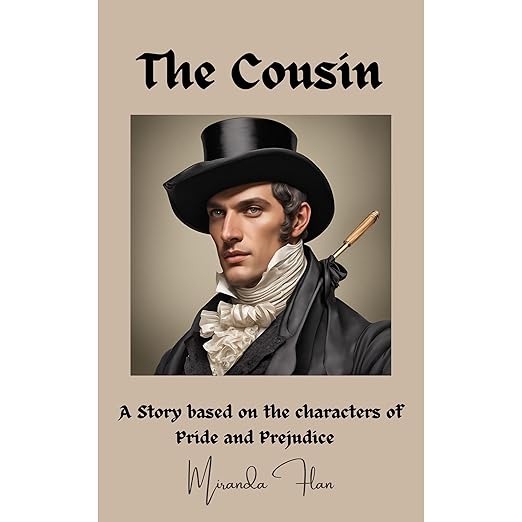
Quick Take
- Narration: Virtual Voice AI narration delivers the text cleanly but lacks the warmth and period nuance this Pride and Prejudice variation deserves.
- Themes: Jane Austen fan fiction, arranged marriage, family loyalty and redemption
- Mood: Warm and familiar with uneven execution
- Verdict: Readers who love Bennet family reimaginings will find the plot inventive, but the prose needs a significant editorial pass before it can fully deliver on its premise.
I picked this one up on a quiet weekday evening, the kind of night where I wanted something cozy and familiar rather than challenging. A Pride and Prejudice variation with a long-lost cousin returning to shake up the Bennet household sounded like exactly the kind of comfort listen I was after. And in many ways, Miranda Flan delivers on that promise, at least in spirit. The plot is genuinely inventive, and I found myself charmed by the central conceit: Johnathan Edward Gardiner, returning to England after years abroad to advance his business interests, arrives to find his family changed in ways he never anticipated.
The premise has real warmth. Fans of the Bennet sisters will recognize the appeal immediately, and the story does deliver on several of its promises, including what one reviewer called happy endings for characters who rarely get them in the original. Anne de Bourgh getting a fuller, more satisfying arc is a particular highlight. The plot moves efficiently, avoiding the trap that many Austen variations fall into of leaning too heavily on direct quotations or scene-for-scene recreations of the source material.
Our Take on The Cousin
This is fan fiction that knows what it is and leans into its strengths: character warmth, wish fulfillment, and the pleasure of seeing the Bennet circle through a fresh lens. Flan has a genuine storytelling instinct. The idea of a protective male cousin figure who steps in precisely when the sisters need it most is well-suited to the genre, and several readers noted how satisfying it is to see the family dynamics reshuffled without losing what makes them appealing. The handling of Lydia, often a thankless character to write, shows some real care.
Where the book stumbles, and this is hard to overlook, is in the execution at the sentence level. Multiple reviewers flag grammatical errors, misused words, and awkward sentence construction throughout. One described it as reading like a first draft, noting that paragraphs often open with something like two characters decided to go for a walk because, followed immediately by a separate paragraph explaining why another character declined. It is a structural tic that becomes distracting over ten-plus hours of listening. This is not a light editing issue; it is the kind of problem that a developmental edit and a thorough copyedit would need to address together.
Why Listen to The Cousin
Despite its roughness, there is a real readership for this title. If you have already worked through the more polished entries in the Austen variation genre and are hungry for more, the story itself offers enough original movement to keep you engaged. The cousin device is not one I have encountered often, and Flan uses it to give the narrative a different center of gravity than most Bennet-focused variations. The plot does not drag, which is a genuine virtue in a genre that can easily tip into endless scenes of drawing room misunderstanding.
The Virtual Voice narration is functional. It reads the text accurately and at a reasonable pace, but it cannot compensate for the prose irregularities, and it lacks the tonal range that a skilled human narrator would bring to the comedy and the more tender moments. If you are sensitive to AI narration, that is worth factoring into your decision.
What to Watch For in The Cousin
Go in expecting a story that is better than its writing. The plot has real forward momentum and genuine heart, but the grammatical inconsistencies will surface regularly enough to pull you out of the Regency atmosphere. Several reviewers mentioned brain glitches caused by word misuse, which is a vivid and accurate description of the experience. The strange formatting that at least one reader noted also surfaces in the audio as an uneven rhythm to how scenes are structured and transitioned.
This is a book with obvious potential that needed more time with an editor before publication. That is not a dismissal of the author’s storytelling ability, which is evident, but a note that the gap between concept and delivery is wider here than it should be.
Who Should Listen to The Cousin
Best suited for devoted Austen variation readers who have a high tolerance for rough prose and are primarily interested in plot and character rather than stylistic precision. If you loved the central idea of a cousin stepping in to protect the Bennets, you will find enough here to satisfy that craving. Listeners who are sensitive to grammatical errors or who expect polished prose will likely find the experience frustrating. New readers to the Austen variation genre should start elsewhere.
Frequently Asked Questions
Is The Cousin a direct retelling of Pride and Prejudice?
It is a variation rather than a retelling. The Bennet sisters are central characters and familiar plot dynamics are present, but Johnathan Edward Gardiner’s return introduces new storylines that deviate significantly from the original.
How noticeable are the grammatical errors in the audiobook format?
Multiple reviewers describe them as frequent enough to be distracting, with misused words and awkward sentence structures surfacing throughout the ten-hour runtime. If prose precision matters to you, this is a meaningful caveat.
Does Anne de Bourgh get a satisfying arc in this story?
Yes, and several readers specifically cited this as a highlight. Characters who are often underserved in the original, including Anne, receive more developed treatment here.
Is the Virtual Voice narration a dealbreaker for this title?
It depends on your tolerance for AI narration. The performance is clean and functional but lacks the warmth and period authenticity that a human narrator would bring to Regency-era dialogue and comic timing.