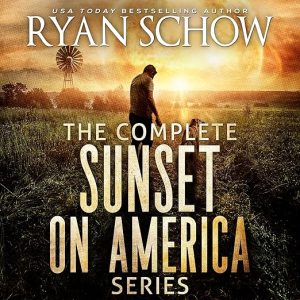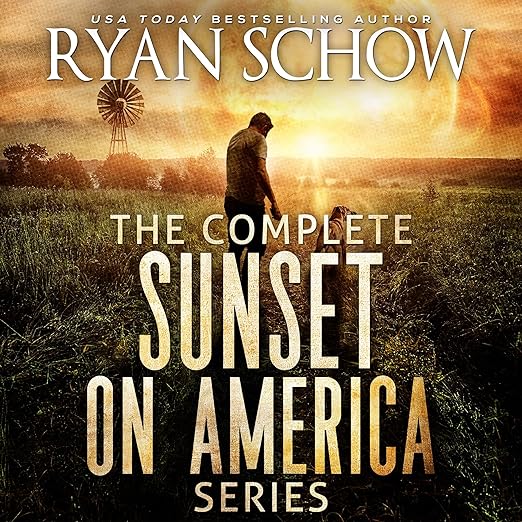
Fifty-eight hours is not a purchase, it is a relationship. This audiobook collects six post-apocalyptic novels by Ryan Schow into one file running fifty-eight hours and forty-five minutes, with Kevin Pierce as the reader of record, and the first decision any prospective listener faces has nothing to do with quality. It is whether you want to spend the equivalent of a working week and a half inside Burning Hollow, Tennessee. A 4.5 average across 211 ratings suggests a healthy number of people did, and would do it again.
The premise is a feud with a bomb dropped on it. Two families, the Bickmores and the Bankses, have fought over one Tennessee town for a century, and the description is precise about the residue: generational wounds that never healed. Then an electromagnetic pulse attack cuts the country's power and the old grievance turns into a survival problem. Rowdy Banks comes back to the holler he had left behind, collides with Chloe Bickmore and her daughter Everleigh, and a single humane act tips the whole community into anarchy. That inversion is the good structural idea here, kindness as the destabilizing force rather than cruelty.
Across the six books the scale escalates deliberately, and the description charts the ladder plainly: stragglers first, then small militias, then a military invasion, with the ground shifting from back roads to barricades. That is sound architecture for a long series, because each installment gets a new order of threat instead of repeating the previous one at higher volume. It also means the early hours are the intimate ones. If the family drama in the opening stretch fails to hold you, the arrival of larger forces later will not rescue the experience, since the same people are still carrying it. I would treat the opening two books as the real audition. If the holler and its inherited grudges hold you through those, the escalating scale will carry you the rest of the way.
Pierce Holds Steady Across Fifty-Eight Hours
Pierce is the single credited voice across the whole span, which is the most demanding aspect of this production and the one worth thinking hardest about before committing. Consistency is the entire assignment at this length. A cast this size, spread over six books, needs voices stable enough to survive from the first hour to the fifty-eighth, or a listener loses track of who is speaking somewhere around the midpoint. One five-star reviewer names characters as distinct individuals when recommending the series, singling out Catrick and Bartholomew as unusual and pointing to Ruth and the Cody boys as the relatable ones, which tells you the cast is large enough for that sorting to matter.
The responses agree on what these books deliver, and it is immersion rather than prose. One five-star notice describes adrenaline during the fight scenes, being present inside them, and crying twice along the way, crediting Schow with painting a picture vivid enough to stand inside. Brad Durham calls the book well written and then immediately glosses that as characters coming to life and a reader kept "captive and interested in his story." Another five-star reviewer welcomes the sheer length explicitly, because a long book "gives you time to get to know the characters". Praise here reaches for effect rather than for sentences, and nobody quotes a line. That is the correct expectation to arrive with.
Reviewers Read the Politics as a Feature
The books carry a political viewpoint, and one reviewer makes it explicit enough that a buyer ought to know in advance. Teresa, at five stars, singles out the political statements as a reason for loving the series more, ties them to a stated view of past government administrations, and connects the rural self-sufficiency on the page to a personal history of livestock, harvests and preserving. Donald Andrews, at four stars, reads the series as instructive, saying the scenario "could actually happen". Whether that outlook energizes or grates on you, it is present in the text and reviewers respond to it directly rather than incidentally.
The bundle format is the other consideration. Buying six novels in one file means no sampling of individual volumes and no exit point that does not feel like abandonment, so if the voice or the viewpoint turns out not to suit you, the commitment was made all at once. Notice too that these notices describe reading throughout, using the vocabulary of pages and downloads rather than of listening, which establishes that the story holds attention without establishing anything about this particular reading of it. All five were posted in the months following the November 2025 release, so at least the pool is current.
Community-Collapse Fans Get an Epic Commitment
Post-apocalyptic regulars are the obvious fit, especially anyone who reads for community-collapse scenarios rather than lone-survivor fantasy, since the whole architecture here concerns a town rather than a man. Listeners wanting a very long commitment they will not have to reassess every fortnight get an ideal format, and one reviewer frames the length itself as the attraction rather than the obstacle. Anyone drawn to feuding-family structures in rural American fiction will recognize the bones immediately, because Schow is running a Hatfield-and-McCoy frame underneath a collapse plot and does not pretend otherwise.
Set aside the literary label attached to this listing, which will mislead the wrong buyer. This is plot-forward genre storytelling with heavy emphasis on incident, and the compliments it collects are about impact rather than about craft. That is a real achievement and a specific one, but it is not the same achievement as a well-made sentence. Anyone who needs both at once should calibrate accordingly, because fifty-eight hours is a long time to spend wishing a book were doing something it never set out to do.
Steer clear if you need short commitments, if collapse fiction with an explicit political charge is not what you want in your ears for a fortnight, or if you prefer apocalypses cool and stylized rather than sweaty and regional. Everyone else gets a large, self-contained world with a definite ending, which is rarer in this genre than it ought to be. One reviewer's reaction captures the effect without meaning to, expressing genuine sadness that the story had finished and pleading for more of a series that has already announced itself complete. Whether fifty-eight hours is too many is not a question I can answer for you, since it is a question about your life rather than about the book.
Common Questions
Can I buy the six books separately instead of this complete audiobook bundle?
The collected edition is what this listing sells, six novels in one continuous file bought as a single item. Individual volumes exist as separate products elsewhere in the catalogue. Buying the bundle removes any chance to sample one book before committing, which is worth weighing against the convenience.
Do I need to have read anything else by Ryan Schow first?
No prior reading is assumed. This series stands entirely on its own, opening with the feud between the Bickmore and Banks families and building from there. Schow has other work, and one reviewer says this collection sent them hunting for more of it, but nothing here depends on any of that.
How political is the series, and will that affect my enjoyment?
Noticeably. One five-star reviewer credits the book's commentary on past administrations as a reason for enjoying it more, while a four-star treats the collapse scenario as a genuine warning about where things are heading. Readers who prefer ideologically neutral apocalypse fiction should know the viewpoint is unhidden.
Does this audiobook reach a real ending or stop partway through an arc?
It concludes. All six books are here and the arc closes, which one reviewer found genuinely saddening, having hoped for a continuation. That completeness is unusual in ongoing post-apocalyptic series and is a real argument for the bundle over waiting on individual releases.