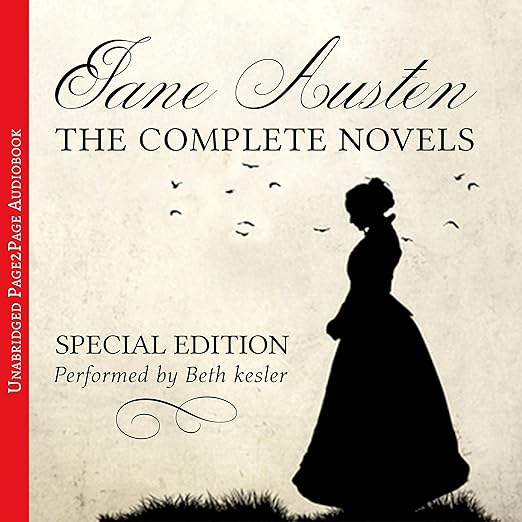
Quick Take
- Narration: Beth Kesler delivers competent, readable prose but at least one reviewer notes a robotic quality that can work against Austen’s wit and irony; fine for multitasking listens, less rewarding for focused attention.
- Themes: Marriage as social contract, irony as moral vision, class mobility and its limits
- Mood: Measured and civilized, occasionally flattened by the production format
- Verdict: A practical way to encounter all of Austen in a single package, but listeners who want the novels done full justice should consider dedicated single-novel productions alongside this collection.
I came back to Jane Austen last winter the way I always do, in pieces, usually starting with Persuasion when the light changes and everything feels a little more elegiac than it should. What made me curious about this collection was the annotated format and the sheer commitment of seventy-eight and a half hours covering every novel Austen completed plus the unfinished fragments, including Sanditon. That is not a casual listen. It is a project.
The collection runs in chronological order of original publication: Lady Susan, then Sense and Sensibility, Pride and Prejudice, Mansfield Park, Emma, Persuasion, Northanger Abbey, and the unfinished Watson fragment, before concluding with Sanditon. For anyone who has only ever read the canonical six and never encountered Lady Susan, there is genuine value in opening with that epistolary novella, which shows a different, sharper, more cynical side of Austen’s intelligence than the full novels tend to display.
Our Take on The Complete Novels of Jane Austen
The case for a collection like this is primarily practical. You get everything in one place, navigable by chapter numbers provided in the synopsis, and the annotated material includes supplementary context that frames Austen within her literary and historical moment. One reviewer mentioned the inclusion of a media adaptation list current enough to reference the 2013 film Austenland, which gives some sense of how far the supplementary material extends. For new readers approaching Austen for the first time, that contextual framing can make a real difference in understanding why, say, the question of whether Edmund Bertram can actually support a wife on a clergyman’s income is not a trivial concern in Mansfield Park.
The value of reading these novels in sequence rather than in isolation is something critics have argued for decades. You begin to see Austen developing her narrative technique in real time: the epistolary distance of Lady Susan giving way to the free indirect discourse she perfects in Emma, where the gap between what Emma Woodhouse believes about herself and what the narrative reveals to us becomes the engine of the entire book. Listening to these in order makes that development audible in a way that reading them years apart never quite allows.
Why Listen to The Complete Novels of Jane Austen
One of the more appealing aspects of a collection of this scope is the ability to listen across activities that make reading impractical. Multiple reviewers noted using this during household chores, cooking, and long drives. Austen’s prose, even when narrated imperfectly, has enough forward momentum in its plotting and enough wit in its dialogue to sustain distracted listening in a way that denser Victorian fiction does not always manage. You can follow the social mechanics of a Austen plot across a two-hour commute without losing the thread.
The inclusion of Sanditon, Austen’s last and unfinished work, is worth noting specifically. It shows her beginning to engage with a more overtly comic and even satirical mode, with the health resort setting and its hypochondriac characters feeling distinctly more modern in sensibility than some of the earlier novels. Having it here alongside the complete works rather than as a separate purchase is a genuine benefit of the collection format.
What to Watch For in The Complete Novels of Jane Austen
The narration question is the one that requires honest attention. At least one reviewer specifically described the narration as robotic, and that word is meaningful in context. Austen’s prose depends enormously on irony and tone: the famous opening of Pride and Prejudice is only funny if you understand what is being said about the people it is describing, and that requires a narrator who can hold the joke in their voice without announcing it. A flattened delivery can make Austen sound mannered and cold rather than sharp and observant. Beth Kesler is competent and clear, and the collection serves multitasking listening well, but for dedicated, attentive listening sessions, some of the novels’ comedy may not land with the force it deserves.
The Watson fragment is listed simply as The Watson in the chapter index, which is a minor transcription issue the synopsis flags. For listeners unfamiliar with Austen’s juvenilia and minor works, the collection provides a useful introduction to writings outside the canonical six, though these fragments are shorter and structurally incomplete in ways that can feel abrupt when encountered without context.
Who Should Listen to The Complete Novels of Jane Austen
This collection is best suited to readers who already have some familiarity with at least one or two of the novels and want a convenient way to experience the whole body of work across a sustained period. It works particularly well for commuters and those who listen while occupied with other tasks. Listeners approaching Austen entirely fresh may find it more rewarding to start with a dedicated production of Pride and Prejudice or Emma first to develop an ear for the prose style before committing to a seventy-eight-hour marathon. Devoted Austen scholars looking for rich vocal performances of individual novels will want to supplement this with production-specific recordings of their favorite works.
Frequently Asked Questions
Does this collection include both the major novels and Austen’s unfinished works like Sanditon?
Yes, it includes all six completed novels plus Lady Susan, the Watson fragment, and Sanditon, arranged in chronological order of original publication. The chapter index in the synopsis shows where each work begins.
Is the narration by Beth Kesler suitable for attentive listening, or is it better suited to multitasking?
Based on reviewer feedback, it works better for multitasking. At least one reviewer described the narration as robotic, which can flatten Austen’s irony. For deep, focused listening, dedicated single-novel productions by narrators known for Austen may serve better.
What does the annotated portion of the collection actually include?
The annotations appear to include supplementary contextual material such as media adaptation lists current through at least 2013, and historical context around Austen’s era. The format is designed to be navigable with working chapter links.
At 78.5 hours, how is the collection best approached, novel by novel or all the way through?
The chronological structure rewards listening novel by novel with breaks between, which allows you to appreciate Austen’s developing narrative technique across her career. Listening in one continuous run without breaks risks the novels blending together, particularly the shorter fragments at the end.