Quick Take
- Narration: Sneha Mathan is exceptional here. Her command of the material across thirty-three hours and three distinct settings, Jaipur, Shimla, and Paris, is a major reason this trilogy works as an audio experience.
- Themes: Women’s autonomy and ambition across generations, class and caste in postcolonial India, secrets and their long consequences
- Mood: Immersive and emotionally invested, with the pleasure of watching characters grow across decades
- Verdict: A generous, richly textured multigenerational saga that rewards the full thirty-three-hour commitment with compound interest.
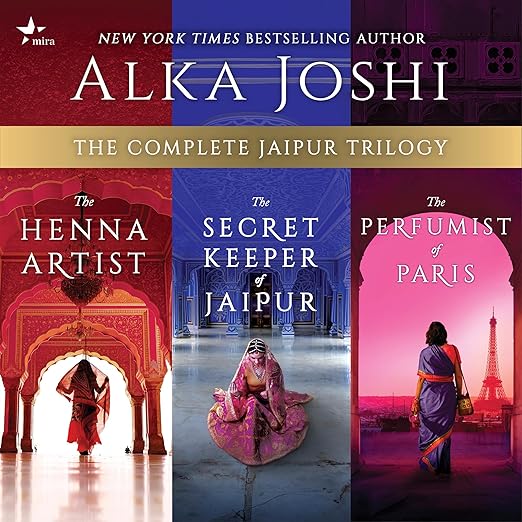
I started “The Henna Artist” on a Tuesday afternoon and finished the final pages of “The Perfumist of Paris” the following Sunday. Not because I had nothing else to do, but because Alka Joshi had created characters I was genuinely reluctant to leave. The Jaipur Trilogy is one of those rare fictional constructions where the second and third installments do not diminish the first but expand and complicate it in ways that feel inevitable in retrospect. Having the complete trilogy in a single thirty-three-hour audio package is the right way to experience it.
The trilogy begins in 1950s Jaipur with Lakshmi, a seventeen-year-old who has escaped an abusive marriage and built herself into the most sought-after henna artist in the city, using her access to wealthy clients to navigate a rigid social world on her own terms. The second book follows Malik, Lakshmi’s protege, into the politics of the Jaipur Royal Palace in 1969. The third shifts to Paris in 1974, where Lakshmi’s younger sister Radha pursues a career in perfumery while managing a marriage strained by ambition and a secret she has carried for years. The generational span from the 1950s through the 1970s allows Joshi to trace real changes in what was possible for women in both Indian and French society, and she does so with specificity rather than generalization.
Our Take on The Complete Jaipur Trilogy
Joshi’s greatest achievement across the three books is the construction of characters whose moral complexity feels earned rather than imposed. Lakshmi is not simply a sympathetic survivor: she makes decisions that protect herself at the expense of others, and the trilogy is honest about the cost of those choices to the people around her. One reviewer noted that some readers find the characters relentlessly self-serving, which is an honest observation about the trilogy’s moral register, though I would frame it differently: Joshi is depicting what survival demanded of women with limited options in societies that were not interested in their wellbeing. The praise from Reese Witherspoon and the Reese’s Book Club selection reflect genuine literary quality rather than simply commercial appeal.
Why Listen to The Complete Jaipur Trilogy
Sneha Mathan’s narration deserves extended attention because it is one of the finest performances in recent world literature audiobooks. Her voice carries the trilogy’s multiple settings, from the heat and color of Jaipur to the gardens of Shimla to the perfume ateliers of Paris, without ever sounding like she is switching registers artificially. Multiple reviewers describe feeling transported to another time and continent, which is a measure of how effectively Mathan’s performance collaborates with Joshi’s prose. At thirty-three hours, the consistency she maintains is genuinely impressive. One reviewer called the narration smooth and pleasant, and credited Mathan’s delivery with making this their favorite audiobook of the year.
What to Watch For Across the Three Volumes
The trilogy’s shift in perspective from book to book, Lakshmi in the first, Malik in the second, Radha in the third, is one of its structural risks. Each shift requires listeners to invest in a new primary perspective while the previous protagonist recedes. Some readers find the second book, centered on Malik’s investigation into a collapsed cinema balcony, the least emotionally absorbing of the three. It is the most plot-driven and the least character-centered, which can feel like a gear change after the intimacy of “The Henna Artist.” The third book returns to the emotional depth of the first and provides the trilogy’s most satisfying synthesis, bringing together the threads of all three women’s stories in ways that retrospectively enrich everything that came before.
Who Should Listen to The Complete Jaipur Trilogy
This is an audiobook for listeners who want a substantial multigenerational story set in a richly evoked historical and cultural context. Readers who love Jhumpa Lahiri’s attentiveness to the interior lives of South Asian women navigating complex social worlds, or who were drawn to the epic scope of Vikram Seth’s “A Suitable Boy,” will find Joshi’s trilogy a compelling companion. The thirty-three-hour runtime is not for listeners who want a quick read, but for those who commit, the investment pays dividends across all three volumes.
Frequently Asked Questions
Can The Henna Artist be listened to as a standalone without continuing the trilogy?
Yes. The first book functions as a complete narrative in its own right. The Complete Jaipur Trilogy package is the most economical way to access all three, but the individual books can be listened to independently, with subsequent volumes adding depth to characters and storylines introduced in the first.
How does Sneha Mathan handle the three different narrative settings across the trilogy?
Mathan is widely praised by reviewers for her ability to evoke the distinct atmosphere of each setting. Her narration of Jaipur, Shimla, and Paris feels calibrated to each location’s social and physical environment, which is one of the primary reasons the trilogy works so well as an audio experience.
Is the second book, The Secret Keeper of Jaipur, weaker than the other two?
Some readers find it the most plot-driven and the least emotionally intimate of the three, partly because it centers on Malik rather than Lakshmi. It is not a weak book, but its mystery-plot structure operates differently from the character-centered depth of the first and third installments.
Does the trilogy engage honestly with caste and class dynamics in postcolonial India?
Yes. Joshi depicts the social hierarchies of 1950s through 1970s India with specificity, including the ways they constrained women of different classes and how Lakshmi navigates them through the particular leverage her skills as a henna artist give her with wealthy clients.