Key Details
- Narration: Kevin Pierce handles the multi-perspective structure and the shifting emotional registers across nearly fifty hours with the consistency a long series demands.
- Themes: EMP collapse survival, fractured family reunification, moral compromise under civilizational breakdown
- Mood: Propulsive and relentless, with the occasional quieter character moment that keeps the apocalypse from feeling purely mechanical
- Verdict: A satisfying post-apocalyptic box set for readers who want density and momentum, with a multi-thread structure that pays off across the full five-book arc.
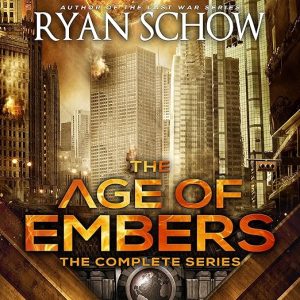
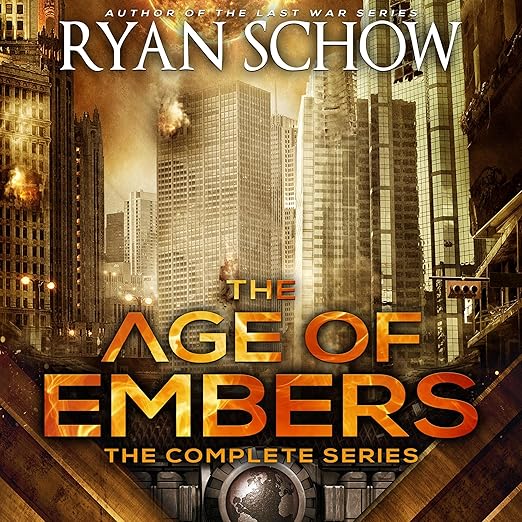
Forty-nine hours of post-apocalyptic fiction is a commitment, and I want to be honest about how I approached The Complete Age of Embers Series. I did not listen to all five books consecutively. I came at it in stretches, the way you might work through a long television series, two or three episodes at a time over several weeks. Ryan Schow is a prolific author with a substantial following in the post-apocalyptic genre, and understanding why requires spending enough time with his work to see the architecture beneath the action.
The EMP premise is familiar territory in post-apocalyptic fiction. An unexplained spasm of violence rocks the country, the grid goes down, infrastructure collapses, and several groups of survivors must navigate a nation in steep decline. What distinguishes Schow's approach is the multi-threaded ensemble structure. Rather than following a single protagonist through the collapse, the series tracks a burned-out DEA agent, a Guatemalan-born cartel daughter, and an estranged brother across intersecting storylines that gradually converge. The individual threads eventually merge into a single narrative, and watching the same scenes from different characters' perspectives is one of the series' more interesting structural choices.
The Verdict, Briefly
Schow's handling of the ensemble is genuinely ambitious for genre fiction of this type. The challenge with multi-protagonist survival fiction is maintaining reader investment in each thread while building toward convergence. Schow manages this more successfully than many comparable series. One reviewer who typically loses interest in long series between books four and eight specifically noted that quality does not drop here, which is a meaningful endorsement for a five-book arc.
The DEA agent protagonist has the strongest early chapters, partly because his professional background gives him a particular lens on the collapse that is both practically useful within the story and narratively interesting. The cartel daughter's arc takes longer to establish its emotional stakes but pays off in the later books when her background becomes central to the group's survival strategy. The estranged brother's thread is the most straightforwardly personal and serves as the series' emotional anchor across the full arc.
At forty-nine hours, the complete series is the natural format for this material. The individual books are not designed as fully self-contained stories. They are chapters in a continuous narrative, and the convergence that reviewers describe as one of the series' pleasures only registers if you are tracking multiple storylines across the full arc. Kevin Pierce's narration across all five books provides consistency that reinforces the sense of a single sustained work rather than a collection of separate installments.
Pierce is a veteran narrator with experience across multiple genre categories, and his steadiness across nearly fifty hours of material is the right choice for a series that requires the listener to maintain orientation across a large cast and multiple timelines. He does not dramatically differentiate voices to the point of caricature, which suits a series where the narrative voice carries as much weight as character dialogue.
What to Watch For in The Complete Age of Embers Series (Books 1-5)
One reviewer noted what they described as a tad too much character self-think, the internal monologue and self-analysis that can slow pacing in fiction where action is the primary currency. This is a fair observation, and listeners who find extended internal reflection interrupts momentum in action fiction should know it is present here. It is not fatal to the experience, and Schow uses those quieter moments to do character work that makes the action sequences matter more, but it is a genuine feature of his style rather than an occasional digression.
The series also contains strong violence and adult situations, as the publisher notes explicitly. This is not violence in service of shock; it is the functional consequence of an EMP collapse scenario that Schow renders with genuine attention to what civilizational breakdown actually means for ordinary people. But listeners with low tolerance for extended violence should approach with that expectation set.
Who Will Get the Most From It
Post-apocalyptic fiction readers who have burned through the major titles in the genre and are looking for a long, well-constructed series with a thoughtfully managed ensemble cast will find this excellent value. The fifty-hour commitment is substantial, but the series rewards it with genuine narrative payoff across the full arc rather than declining quality in later installments.
Listeners who prefer tightly contained single-novel post-apocalyptic fiction will find the series structure works against the kind of narrative closure they typically seek. This is unambiguously a long-form serialized story, and its pleasures are those of sustained investment rather than immediate resolution. If that is your mode, the Age of Embers series is among the better options in its category.
Frequently Asked Questions
How does Kevin Pierce handle the multiple protagonists across almost fifty hours of narration?
Pierce maintains consistency across the full arc without dramatically differentiating voices to the point of caricature. His approach suits a series where narrative voice carries as much weight as character dialogue, and his steadiness prevents listener disorientation across a large ensemble cast.
Does this series connect to Schow's Last War universe, and do I need to read those books first?
The Age of Embers series is set in the Last War universe and characters from each series overlap. However, the publisher and reviewers both note the two sagas can be enjoyed independently of each other, so prior familiarity with Last War is useful but not required.
How does the pacing hold across five books, and does quality drop in the later installments?
Multiple reviewers specifically note that quality holds across the full arc, which is unusual for a series this long. One reviewer who typically loses interest between books four and eight found this series maintained engagement throughout, crediting Schow's ability to keep multiple storylines interesting simultaneously.