Quick Take
- Narration: Simon Vance is a consistent performer in dark fantasy, and his ability to sustain tone across a nearly 44-hour boxset is a genuine asset for a trilogy that depends on atmospheric consistency.
- Themes: The return of forbidden magic, empire as corruption, the cost of knowledge
- Mood: Dark, methodical, and atmospheric, closer to Gothic thriller than high fantasy
- Verdict: A complete trilogy boxset that earns its length, particularly for listeners who want their fantasy mysteries to commit to genuine darkness.
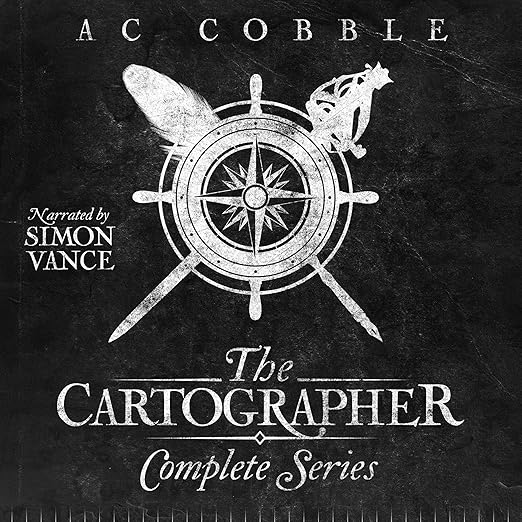
I started listening to The Cartographer on a Sunday afternoon with the expectation of a straightforward fantasy mystery, and by the time I reached the end of the first book I had substantially revised my expectations. AC Cobble writes with a particular kind of controlled darkness, not gratuitous, not grimdark in the contemporary fashion, but genuinely Gothic in the sense that the darkness has roots in specific human corruption rather than in the mechanics of an evil system. This boxset collects all three books in the Cartographer series, and at just under 44 hours it is a substantial commitment. It is also, for the right listener, a very satisfying one.
The world is Enhover, an empire whose power rests on commerce and colonization, and where sorcery was supposedly eradicated generations ago. Duke Oliver Wellesley, son of the king, adventurer, cartographer, is dispatched to investigate a heinous murder in a small village, the kind of case a duke would not normally handle personally. When evidence of occult ritual and human sacrifice turns up, the investigation widens from a local crime into something that reaches across the known world and eventually back to the center of the empire itself. His partner in the investigation is Samantha, an agent of the Church who has been trained by a priest-assassin for a battle with ultimate darkness that was supposed to be purely theoretical.
Our Take on The Cartographer
The comparison to Robert Jackson Bennett’s Divine Cities trilogy that appears in one review is apt, and it is useful framing for prospective listeners. Like Bennett’s series, The Cartographer is interested in how power corrupts institutions, how empires generate the conditions for their own collapse, and how individuals navigating those collapsing systems must make choices that are not cleanly moral. The mystery structure gives the series a propulsive quality that Bennett’s more meditative approach sometimes lacks, while the thematic ambition gives it more weight than a purely genre-mechanical thriller would carry.
What reviewers most consistently praise is the ending, specifically that the series has one that matches the quality of its setup. A reviewer who had found Cobble’s earlier series’ endings disappointing describes this as his best work specifically because the destination matches the journey. For a series of this length, that matters considerably. Nothing deflates a 44-hour investment faster than a third-act collapse.
Why Listen to The Cartographer
Simon Vance is one of the most reliable narrators working in fantasy and historical fiction, and his performance here reflects that reliability. He brings a measured authority to the investigation sequences and shifts register effectively between Oliver’s aristocratic nonchalance and the increasingly desperate stakes as the conspiracy deepens. At 44 hours across three books, maintaining tonal consistency is a significant challenge, and Vance manages it without the kind of performance drift that sometimes affects long narration projects.
The murder-mystery framework gives the series a structure that keeps the long-form storytelling organized. Each book advances the investigation while widening the scope of what is being investigated, which is a harder structural problem to solve than it looks. Cobble handles it by keeping the specific mystery of each volume solvable, you get resolution at the end of each book even as the larger conspiracy remains open, which gives the audiobook experience a satisfying rhythm.
What to Watch For in The Cartographer
One reviewer found the world-building somewhat lacking relative to the strength of the plot, interesting enough, but not developed to the depth that the story’s ambition seems to call for. This is fair criticism. Enhover as a setting is functional rather than fully realized; the empire’s colonial structures are referenced more than they are examined, and the magic system is deliberately opaque in ways that are thematically appropriate but sometimes feel like shortcuts. Listeners who prioritize deep world-building over plotting may find the balance slightly off.
The grunting that one reviewer found excessive is a stylistic habit in Cobble’s prose that several readers have noticed. It is a small thing, and it does not undermine the reading, but Vance has to deliver it consistently across 44 hours, which does occasionally become noticeable.
Who Should Listen to The Cartographer
Frequently Asked Questions
Is this the complete Cartographer trilogy, and does the story have a conclusive ending?
Yes to both. The boxset contains all three books in the series, and reviewers specifically praise the ending as matching the quality of the setup, a notable achievement for a trilogy of this length.
How does Simon Vance handle the near-44-hour narration without performance drift?
With the consistency that characterizes his best work. His tonal register stays coherent across all three volumes, and his differentiation between Oliver’s upper-class nonchalance and the darker register of the sorcery investigation holds throughout.
Is prior knowledge of AC Cobble’s other series necessary before starting The Cartographer?
No. The Cartographer series is set in a different world with different characters and requires no knowledge of Cobble’s other work. Several reviewers discovered Cobble through this series.
How closely does the mystery structure hold across all three books, or does the series drift into pure fantasy in the later volumes?
The mystery structure remains central throughout, with each book following the investigation of specific crimes while the larger conspiracy expands. It does not drift into standard high fantasy, the Gothic thriller register and the investigation framework stay consistent.