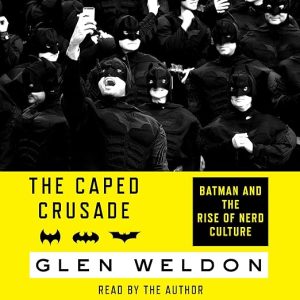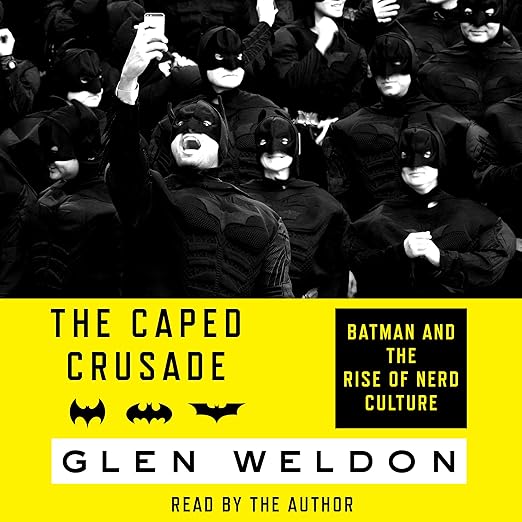
Glen Weldon narrates his own audiobook The Caped Crusade, and that choice alone is one of its strengths. Weldon is an NPR contributor and longtime book critic, and the combination of his prose and his voice produces something that feels less like a conventional listening experience and more like an extended, erudite conversation with the most interesting person at the party. Batman, it turns out, is the ideal vehicle for examining American identity, anxieties, and the persistent tension between taking things seriously and having fun with them. The runtime is 9 hours and 26 minutes, and it passes faster than most audiobooks half its length.
The synopsis calls this a chronicle of Batman's rises and falls, and that is accurate as far as it goes. But what the description undersells is how much of the book is really about fandom itself, specifically the pitched cultural war between what Weldon calls nerds and normals. The nerd, in Weldon's framing, is someone who takes ownership of a cultural property, who feels personally wounded when Hollywood or a TV executive makes Batman camp rather than grim, and who has built a significant portion of their identity around a fictional character. That is a potentially unflattering portrait, and Weldon is unflinching in pointing it out, but he includes himself in the indictment, which makes the whole thing generous rather than condescending.
Weldon's central argument is that Batman's endurance comes precisely from his endless adaptability. From Bob Kane and Bill Finger's original hyphenated detective in Detective Comics #27 to the Adam West camp sensation of the 1960s to Christopher Nolan's post-9/11 Dark Knight, each iteration reflects something specific about the cultural moment that produced it. Weldon is particularly sharp on the Adam West era, long dismissed by self-serious Bat-fans as an embarrassment, and his rehabilitation of the campy double entendres and blithe homoerotic subtext as legitimate creative choices is one of the book's genuine intellectual pleasures. The Washington Post called this a colorfully rendered magical history tour, and that captures the tone: nostalgic in the best sense, rendering the past with genuine affection while refusing to let it off the hook. The cultural analysis spans from the 1930s origins through to recent adaptations, and Weldon traces not just what changed in Batman's depiction but why, connecting each reinvention to the social anxieties and popular appetites of its era. The result is a book that doubles as an American cultural history told through a single fictional figure.
Why The Caped Crusade Works as an Audiobook
The case for the audiobook format here is strong and specific. Weldon narrates with the timing of someone who has spent years on radio, his jokes hit their marks cleanly, his pauses are deliberate, and his enthusiasm for the material is unmistakably real. One reviewer called it the only audiobook he had ever gotten all the way through on a gym treadmill, and that rings true: the prose has a rhythm that rewards sustained listening rather than skimming. The nine-and-a-half-hour runtime passes quickly because Weldon structures the book chronologically and each chapter brings a genuinely different version of Batman into focus, meaning the material refreshes itself regularly. If you have read a lot of pop culture criticism that dresses up enthusiasm as analysis, Weldon's book is a useful corrective, the research is exhaustively thorough without ever feeling pedantic. The audiobook also benefits from Weldon's ability to modulate his register, moving between analytical close reading and affectionate fandom without the seams showing. That tonal flexibility is what keeps 9 hours and 26 minutes of cultural criticism from ever feeling like a lecture.
Weak Spots in The Caped Crusade
Readers who come expecting a plot-by-plot breakdown of Batman's comic book canon may find themselves adjusting expectations. As one reviewer notes, the book does not really dig into the actual content of comics storylines the way a fan-wiki does, it is a cultural history, not a reader's guide. The focus is consistently on reception: how audiences and critics responded to each iteration of Batman and what that response reveals. This is a strength, not a weakness, but if you want panel-by-panel analysis of the Dark Knight Returns or a comprehensive breakdown of the Knightfall storyline, look elsewhere. The new afterword, added for this edition, extends the analysis through more recent Batman material, which is welcome, the Nolan trilogy naturally loomed large when the book was first published, and the afterword gives Weldon space to place it more firmly in the larger arc. Weldon is also candid about the limits of his own investment, there are Batman eras he finds less compelling, and he says so, which makes the book feel like a critical perspective rather than an encyclopedic survey of equal enthusiasm for everything.
The Right Listener for The Caped Crusade
This audiobook works well for two different audiences that do not always overlap. If you are a Batman enthusiast who has strong feelings about whether the 1966 TV show was a betrayal or a legitimate interpretation, Weldon will give you the most sophisticated framework you have encountered for thinking through that argument. If you are a cultural studies reader with only passing familiarity with Batman, the book holds up entirely as an examination of how fan communities form around intellectual property and how those communities shape the IP in return. Where it may test patience is with listeners who want their criticism without the jokes, Weldon is consistently funny, which is a feature, but it does mean the tone stays lighter than pure academic criticism. Booklist described this as possibly the most erudite and well-researched fanboy manifesto ever written, and that assessment is accurate and affectionate, not dismissive. The Caped Crusade earns its reputation, and Weldon narrating his own work pushes it further still. The book also works for anyone who has experienced the specific frustration of watching a beloved cultural property get adapted in ways that feel wrong, Weldon is extraordinarily good at articulating why those feelings are real and what they reveal about the relationship between audiences and the stories they claim.
In Brief
- Voice: Glen Weldon narrates his own work with the dry wit and NPR-trained precision you would expect from a veteran culture critic, every punch line lands exactly where he intends it.
- Big ideas: Pop culture identity, nerd subculture vs. mainstream reception, the mythology of the superhero
- Atmosphere: Sharp, funny, and unexpectedly scholarly
- Worth it?: Anyone who has ever argued about Batman with another fan owes themselves this audiobook, Weldon arms you for every argument and dismantles a few you thought you had won.
Does the audiobook version of The Caped Crusade add anything over reading the print edition?
Substantially. Weldon has a background in radio and his timing is part of what makes the jokes work, reading the same prose silently loses some of that precision. The 9 hours and 26 minutes move faster than expected because his narration keeps the energy consistent throughout.
Do I need to be a hardcore Batman fan to get value from this audiobook?
No. Weldon's frame is cultural history and fan psychology rather than comic book continuity. Listeners with only casual familiarity with Batman, the films, the TV show, will follow everything without difficulty.
Does the new afterword in this edition cover more recent Batman films and comics?
Yes. The afterword extends the analysis beyond where the original edition ended, addressing more recent material and giving Weldon space to contextualize the Nolan trilogy more fully within the longer cultural arc he traces.