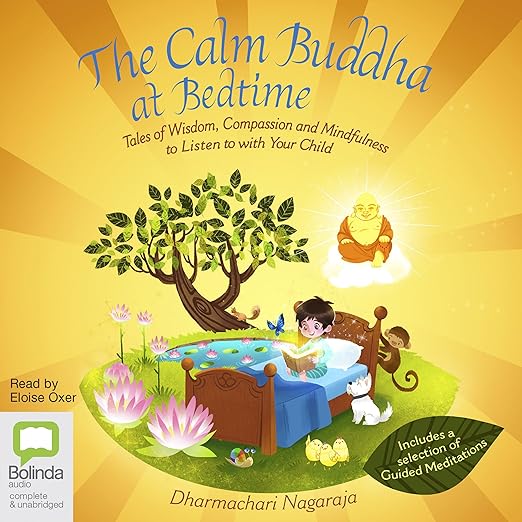
Quick Take
- Narration: Eloise Oxer’s voice is gentle and unhurried, well-suited to a bedtime listening context, with enough warmth to carry the compassion-focused stories without sentimentality.
- Themes: Mindfulness, friendship, compassion, facing adversity honestly
- Mood: Calming and imaginative, with a quiet moral undercurrent
- Verdict: A genuinely useful audiobook for parents who want bedtime listening to carry real ethical content, not just soporific narrative.
I came to this one late on a weeknight, putting it on partly as a test and partly because I was tired enough to want something that would not demand concentration. By the time Percy the ostrich’s friendship story was underway, I had forgotten I was reviewing and was simply listening. That is probably the right response to The Calm Buddha at Bedtime, and it is a response that Dharmachari Nagaraja has clearly worked to engineer.
This is the third volume in the At Bedtime series, and the concept is elegant in its simplicity: short narrative fables drawn from Buddhist ethical teaching, each designed to illustrate a specific principle while remaining fully accessible to children who have no Buddhist background at all. The stories work because they are genuinely good stories first and ethical instruction second.
The Percy and Marina Stories as Ethical Architecture
The synopsis highlights two of the book’s central stories: Percy the ostrich and Kevin the snail, which explores the nature of friendship, and Marina the mermaid and the golden shell, which focuses on meeting adversity with honesty and compassion. These are not generic fable templates. Nagaraja has thought carefully about what makes a story illustrate its principle rather than merely assert it, and the narratives function through the specific choices characters make rather than through stated morals.
Percy’s story is particularly well-constructed. The friendship theme is approached through conflict and misunderstanding rather than simple harmony, which gives young listeners a framework for their own friendship difficulties rather than just an idealized portrait of what friendship should look like. The Buddhist concept of compassion as active practice, rather than passive feeling, runs through both stories in ways that children can intuit even without the conceptual language to name it.
Buddhism for Children Without Barriers to Entry
One reviewer’s daughter had been requesting this book nightly since age three and a half, and another’s ten-year-old granddaughter had been listening to these stories since babyhood. That intergenerational durability is not accidental. Nagaraja’s approach to Buddhist wisdom is accessible rather than doctrinal: the Four Noble Truths are introduced briefly as context, but the stories do not require belief in or knowledge of Buddhist tradition. They work as universal ethical fables for any child regardless of family religious background.
This matters for the audiobook format specifically. Parents who might hesitate to read their child a book with explicit Buddhist framing can approach this as a collection of character-building fables, because that is genuinely what it is. The Buddhist context enriches rather than gates the content.
Eloise Oxer’s Bedtime Calibration
Eloise Oxer’s narration is the right choice for this material in ways that only become clear when you consider what the wrong choice would have been. A more animated or characterful narrator would have made this an engaging daytime listen and a poor bedtime one. Oxer reads at a pace and pitch designed to support the body’s natural movement toward sleep, with enough vocal warmth to carry the emotional content of each story. At nearly three hours, this is longer than most bedtime listening sessions will last in a single sitting, which is actually an advantage: it is material that can be returned to across many evenings rather than consumed once and set aside.
Who Should Listen and What to Expect
This audiobook is well-suited to children aged three through ten, with the stories retaining appeal across that range due to the layered quality of Nagaraja’s fables. Younger children will respond to the characters and narrative; older children will begin to engage with the ethical questions more consciously. Families who want to build a mindfulness or contemplative practice into bedtime routine without the barriers of formal meditation instruction will find this a genuinely useful resource.
Frequently Asked Questions
Is The Calm Buddha at Bedtime suitable for children from non-Buddhist families?
Yes. Nagaraja’s approach treats Buddhist wisdom as a source of universal ethical fables rather than as doctrine, and the stories work for children regardless of family religious background. The Buddhist context is present but never restrictive.
Does Eloise Oxer’s narration style suit the bedtime format specifically?
Yes, more so than many narrators who might be assigned to children’s collections. Oxer reads with the calm, unhurried pace that supports a child’s transition toward sleep, which is precisely what the material requires.
How does this third volume in the At Bedtime series compare to the earlier books?
Reviewers who have encountered multiple volumes consistently recommend starting anywhere in the series, as each volume is self-contained. This third volume has drawn particularly enthusiastic responses, with several listeners describing it as their favorite of the three.
Is the three-hour runtime practical for actual bedtime use?
The length works in the book’s favor rather than against it. Most families will not complete three hours in a single sitting, but the short-story format means listeners can stop anywhere without narrative disappointment, and the material has enough variety to sustain interest across multiple evenings.