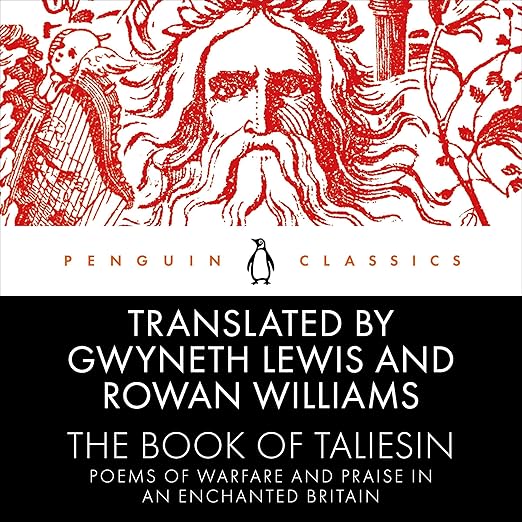
Quick Take
- Narration: David Sibley, best known for Henry V and War and Peace, brings scholarly weight and genuine lyrical instinct to ancient Welsh verse.
- Themes: Bardic identity, warfare and elegy, myth at the border of history and legend
- Mood: Ancient and ceremonial, demanding but quietly exhilarating
- Verdict: The Lewis and Williams translation makes these seventh-century Welsh poems genuinely accessible, and Sibley’s performance is the ideal delivery for listeners new to early British verse.
Poetry in audio is a gamble. Get the narrator wrong and what should be incantatory becomes merely loud. Get it right, and the form comes alive in ways that a silent reading on the page cannot always produce. I came to The Book of Taliesin audiobook with some wariness, having had mixed experiences with recorded poetry collections, and was surprised by how quickly David Sibley’s voice oriented me inside the material.
The Book of Taliesin is one of the most important texts in Welsh literature and, depending on which scholars you trust, one of the foundational documents of the entire British poetic tradition. Robert Graves’s claim that Taliesin represents the root of all English poetry is linguistically overclaiming, as a reviewer with a PhD in the subject notes, but it gestures at something real about the centrality of this tradition. The poems gathered here span centuries of composition and accumulated mythology around a single legendary figure: a poet, shapeshifter, seer, and chronicler of battles.
Our Take on The Book of Taliesin
The Penguin Classics edition translated by Gwyneth Lewis and Rowan Williams is the first complete English gathering of The Book of Taliesin since 1915, which itself marks it as an event in the literary history of British poetry. Lewis and Williams bring different skills to the project: Lewis is a poet in both Welsh and English, Williams is a theologian and literary scholar, and the combination produces a translation that is artfully accessible without dumbing down the strangeness of the source material.
That strangeness is worth emphasizing. These are not gentle pastoral verses. They are praise poems, battle elegies, cosmic boasts, and shapeshifter riddles that sit somewhere between oral performance and written artifact. The editing hands of thirteen centuries of anonymous copyists are layered into the text. What emerges is genuinely wild, and the translation does not sand those edges smooth.
Why Listen to The Book of Taliesin
Sibley’s narration is the decisive argument for choosing audio over the printed edition for a first encounter with this material. He has the experience to understand that poetry of this kind requires air, not pace. He lets lines settle before moving forward, handles the repetitions and catalogues of names without turning them into monotone lists, and brings a vocal physicality to the battle poems that makes their boastful aggression land as intended.
The translation’s introduction, read as part of the recording, is valuable context. Lewis and Williams explain the manuscript history, the legendary biography of Taliesin, and the challenges of translating a tradition that slips between documented history and mythological elaboration without ever stabilizing into one or the other. Listening to that introduction before the poems themselves orients you properly.
What to Watch For in The Book of Taliesin
One reviewer, clearly approaching from a Pagan or Druidic perspective, found the translation overly Christianized and incorrect in several places. That is a legitimate concern. Lewis and Williams bring their own interpretive frameworks to the text, and Williams’s theological background influences certain choices. Readers looking for a scholarly apparatus that addresses competing interpretations should seek out Marged Haycock’s annotated translation alongside this one. What the Lewis-Williams version offers is accessibility and literary pleasure; what it does not offer is the definitive scholarly edition.
The poems themselves resist the kind of passive listening you might apply to a novel or even a nonfiction audiobook. They reward attention and repetition. This is a recording you will want to revisit.
Who Should Listen to The Book of Taliesin
Readers with an interest in Celtic mythology, early British literary history, Arthurian legend sources, Druidic tradition, or the roots of Welsh poetic practice will find this an essential listen. Poets who want contact with a tradition that predates and runs alongside the classical Greek and Latin influences that dominate most Anglo-American literary education should move this up their queue. Casual audiobook listeners looking for accessible narrative content may find the form demanding. This is genuinely ancient verse, and it asks something of you.
Frequently Asked Questions
Do I need any background in Welsh mythology or medieval literature to appreciate this audiobook?
Not strictly, but some curiosity about the material helps. The introduction read by David Sibley provides useful context, and Lewis and Williams’s translation is designed for general readers. Listeners with prior interest in Celtic myth or Arthurian legend will find the density more rewarding than those approaching cold.
How does the Lewis and Williams translation compare to more scholarly editions of Taliesin?
It is more accessible and literarily alive than Marged Haycock’s formidable annotated scholarly edition, which is the standard academic reference. Lewis and Williams prioritize readability and poetic resonance. For serious academic study you need both; for a first encounter, this translation is the right starting point.
Is this audiobook appropriate for listeners with a Pagan or Druidic practice?
With caveats. One reviewer from that tradition found the translation overly Christianized, which reflects Williams’s theological background shaping certain interpretive choices. It remains a rich resource for Druidic study, as another reviewer confirms, but scholars from that tradition may want to compare it against alternative translations.
How long is the audiobook and does the poetry format work well over that duration?
It runs 6 hours and 16 minutes. Poetry in audio rewards pausing and replaying more than prose, so the runtime is best treated as approximate. Sibley’s narration is unhurried in a way that suits returning to specific poems rather than listening straight through in a single session.