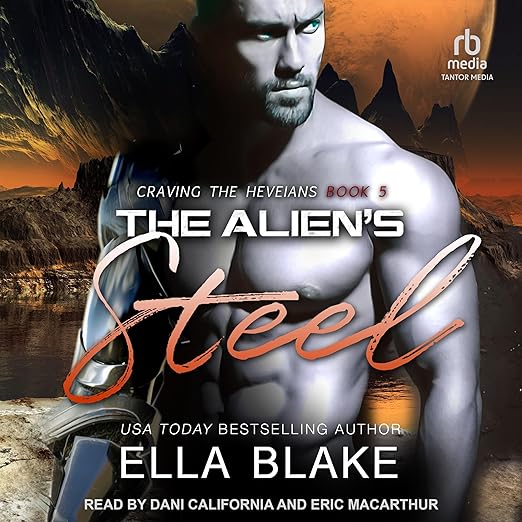
Quick Take
- Narration: Dani California handles the dual-POV structure with warmth and conviction, giving both Claire and Craal distinctly sympathetic interior voices.
- Themes: Memory and selfhood, age-gap love treated as genuine rather than transgressive, healing through connection across difference
- Mood: Adventure-forward with a warm romantic core and emotional stakes that feel earned
- Verdict: A fifth-in-series alien romance that does the unexpected by centering a middle-aged heroine, and makes that choice feel essential to everything the story is trying to do.
I came to The Alien’s Steel knowing it was book five of Ella Blake’s Craving the Heveians series, and knowing that the character of Craal had appeared in earlier books as a mute, traumatized prisoner rather than a functioning protagonist. I’ll be honest: I did not expect to find myself as thoroughly invested as I was by chapter three. Something about the specificity of Claire’s situation, a doctor in her late forties who has spent months helping a recovering cyborg alien rebuild his mind and sense of self, and who is now trying to maintain professional boundaries while that work creates genuine intimacy, cut through my genre skepticism in a way I wasn’t anticipating.
Alien romance as a genre is broader and more varied than its reputation suggests, and the better examples tend to find their resonance not in the exoticism of the alien but in the human emotional truth the alien allows the author to access from an unfamiliar angle. This book earns its place in that more interesting subset of the genre. The alien setting is doing real work here rather than serving as fantasy costume.
Craal’s Memory and What It Costs Him to Find It
The book’s central premise builds around Craal’s fragmented identity: he was turned into a weapon against his own people, his sense of self stripped systematically through experimentation, and his long rehabilitation under Claire’s medical oversight has been gradual and incomplete rather than clean or triumphant. When the two of them travel to the village of his youth to reconnect with his family, his recovered memories don’t match what they find there, and the gap between what he remembers and what is actually true becomes the engine of the book’s mystery plot.
Blake handles the amnesia premise with more care than the genre typically demands. Craal’s uncertainty about his own past isn’t deployed purely as a plot mechanism for suspense; it’s an ongoing emotional state that shapes how he relates to Claire, to his sense of his own people, and to his understanding of what was done to him and why. One reviewer described him as a character who had taken a long road through experimentation, lost memories, and lost limbs to become the person he was slowly recovering, and that accumulation of suffering and recovery is what makes the relationship with Claire feel earned rather than merely convenient. He has something specific to offer her precisely because of what he’s been through, and the reverse is equally true.
Claire and the Choice Blake Makes That Changes Everything
The book’s most consequential decision is making Claire a 47-year-old scientist rather than a younger woman in the usual romance protagonist mold. One reviewer was honest about starting the book skeptical of this choice and ending it genuinely converted, which mirrors my own experience closely enough to warrant direct acknowledgment. Blake doesn’t sentimentalize the age question or deploy it as a source of conflict between the characters; she treats Claire’s maturity as a resource rather than a liability, as the source of her patience, her professional discipline, and ultimately her capacity for a kind of courage that younger characters often lack because they haven’t yet been tested in the same ways.
The romance that develops between Claire and Craal is persuasive partly because both characters have enough specific history to have something real to offer each other rather than the blank-slate emotional availability that younger protagonists bring to genre romance by default. Claire knows exactly what she’s risking by crossing the professional line she’s maintained carefully, and she makes her choice with open eyes. Craal understands what his feelings for her mean in the context of a culture and a selfhood he’s still reconstructing. Neither of them is operating from fantasy; they’re operating from genuine knowledge of each other.
The Mystery Underneath the Romance
The pulsing sound that gives Claire persistent headaches, the zombie-like behavior of Craal’s village inhabitants, the abandoned mines, and the weapon the antagonist UCP has deployed are the thriller mechanics that keep The Alien’s Steel from being purely a character study. The mystery has a resolution that reviewers consistently praised as genuinely surprising while retroactively coherent, which is the mark of good genre plotting: you didn’t see it coming but it makes complete sense in retrospect. Without spoiling the specific reveal, Claire’s professional expertise plays a central role in figuring out what has happened, which is satisfying because it means her identity as a scientist rather than a fighter is the key rather than an obstacle to be overcome.
The UCP as a recurring antagonist across the Craving the Heveians series carries specific menace that serves a returning reader well while remaining functional for a newcomer. The conspiracy is sketched in enough detail to generate stakes without requiring extensive series history to understand, which is the right balance for a book that can reasonably be read as a first point of entry to the universe.
Dani California and the Dual-POV Structure
The book alternates between Claire and Craal’s first-person perspectives, which means the narrator has to make two very different interior voices credible and distinct without the separation becoming a performance of contrast. Dani California manages this with an approach that emphasizes emotional temperature rather than vocal architecture: Claire’s sections carry the quality of controlled professional assessment that is frequently and increasingly pierced by something warmer she’d prefer not to name; Craal’s sections have a directness and physicality that reflects his recovering warrior’s body and his still-forming sense of who he is becoming rather than who he was.
At under six hours, this is a compact listen that doesn’t overstay its premise. Blake moves through her mystery and her romance with enough efficiency that neither element feels crowded or underdeveloped, and the ending, described by at least one reviewer as the most beautiful possible resolution for a love story given what these two characters have been through, delivers on the emotional setup the book has carefully constructed. The compact length is an asset rather than a limitation: this is a story that knows exactly how much space it needs.
Frequently Asked Questions
Does The Alien’s Steel work as a standalone or does it require familiarity with the earlier Craving the Heveians books?
Blake provides enough context for new readers to follow the story and care about the characters. Claire is a new protagonist rather than a returning one. However, Craal’s history and the UCP’s role carry additional weight if you’ve encountered the earlier volumes, particularly book three where Craal first appears as a prisoner.
Is the age-gap romance between Claire and Craal a source of tension or conflict, or does the book treat it as straightforward?
The doctor-patient professional boundary is treated with real ethical seriousness, and Claire’s age is addressed directly rather than avoided. Blake frames her maturity as a strength of the relationship, which is an unusual and effective choice that distinguishes this from more generic romance novel treatments of the same dynamic.
Does Dani California’s dual-POV narration keep Claire and Craal’s perspectives distinct enough to follow easily?
Yes. California uses emotional register and vocal texture rather than dramatic differentiation to distinguish the two perspectives, and the chapters are clearly attributed in a way that makes tracking straightforward even for listeners unfamiliar with the series.
Is the mystery element of the story as developed as the romance, or does the thriller premise take a back seat?
Both elements receive serious development. The mystery has a genuinely surprising resolution that reviewers consistently praised, and it gives Claire a heroic role grounded in her scientific expertise rather than requiring her to operate outside her established competence.