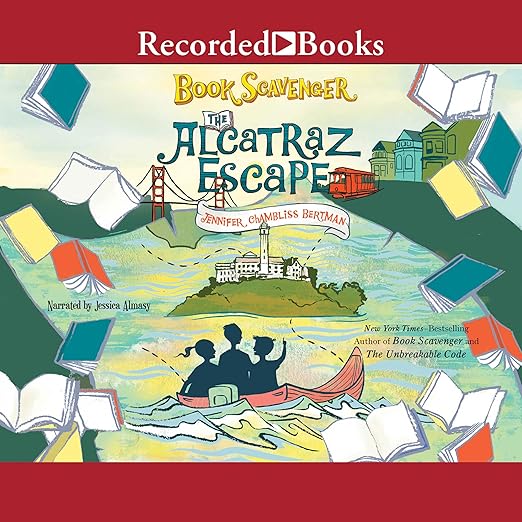
Alcatraz Island as a setting for a middle-grade mystery is an almost unfairly good choice. The real place carries the weight of its own legend: escape attempts, isolation, the cold water of San Francisco Bay. Jennifer Chambliss Bertman uses all of that in The Alcatraz Escape, the third installment in the Book Scavenger series, and she uses it with enough restraint that the history stays atmospheric rather than overwhelming the puzzle at the center. The audiobook brings narrator Jessica Almasy back to continue Emily and James's adventures, and within the first few minutes you remember why this pairing works. Almasy has logged enough hours with these characters across the series that her Emily feels genuinely inhabited.
The setup is elegant by design. Legendary literary game maker Garrison Griswold returns with an event called Unlock the Rock, a game staged across the island. When items from the game begin disappearing and Emily's brother Matthew is framed as the culprit, the stakes become personal in a way that lifts the mystery above simple puzzle mechanics. This is the tension the Book Scavenger series has always managed well: intellectual games that become emotionally urgent because people you care about are implicated. The Alcatraz Escape delivers that structure with practiced confidence across a runtime of 5 hours and 35 minutes.
Two Timelines Run in Genuine Parallel
Bertman's choice to weave in a 19th century mystery involving Harriet Beecher Stowe is the most interesting structural decision in the book. It asks middle-grade readers to hold two timelines in parallel, connecting present-day thievery to a historical tragedy in a way that requires genuine intellectual engagement. That's ambitious for the genre, and it mostly works. The Stowe thread gives the book a dimension that prevents it from feeling like a standard sequel and opens up genuinely interesting material about history, authorship, and what gets remembered or forgotten by literary culture across generations.
Reviewers note that this book works best for readers who have read the previous two entries in the series. One reviewer who gifted it to a ten-year-old granddaughter observed that the prior books were necessary context. That's an honest assessment. The relationships between Emily, James, Matthew, and Griswold are built across the series, and the emotional weight of Matthew's predicament requires that investment to land fully. As a standalone, the Alcatraz setting and puzzle mechanics still carry significant appeal, but the personal stakes resonate considerably harder with the series context in place.
Almasy's Emily Balances Intelligence and Exasperation
Jessica Almasy's narration for this audiobook is one of its consistent pleasures. She handles the shift between Alcatraz's spooky history and the puzzle-solving urgency with real skill, and her voice for Emily carries the right combination of determined intelligence and occasional exasperation that makes the character likable without making her a saint. The 5-hour-35-minute runtime is well-paced for the material. This is a book that works especially well as a family listen on long car journeys, because Almasy keeps the rhythm moving and the clues land with satisfying clarity in audio form.
The educational layer is worth noting for parents and teachers. The historical mystery surrounding Harriet Beecher Stowe is not decorative. Bertman uses it to introduce her young readers to the author of Uncle Tom's Cabin, to 19th century publishing culture, and to questions about legacy and attribution. For families who want entertainment that also opens windows onto literary history, this audiobook does that work without feeling didactic. One reviewer compared the experience favorably to the Mr. Lemoncello's Library series, which is a reasonable reference point for fans of puzzle-forward middle-grade fiction.
A 4.8 Across 641 Reviews Is a Real Signal
The mystery's resolution requires keeping track of several parallel threads simultaneously, and some younger listeners may find the Harriet Beecher Stowe historical component slightly demanding. Bertman trusts her readers with complexity, which is generally admirable, but the dual-timeline structure is more elaborate here than in the earlier books in the series. Almasy's narration helps considerably by maintaining clear tonal distinctions between present-day scenes and historical material, but parents listening with younger children should be prepared to field some questions along the way.
The ending has been described by reviewers as a satisfying close to the trilogy, and for readers who have followed the series, the resolution of Matthew's situation and the Griswold plotline delivers on its promises. The book holds a 4.8 rating across 641 reviews, which is an unusually strong signal for middle-grade fiction. That rating reflects both quality and the loyalty of a readership that has followed these characters through three books. The series does not overstay its welcome, and The Alcatraz Escape serves as a confident conclusion to a story worth following.
A Family Audiobook for Long Car Trips
The ideal listener is a child aged eight to twelve who has read or listened to the first two Book Scavenger books and is ready for a more historically layered adventure. It also works as a family audiobook for long car trips, where the puzzle structure gives everyone something to track and Almasy's narration keeps the energy consistent. Adults accompanying younger listeners will find the Harriet Beecher Stowe thread genuinely interesting on its own terms. First-time listeners to the series will still enjoy the Alcatraz setting and game mechanics but will get significantly more out of the emotional arc with the series context in place. It is the kind of middle-grade audiobook that parents find themselves following as closely as their children do.
Key Details
- Performance: Jessica Almasy brings the right energy to Emily and James, calibrating nicely between the puzzle-solving excitement and the emotional stakes of Matthew's situation.
- What it covers: Literary mystery-solving, friendship under pressure, historical detection
- Feel: Fast-paced and puzzle-dense, with a satisfying sense of place
- Our call: The third Book Scavenger installment holds up, with Alcatraz Island and a Harriet Beecher Stowe thread giving it historical texture the earlier books couldn't match.