Quick Take
- Narration: Brianna Bronte handles the tonal range of paranormal romance confidently, bringing warmth to the tenderness and appropriate charge to the more intense passages.
- Themes: Enemies to lovers under threat, genetic identity and freedom, loyalty versus mission
- Mood: Intense and sensual, with genuine stakes underneath the romance
- Verdict: A strong Breeds entry that readers can follow without the full series history, though series loyalists will get more from the accumulated character context.
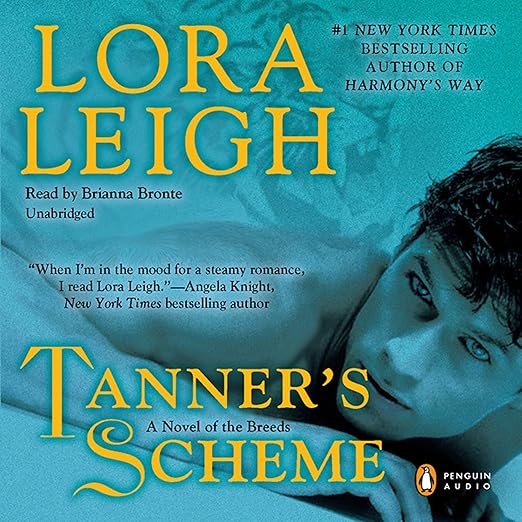
A listener wrote to me asking which entry point she could use to sample Lora Leigh’s Breeds series without committing to seven books of backstory before getting to a character she found interesting. I told her I would get to it. Tanner’s Scheme turned out to be the answer I should have given her immediately. While it is technically book eight in A Novel of the Breeds, it functions with enough internal completeness that new readers are not left confused, even if they miss some of the resonances that series veterans will pick up.
The Breeds series is built on a premise that sits at the intersection of science fiction romance and paranormal romance: genetically engineered human-animal hybrids, created by a shadowy organization called the Genetics Council and then hunted by it, are fighting for survival and recognition in a world that does not know how to categorize them. The world-building is more substantive than typical paranormal romance, with ongoing political stakes and an organizational villain that provides continuity across the series. Tanner’s Scheme focuses on Tanner Reynolds, one of only two Bengal tiger Breeds, who kidnaps Scheme Tallant as an act of revenge against her father, a high-ranking Council member. When Tanner discovers that Scheme is herself a target of her father’s ruthless agenda, the dynamic shifts from captor and captive to something considerably more complicated.
The Kidnapping Trope and What Leigh Does With It
The kidnapping setup is a well-worn convention in paranormal and dark romance, and how an author handles the power imbalance it creates tells you a great deal about their priorities. Leigh’s approach is to complicate the dynamic quickly and through plot causation rather than romantic convenience. Scheme is not a passive captive. She is intelligent, morally compromised in her own ways, and carrying secrets that change Tanner’s calculations significantly once he learns them. The shift from vengeance to protection happens because Tanner learns something that genuinely alters the situation, not simply because the romantic premise requires proximity to produce attraction.
One reviewer described Tanner as a resident Breed playboy with perfect camouflage for his real self, a man unwillingly yearning for a mate. That characterization is accurate, and it is the emotional engine of the book. Leigh is consistent across the series in her interest in characters who perform one version of themselves publicly while privately needing something quite different. Tanner’s playboy persona and his underlying seriousness create a tension that Scheme’s situation eventually resolves in ways the book earns.
Brianna Bronte’s Performance
Twelve hours of paranormal romance requires a narrator who can manage both the emotional intensity of the romantic content and the action-oriented plot passages without flattening either into a single undifferentiated register. Bronte achieves this. Her handling of the more explicit scenes is confident rather than clinical or overperformed, which is the register paranormal romance requires to work. Her Tanner and Scheme are clearly distinct voices, and she conveys the shift in their dynamic as the novel progresses through the various complications Leigh introduces.
The Bengal breed elements, the physical description, the feline qualities woven into Tanner’s behavior and instincts, are handled without self-consciousness. The world-building exposition that Leigh needs to deliver for new readers is absorbed into the narrative rather than delivered as information dumps, which speaks to how the series has developed its internal conventions across eight books.
Series Context Versus Standalone Quality
The honest assessment is that familiarity with the earlier Breeds novels adds to the experience in meaningful ways. The Genetics Council as a villain has more weight if you have seen its operations across multiple books and watched it pursue Breeds through earlier installments. The significance of Tanner’s Bengal breed status, shared only with Cabal, lands with more force if you know why Bengal Breeds are so rare in this world. But Leigh also provides enough information within this volume that new listeners are not lost. The emotional core of the novel, Tanner and Scheme’s specific situation and the nature of their connection, is fully self-contained and does not require outside knowledge to invest in.
One series reviewer noted that Leigh finds a way to make every story new while forwarding the Breed history in a way that keeps each installment satisfying on its own terms. That is a genuine technical achievement across a series of this length, and it is part of why Tanner’s Scheme works even for relatively new readers who stumble into the series at book eight.
Who the Breeds Series Is For
Recommended for listeners who enjoy paranormal romance with science fiction world-building elements, and for readers of Leigh’s other work looking to sample the Breeds series. Available as a free audiobook through Audible membership. Approach with awareness that the explicit content is genuine rather than implied. If you prefer romance without significant heat, this is not the right entry point for the series.
Frequently Asked Questions
Does Tanner’s Scheme work as an entry point to the Breeds series, or is prior series knowledge required?
It functions as a readable standalone. New listeners will understand the central conflict and relationship without the full series history, though familiarity with earlier books adds depth to the world-building and character references throughout.
How explicit is the romantic content, and does Brianna Bronte’s narration handle it well?
The content is explicit in keeping with Lora Leigh’s established style in the Breeds series. Bronte handles it without affectation or excessive dramatization, which is the appropriate approach for this kind of material.
What makes the Bengal breed element significant within the series, and does it matter for this specific book?
The rarity of Bengal breeds within the Breeds world is a plot element in multiple books. In Tanner’s Scheme it is relevant to his dynamic with Cabal. New readers will get enough context from this volume, but the significance deepens considerably if you know the broader series history.
Is the enemies-to-lovers dynamic in Tanner’s Scheme handled with enough plot justification, or does it rely primarily on romantic convention?
It is plot-justified. The shift in Tanner’s approach to Scheme happens because he discovers information that genuinely changes the situation, not simply because the romance requires proximity to produce attraction. Leigh grounds the dynamic shift in character revelation rather than convenience.