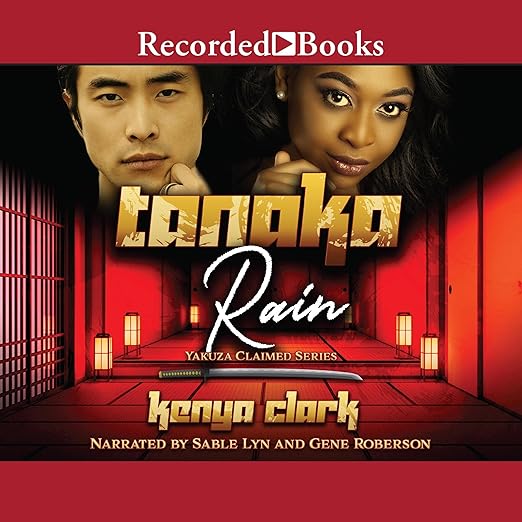
Quick Take
- Narration: Sable Lyn delivers a warm, emotionally invested performance that suits the intimate scale of the story, handling both Ebony’s vulnerability and Rain’s quiet intensity with care.
- Themes: Multicultural romance, class mobility, loyalty under pressure
- Mood: Urgent and romantic, with a noir undercurrent
- Verdict: A compact multicultural romance with genuine heat and a protagonist worth rooting for, though readers who prioritize polished prose should know the editing gaps are real.
I listened to Tanaka Rain on a Friday evening when I wanted something short and self-contained, the kind of story that wraps up before midnight and leaves you feeling like you spent time with people who actually matter to each other. At four and a half hours, Kenya Clark’s novel is lean in a way that forces every scene to carry weight. By the time I’d finished my second cup of tea, Ebony Drake and Rain Tanaka had gotten under my skin in ways I wasn’t fully expecting.
What drew me in immediately was the setup’s honesty. Ebony isn’t escaping a bad relationship or running from a breakup. She’s escaping her mother’s addiction, the gravitational pull of poverty, and a life that has told her, repeatedly, that she doesn’t deserve better. That’s a harder thing to write and a harder thing to narrate, it requires the character to be both wounded and actively moving, and Clark manages that balance more often than not.
Our Take on Tanaka Rain
This is a multicultural romance that takes its cultural specificity seriously. Rain Tanaka’s Japanese heritage and his family’s Yakuza entanglements aren’t window dressing, they’re the structural tension that drives the second half of the novel. Clark doesn’t exoticize the Yakuza angle, but she doesn’t sanitize it either. When Rain walks away from Ebony, you understand why, even as it stings, because Clark has established that his loyalty to family runs in directions that aren’t always compatible with the life he wants.
The contract that one reviewer called “the best thing Rain could’ve come up with” is the novel’s most inventive narrative device. It’s the kind of plot mechanism that could tip into absurdity but instead functions as an honest expression of who these two characters are: one person who needs control in order to feel safe, and another who will accept unusual terms just to stay close to someone she’s beginning to trust. Readers will either find it charming or contrived, and that response will tell them a lot about whether this book is for them.
Why Listen to Tanaka Rain
Sable Lyn’s narration is the audiobook’s strongest asset. She handles Ebony’s interiority with a naturalness that keeps the first-person perspective from feeling claustrophobic. When Ebony is scared, Lyn doesn’t reach for obvious vocal signals, fear comes through in the pacing instead, in the slight hesitation before certain lines. Rain’s chapters require a different register, and Lyn adjusts without calling attention to the shift. The friendship between Ebony and Jess also benefits from the performance; Jess has a brisk, protective energy that several reviewers noted as a highlight, and Lyn makes her feel like someone who existed before the novel began.
Clark has a genuine feel for how desire operates between people who don’t think they deserve what they want. The chemistry isn’t manufactured through proximity or convenience, it emerges from two characters who are both, in different ways, trying to build something outside the family structures that defined them. That’s a more interesting love story than the synopsis lets on.
What to Watch For in Tanaka Rain
The editing gaps are real, and multiple reviewers flagged them directly. Grammatical errors appear with enough frequency to break immersion, and a handful of characters are introduced without proper setup, they arrive as if the reader should already know them, and the audiobook format makes this more disorienting than it might be in print. Lyn navigates these moments professionally, but the listener still feels the bump.
The pacing in the first third is slightly uneven. Clark moves quickly between Ebony’s backstory and her present circumstances, and while this efficiency suits the short runtime, it means some of the emotional groundwork gets compressed. A reviewer noted they finished it in one sitting, that’s accurate, and it’s a compliment, but it also reflects the fact that the book trusts momentum over depth in places where depth would have been more satisfying.
Who Should Listen to Tanaka Rain
This audiobook is well suited for readers who enjoy multicultural romance with a street-level realism that most of the genre avoids. If you’ve found yourself frustrated by romance novels where class is treated as aesthetic rather than lived experience, Ebony’s story will resonate. Fans of Kenya Clark who have followed the Tanaka family across the series will get more from this installment than newcomers, but the story is self-contained enough to work as an entry point. Readers who need clean prose and tight copy editing may find the grammatical issues distracting, this is a story carried by its characters and its narrator, not its sentence-level craft.
Frequently Asked Questions
Do I need to read the Tanaka series in order, or does Tanaka Rain stand alone?
The novel works as a standalone story, Ebony and Rain’s arc has a clear beginning, middle, and resolution. That said, reviewers who were already familiar with the Tanaka family noted that earlier context added dimension to Rain’s loyalty conflicts. If you’re new to the series, start here without hesitation, but know that the world is richer if you go back to earlier books afterward.
Is the Yakuza storyline a major plot driver or more of a background detail?
It’s a genuine structural element, not just atmosphere. Rain’s family obligations and the Yakuza code of conduct directly cause the central conflict, his separation from Ebony, and the resolution hinges on how that tension gets addressed. It’s handled with enough specificity to feel real without becoming the story’s entire focus.
How does Sable Lyn handle the multicultural elements of the narration?
Lyn’s performance is assured and naturalistic. She doesn’t lean on accent work to differentiate characters, instead distinguishing voices through rhythm and emotional register. Several reviewers praised her handling of Jess in particular, and her portrayal of Ebony’s interiority is the emotional anchor of the listening experience.
The synopsis mentions editing issues, are they bad enough to make the audiobook difficult to follow?
The grammatical errors are noticeable but don’t undermine the story’s core. Because Sable Lyn reads with confidence and emotional clarity, the listening experience is smoother than reading the text directly might be. The structural issue of characters appearing without introduction is more disorienting, but it happens infrequently enough that most listeners should be able to track the story without trouble.