Quick Take
- Narration: Patrick Blackthorne handles the material with a clinical detachment that some listeners will find appropriately dominant and others will find distancing, the performance mirrors the book’s own tonal choices.
- Themes: Consensual power exchange, identity under control, sci-fi world-building as erotic premise
- Mood: Deliberately transgressive and genre-specific, not for general audiences
- Verdict: A well-executed entry in a niche within a niche, rewarding for readers already familiar with the Captive Brides framework and significantly less so for anyone else.
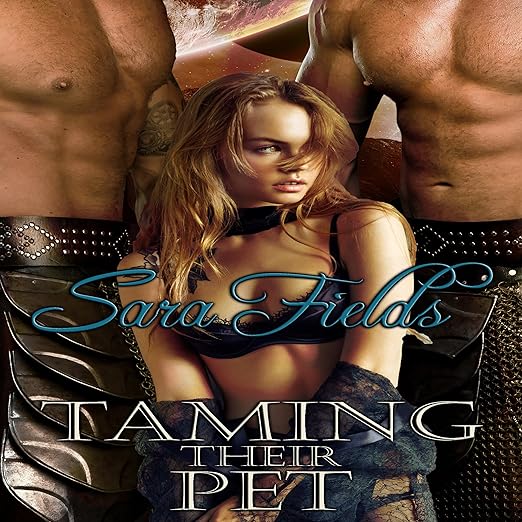
I want to be precise about what Taming Their Pet is before saying anything else, because imprecision in either direction does a disservice to readers trying to figure out whether this book is for them. This is an explicit dark romance in a science fiction setting, the third entry in Sara Fields’s Captive Brides series, and it engages in content, BDSM, domestic discipline, non-consensual-adjacent scenarios presented as erotic, that is not incidental to the reading experience. It is the reading experience. Listeners who come to this expecting it to be primarily a science fiction novel with romantic elements will be significantly wrong about what they are getting.
That clarity out of the way: within its genre, Taming Their Pet is a competent and, for its audience, genuinely satisfying piece of work. Fields has built a coherent world in which Earth’s overpopulation policy creates a category of illegal third children who are processed through a detention facility and sold as brides or, in Isabella’s case, as something else entirely. The worldbuilding exists to support the erotic premise rather than to be explored for its own sake, and the book is honest about that transaction.
The Captive Brides Universe and Its Rules
Fields has built a coherent speculative framework for this series, and it is worth understanding before deciding whether Taming Their Pet is for you. In the Captive Brides world, Earth’s strict two-child policy has created an entire bureaucratic apparatus for processing illegal third children, specifically daughters, who are seized by authorities and transported to a detention facility located at the edge of the solar system. From there, they are sold, primarily as brides, to alien species. The third book introduces a wrinkle: Isabella is not sold as a bride but as a pet, which is the specific premise that drives the book’s entire dynamic. That premise is presented without irony, and the book’s emotional and erotic architecture depends on the reader being inside the fantasy logic rather than outside it.
Isabella and the Logic of the Fantasy
Isabella Bedard begins the book as the daughter of a politician who has managed to hide her illegal status until she cannot hide it anymore. Her processing through the detention facility and subsequent auction is presented in enough detail to establish the world’s rules before Zack and Noah enter the narrative. The two alien men who purchase her, experienced, dominant, described as specialists in taming headstrong females, are genre archetypes presented without irony or interrogation. The book’s fantasy logic depends on the reader accepting the premise of Isabella’s gradual capitulation as pleasurable rather than troubling, and Fields executes that logic with more narrative intelligence than much of the genre manages.
One reviewer noted something important: early in the book, she found herself thinking about what Isabella’s experience would look like if she never warmed to Zack and Noah’s treatment. That is a legitimate critical observation and one that Fields does not engage with, the book’s internal rules require that Isabella’s resistance eventually gives way to desire, which is the foundational premise of this particular fantasy structure. Readers who cannot accept that premise will find the book uncomfortable in ways that no amount of craft can resolve.
What the Genre Rewards and What It Forecloses
The reviewer who called this the best Fields book they had read up to the ending made a sharp observation. The prose avoids some of the generic phrasings that plague the category, the boilerplate language that signals a writer working from template rather than specificity. Fields, in the middle sections of the book, writes with more texture than average for the genre. The pony and kitten training sequences are handled with a specificity that committed readers of this type of content will find satisfying, and the emotional development between the three main characters has enough interiority to give the fantasy weight.
The ending, by contrast, arrives too fast. This is a consistent criticism across multiple reviews, and it is a fair one. The resolution of Isabella’s emotional capitulation and the establishment of the triad’s dynamic is condensed in ways that feel rushed relative to the care invested in the preceding sections. Whether this reflects a genre convention about not overstaying the fantasy’s welcome or simply an editorial failure is hard to determine from the outside, but the effect is a diminished final impression for a book that earned something better.
Patrick Blackthorne’s Narration and the Listener’s Position
Blackthorne performs the material with the kind of controlled authority the genre expects from its narrators. His delivery of Zack and Noah’s dominant dynamic is consistent with how audio performance in this category typically approaches those roles, confident, deliberate, offering little of the listener’s own interpretive space back. Whether that serves the material well depends almost entirely on whether the listener is already sympathetic to the fantasy being offered. For committed readers of the Captive Brides series, the narration will feel correct. For listeners who stumble onto this without genre expectations firmly in place, Blackthorne’s performance will feel like an immersion in a world whose premises they may not have agreed to enter.
At 4.1 stars from over 900 listeners, Taming Their Pet sits in the mixed-positive range that honest genre fiction often occupies: beloved by its core audience, alienating to those outside it, and not particularly interested in serving both.
Frequently Asked Questions
Is Taming Their Pet part of a series, and does it need to be read in order?
It is the third book in the Captive Brides series but functions as a standalone. The synopsis and most reviews confirm that the essential world-building context is provided within this volume. Readers unfamiliar with the series can start here without significant confusion.
How does Sara Fields handle the consent dynamics in this book?
The book operates within what the genre calls consensual non-consent or dubious consent fantasy, in which Isabella’s initial resistance gives way over the course of the narrative to genuine desire. Fields does not interrogate this structure or present the dynamic critically, it is the book’s foundational fantasy premise, and the narrative is designed to make it satisfying rather than troubling for the intended audience.
Why do some reviewers feel the ending is too rushed?
Multiple reviewers flagged the resolution as arriving too quickly relative to the narrative investment in the central relationship. The emotional and erotic development across the middle of the book is handled with more care than the final consolidation of the triad dynamic, which compresses a resolution that the preceding chapters arguably earned a more gradual landing.
Is Taming Their Pet available as a free audiobook through Audible?
Yes, Taming Their Pet is currently available as a free audiobook for Audible members. Given its niche audience, the free access is a useful way for curious listeners to determine whether this type of content is for them before committing further.