Quick Take
- Narration: Rax King reading her own essays is the right call, her delivery is casual and sharp in exactly the register the writing demands, and her timing on the funnier passages is impeccable.
- Themes: Low-culture nostalgia as emotional archive, millennial identity and irony, grief refracted through pop artifacts
- Mood: Funny and tender, with unexpected emotional depth in the quieter essays
- Verdict: A collection that is funnier and more serious than it announces itself to be, and one that works significantly better in audio with King narrating her own work.
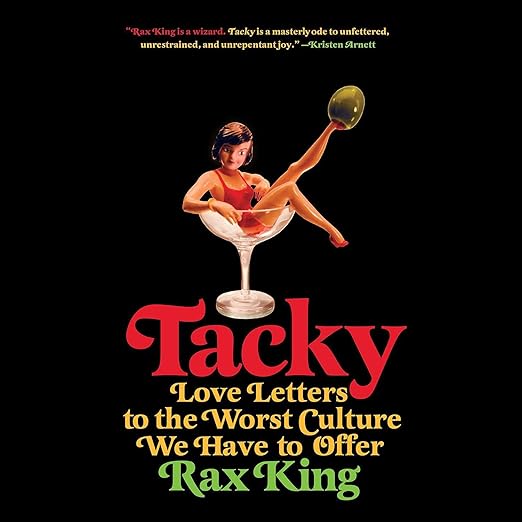
I started Tacky on a Sunday afternoon expecting something breezy and a little clever, the kind of essay collection that earns its praise by being charming about things that are not usually taken seriously. What I got was something more complicated. Rax King is funny, genuinely funny in a way that does not require a setup, but she is also doing something more ambitious with this material than the Hot Topic and Creed cover suggests. By the time I reached the Jersey Shore essay, which turns into an excavation of grief over the death of her father, I had recalibrated what kind of book this was.
The fourteen essays each revolve around a different maligned cultural artifact: frosted lip gloss, snakeskin pants, the Cheesecake Factory’s menu, Jersey Shore, Sex and the City, America’s Next Top Model. These are the things the millennial generation has been trained to be embarrassed about enjoying, and King’s project is to stop performing that embarrassment and look at what these artifacts actually did for the people who loved them. The result is part cultural criticism, part memoir, and part argument about what aesthetic judgment costs us when we let it govern everything.
Our Take on Tacky
King is a James Beard Award-nominated writer known for her Catapult column Store-Bought Is Fine, and her food writing background surfaces in the way she approaches cultural artifacts: with specificity, without snobbery, and with genuine curiosity about what experiences actually taste like to the people having them. The Guy Fieri essay, which covers healing from an abusive relationship through the particular warmth of Triple D-era Food Network, is perhaps the best demonstration of this. It should not work as well as it does, and it does.
The collection’s honesty about what nostalgia is actually doing, how it functions as emotional storage, how the things we loved in adolescence encode experiences we have not finished processing, is what separates this from a more straightforward exercise in millennial reclamation. King is not just defending guilty pleasures. She is arguing that the guilt is the wrong response and the pleasure is telling you something real.
Why Listen to Tacky
The author-narrated audio is the format this collection was built for. King’s delivery is conversational and sharp, and she knows exactly where her essays breathe and where they land. One reviewer listened to it in one night and was on camera by 9:30 the next morning telling her audience about it, which gives you a sense of the reading experience’s velocity. Another described King as fluent in nostalgia, which is the right way to put it.
The essays about You Wanna Be On Top and early aughts girlhood specifically resonate for listeners who grew up in that cultural moment. But reviewers who are a generation removed from the specific references also find the thematic core legible, which suggests King’s framing is doing more work than the artifacts themselves.
What to Watch For in Tacky
The collection’s humor is uneven, as one reviewer noted. Some essays land every joke. Others are funnier in concept than in execution, and the pacing within individual essays varies. The collection is also genuinely age-specific in a way that older readers acknowledge honestly: one reviewer who hung around malls in the eighties could appreciate the argument without fully inhabiting the references. That is not a flaw exactly, but it is an accurate picture of how the book distributes its pleasures.
Listeners who approach this expecting a purely comedic experience will be surprised by the grief essay and the more serious emotional registers that surface in several pieces. That surprise is mostly a good one, but it is worth knowing the collection has range.
Who Should Listen to Tacky
Millennial readers who grew up with any of King’s reference points, Jersey Shore, Hot Topic, early aughts reality television, will find this hitting at a frequency that is difficult to describe to people outside that cultural experience. Essay collection readers who appreciate writers with a distinct and consistent voice will find King’s register pleasurable regardless of the specific nostalgia. Those who need their cultural criticism to be academically distanced or their humor to be consistent throughout may find the collection’s tonal shifts a harder adjustment.
Frequently Asked Questions
Does Rax King narrating her own essays make a significant difference to the listening experience?
Yes. Her delivery has a naturalness that comes from writing and speaking in the same voice, and her timing on the funnier passages, particularly in the Jersey Shore and Guy Fieri essays, is difficult to replicate with another narrator. For essays this conversational in register, author narration is the right choice.
Is Tacky primarily comedy or does it have genuine emotional depth?
Both, often within the same essay. The Jersey Shore piece is one of the funniest in the collection and also one of the most emotionally serious, turning into an account of grief over her father’s death. King’s ability to hold those registers simultaneously is what makes the collection more than a nostalgia exercise.
How much does it matter if I don’t recognize all the cultural references in Tacky?
The specific artifacts, from Creed to ANTM to the Cheesecake Factory, are the vehicles, not the destination. Reviewers who did not share all the references still found the thematic argument about nostalgia, shame, and what we protect by caring about things, intelligible and worth engaging. The millennial-specific context helps but is not required.
How does Tacky compare to other essay collections dealing with pop culture and nostalgia?
King occupies a specific position: she is more emotionally honest than most pop culture criticism and more interested in the artifact’s affective function than in its cultural significance. Writers like Hanif Abdurraqib, who takes seriously what popular music means to the people who love it, are useful comparisons. King is funnier and more personal, and arguably more interested in shame specifically than most writers in the adjacent space.