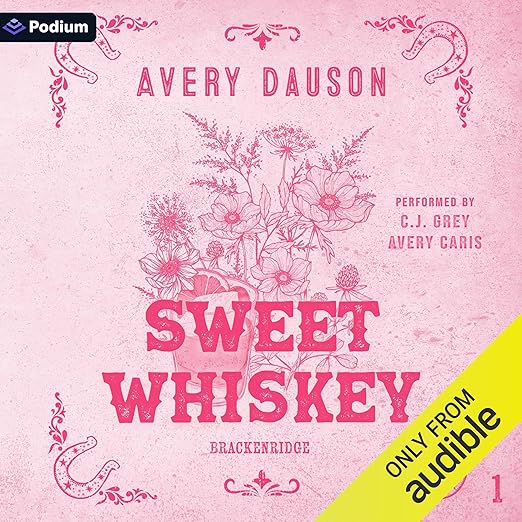
Quick Take
- Narration: C.J. Grey delivers the MFMM multi-POV structure with clear vocal differentiation between characters, keeping the three alphas distinct without resorting to caricature.
- Themes: Omegaverse pack dynamics, identity and found family, the tension between a personal search and unexpected desire
- Mood: Fast-burn, warm, and spicy, designed to sweep rather than linger
- Verdict: A debut that delivers exactly what the omegaverse western subgenre promises, with enough heart in Kinsey’s dual quest, for her father and for belonging, to give the heat something to anchor to.
I want to be upfront about where I am coming from with Sweet Whiskey: omegaverse fiction is not my native genre territory. I came to this as a reviewer rather than a fan, which means I had to calibrate my response against the genre’s own conventions rather than my personal preferences. What I found is a debut novel that understands its audience with considerable precision, delivers what the form promises, and adds just enough of a specific emotional hook, Kinsey’s search for her father, to give the romance a foundation that goes slightly deeper than pure fantasy mechanics.
The setup is efficient. Kinsey and her best friend Brielle take a road trip to Brackenridge, a small town that holds the only clue to Kinsey’s father’s identity: a bar named Sweet Whiskey, where her parents met. The moment she walks in, she meets Colt, an alpha cowboy in a tight Henley who is immediately, biologically her scent match. His pack includes Brooks, who is bubbly and charming, and Dallas, who is serious but nurturing. This is a first-person multi-POV MFMM omegaverse, which means you are getting Kinsey’s perspective alongside the alphas’, and the story unfolds at the kind of accelerated pace that reviewer Emily D describes as super fast-paced and completely consuming.
Our Take on Sweet Whiskey
Avery Dauson’s debut is noteworthy for a few reasons beyond the core fantasy. The Coyote Ugly-adjacent setting, a bar where Kinsey works as a dancer, gives the story a visual energy that reviewer Dee Homburg invokes directly with the Coyote Ugly meets Omegaverse description. That is an apt frame. There is a theatrical, performative quality to the Brackenridge setting that the novel uses well, particularly in the scenes where Kinsey’s dancing becomes a site of both desire and power.
The father search is handled with enough restraint to avoid dominating the romance, which is the right call. It functions as the reason Kinsey is in town and as an emotional undercurrent, she is someone looking for a sense of origin and belonging, which makes her susceptibility to a pack who offers exactly that kind of biological and emotional belonging feel thematically coherent rather than coincidental. Dauson has thought about why this specific character would respond to this specific scenario, and that thinking shows.
Why Listen to Sweet Whiskey
C.J. Grey’s narration is well matched to the material. MFMM multi-POV is technically demanding for a narrator because you need to make each alpha voice distinctly recognizable without the performance becoming exhausting across the full runtime. Grey manages this cleanly, keeping Colt, Brooks, and Dallas differentiated in ways that serve the story without drawing attention to the mechanics. The pacing of the narration matches the novel’s own fast-burn energy, which at five hours and thirty-nine minutes does not overstay its welcome.
Reviewer Jess McDaniel notes that the scent-match instant attraction setup means the story gets spicy quickly from the start without feeling overwhelming, which is the tonal balance the genre aims for. The heat arrives early, but the emotional stakes are present alongside it, preventing the book from feeling purely mechanical.
What to Watch For in Sweet Whiskey
This is a debut, and the seams occasionally show. Reviewer Jess McDaniel notes that certain character relationships feel partially developed in the first book, one in particular that is introduced early and then not fully resolved by the ending. Reviewer Tarah’s three-star assessment, while still broadly positive, flags some small bumps in the story and an occasional unevenness in how the three alpha relationships develop relative to each other. These are the kinds of first-novel issues that tend to smooth out across a series, and the Brackenridge books are clearly designed to continue.
The secret the alphas are keeping from Kinsey, the conflict that brings the romance to its crisis point, is not particularly surprising to anyone familiar with the genre conventions. The revelation lands more as confirmation than shock. That is not necessarily a failure; readers coming to this book want the emotional beats of the genre delivered competently, and Dauson delivers them. But listeners hoping for narrative subversion will not find it here.
Who Should Listen to Sweet Whiskey
Omegaverse readers who want a warm, fast-moving cowboy setting will find this delivers exactly what the premise suggests. The western backdrop is specifically and effectively rendered, the ranch, the bar, the tight Wranglers, without feeling like a costume over a generic contemporary romance. Readers who enjoyed Grace McGinty’s or Lola Glass’s rural shifter romances will find familiar pleasures here.
Listeners outside the omegaverse genre who are not sure whether the alpha-omega dynamic and heat spike mechanics sound appealing should start by understanding what the subgenre involves before committing, as the biological fantasy framework is central rather than incidental. Sweet Whiskey is not a gateway to omegaverse for skeptics, it is a solid entry for readers who already know they enjoy the form.
Frequently Asked Questions
Does Sweet Whiskey work as a standalone or do you need to read the rest of the Brackenridge series?
The first book concludes the central romance arc and resolves the main conflict, making it functional as a standalone. However, some character threads and the father subplot are clearly set up for continuation. Reviewer responses suggest satisfaction with the first book on its own, while also leaving enough open to pull readers into subsequent volumes.
How explicit is Sweet Whiskey, and is it appropriate for all romance readers?
The novel is described by its author as spicy and by reviewers as fast-burn, meaning it moves quickly to explicit content and contains multiple heat spike scenes. This is an adult romance novel with explicit sexual content. It is not appropriate for younger readers or those seeking non-explicit romance.
How does C.J. Grey handle the multi-POV MFMM narration with three distinct alpha voices?
Grey maintains clear vocal differentiation between Colt, Brooks, and Dallas across the multi-POV structure, keeping each alpha recognizable without the character voices becoming distracting or exaggerated. The narration paces itself to match the novel’s fast-burn energy, which serves the material well at the five-and-a-half-hour runtime.
Is the father-search subplot a significant part of Sweet Whiskey or mainly a framing device for the romance?
It functions primarily as the emotional motivation that brings Kinsey to Brackenridge and provides a thematic undercurrent about belonging and identity. It does not dominate the romance, which is the right balance for the genre. The search gives Kinsey a specific reason to be in town and resonates with her emotional response to the pack dynamic, but the romance is the central event.