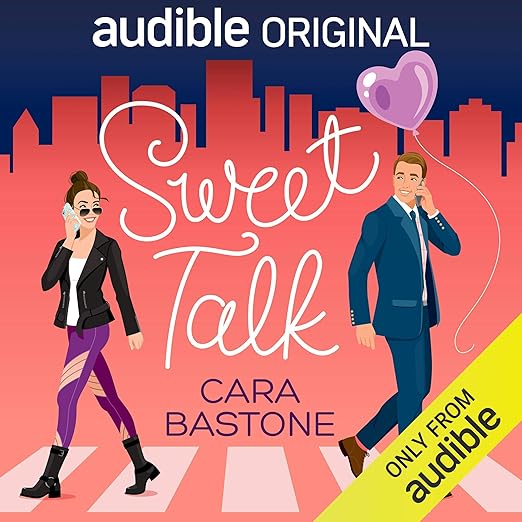
Quick Take
- Narration: Lidia Dornet brings Jessie’s voice to life with genuine warmth and comic timing; as an Audible Original scripted for audio, the production feels designed for the format rather than adapted from print, which makes a real difference.
- Themes: Anonymity and vulnerability in early romance, insomnia and the intimacy of late-night conversation, identity concealed and revealed
- Mood: Playful and sweet with a current of genuine longing underneath
- Verdict: A tight, charming Audible Original rom-com that uses the text-message-and-phone-call format to maximum effect; it is slight by design but executes its intentions with skill.
I listened to Sweet Talk on a restless Sunday night, which turned out to be exactly right. There is something fitting about a book built around insomniac late-night conversations being best appreciated when you are yourself wide awake at an hour you weren’t planning to be. Cara Bastone scripted this one directly for audio, and you can feel that in how the pacing works: it has the rhythm of spoken exchange rather than prose, and Lidia Dornet’s narration flows with a naturalness that adapted audiobooks rarely achieve. The whole thing has the energy of something that knows exactly what it is and executes it without apology.
This is the second book in the Love Lines series, though it functions as a standalone with only a brief crossover from the first installment. Jessie is the building superintendent of an apartment complex, having taken over from her ill father, a detail that immediately establishes her as someone whose life has been reshaped by obligation. Eliot is a tenant who has been struggling with insomnia since his apartment was robbed and the perpetrator never caught. One night, a wrong-number text arrives from Eliot to Jessie’s phone, and instead of correcting the mistake immediately, Jessie texts back. What follows is months of late-night exchanges that go everywhere and nowhere simultaneously.
The Wrong Number That Builds Something Real
The mistaken identity setup is a rom-com staple, and Bastone is self-aware enough not to pretend otherwise. What she does with it is find the specific texture of why anonymity can produce honesty. Jessie’s combat boots and apartment-super life are facts she is certain will make Eliot see her as something other than romantic possibility, so she withholds them. The conversations that unfold in that space feel genuine precisely because neither character is performing for the other’s expectations. They are talking in the dark, figuratively and sometimes literally, and that darkness strips away the performance that daylight requires.
Reviewer Brittany Sjostrom captured this dynamic well: by leaving out who they are, they were able to focus on more important and deeper subjects. That is the structural logic the book is building, and Bastone earns it through the specificity of the conversations rather than simply asserting emotional depth. The discussions of reality TV are funny. The discussions of Eliot’s art have real tenderness. The middle-of-the-night vulnerability has a quality that feels recognizable to anyone who has ever said something at 3 a.m. they would not have managed at noon. Reviewer Debbie L. Thune’s plot summary reveals a useful detail: Eliot’s insomnia stems from anxiety after being robbed, and Jessie’s from a personality that simply can’t quiet itself. Two different kinds of wakefulness, finding each other in the dark.
What the Audible Original Format Makes Possible
Sweet Talk was scripted exclusively for audio, and this matters in concrete ways. The dialogue has a punchiness that print rom-coms rarely achieve because it was written to be heard, not read. The pacing allows for silence in ways that prose cannot really represent on the page. Lidia Dornet’s delivery of Jessie’s voice, sardonic and slightly defensive on the surface, genuinely hopeful underneath, is the kind of characterization that works better aurally than it would in written form.
Reviewer Deonna Balentyne noted that the duet style was fun and the banter felt real, which is about the highest compliment a rom-com can receive in terms of its central relationship mechanics. One of the persistent failures of audio romance is that narrators tend toward warmth in ways that sand down the edges of more complicated characters. Dornet manages to keep Jessie’s sharpness intact while still making her sympathetic, which requires genuine skill. The book also benefits from Bastone’s decision to tie the ending to a character from the first Love Lines book, a cameo that rewards loyal readers without alienating new ones, a balance that series romance often gets wrong.
Where the Short Format Creates Limits
At five hours and forty-two minutes, Sweet Talk is a quick listen, and the brevity serves the premise better than an extended runtime would. But it also means the relationship development is necessarily compressed, and the moment when the inevitable identity revelation arrives feels slightly rushed compared to the leisurely establishment of the secret. The reconciliation after the moment of reckoning resolves faster than the emotional logic quite supports, which is the most common structural weakness in short romantic fiction and one that even skilled writers tend to stumble over.
Reviewer Priscilla Reinart noted it was not crazy LOL funny, which is fair. This is a gentle romantic comedy rather than a farce. The humor is character-based and warm rather than situational and broad, which is a legitimate stylistic choice but worth knowing if you are expecting high-energy comedy throughout. The book’s pleasures are more intimate than that, more about the feeling of being seen in a conversation than about the mechanics of comic misunderstanding.
Where This Sits in the Rom-Com Landscape
Listen if you want a brief, well-crafted audio-native romance with genuinely likable characters and a premise that the format actively enhances. Listen on a night when you’re not ready to sleep and want company that is light without being empty. Skip if you need your romantic comedies to have substantial external plot beyond the relationship itself, or if you prefer longer, more developed narratives with more room to breathe between emotional beats. This one is light in the best sense of the word, which means it is exactly what some nights require.
Frequently Asked Questions
Does Sweet Talk need to be listened to after the first Love Lines book?
No. The book is designed to work as a standalone, and the connection to the first Love Lines installment appears mainly at the ending in a brief character crossover. New listeners will not be confused or feel they are missing essential context.
What makes this Audible Original format different from a standard audiobook production?
It was scripted specifically for audio rather than being a print book adapted into audio format. This means the dialogue, pacing, and structural rhythms were designed with listening in mind from the start, which gives the production a naturalness that adapted audiobooks often lack.
Is Jessie’s character consistent with the tough-exterior trope, or does Bastone do something different with her?
Bastone acknowledges the trope and works within it, but Jessie’s combination of combat boots and genuine emotional intelligence is handled with enough specificity that she feels like a character rather than a type. Her reasons for withholding her identity from Eliot are psychologically coherent rather than simply convenient for the plot.
How does this book compare to other Cara Bastone rom-coms in terms of tone and heat level?
Sweet Talk is on the sweeter, lighter end of Bastone’s range. It is not heavily explicit and its emotional register is warm rather than intense. Readers who have found other Bastone books to be exactly their comfort zone will likely feel at home here; readers looking for something edgier may want to check her other titles first.