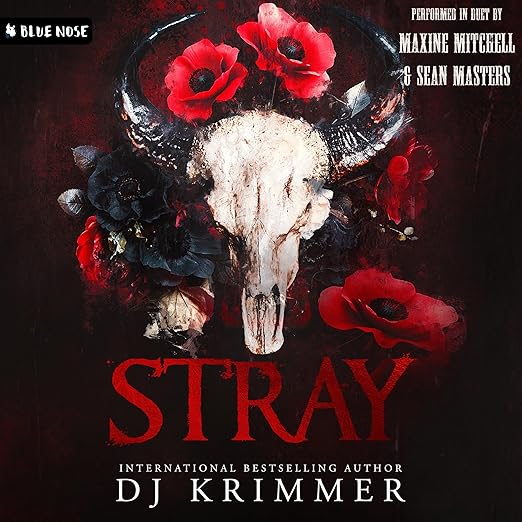
Quick Take
- Narration: Maxine Mitchell and Sean Masters share duties, both turning in performances strong enough that reviewers say they ceased to feel like narrators and simply became Ozzy and Jackson.
- Themes: Found family and healing from trauma, trust rebuilt through friction, the grumpy cowboy as emotional mirror
- Mood: Emotionally raw with bursts of humor, the kind of romance that earns its tears
- Verdict: A dual-POV ranch romance that leans harder into emotional damage than most of its genre peers, and is more rewarding for it.
I finished Stray on a Sunday afternoon when I had not planned to be anywhere near my headphones. The last two hours happened because I kept telling myself one more chapter, and by the time I realized what I was doing it was nearly dark. That is not something I planned to admit in a review, but it is the honest account of how DJ Krimmer’s debut in the Rowe Ranch series works on you when you are not paying attention to the mechanism.
The setup is familiar to anyone with time in the contemporary western romance space. Ozzy Davenport takes a nursing job on a Virginia ranch to disappear from something in her past. The patient is a grumpy old man dying on his own terms. His son Jackson Rowe is a complication she does not need and cannot avoid. What is less familiar is how much weight Krimmer puts on Ozzy’s history before she ever arrives at the ranch, and how long the book earns its central relationship before asking you to invest in it.
Our Take on Stray
This is a romance structured around two people who are genuinely difficult to be around. Ozzy’s guardedness is not the decorative kind that lifts at the first kiss. It is rooted in something specific and serious, and the book does not reveal it cheaply. Jackson, for his part, is not simply brooding. He is managing a dying father, a fractured family, and his own anger in real time. The reviewer who calls the book a love letter to survivors is reaching for the right language. Krimmer is writing about the kind of healing that happens in increments and sometimes goes backward, not the kind that resolves in a single conversation. One reviewer notes it could have been slightly shorter, and she is not wrong that the middle sections occasionally drift, but the emotional investment that accumulates in those pages is precisely what makes the final third hit as hard as it does.
Why Listen to Stray
The audiobook performance is the primary reason to choose listening over reading. The dual narration, Maxine Mitchell handling Ozzy and Sean Masters taking Jackson, is exceptional. Mitchell in particular captures Ozzy’s mixture of sarcasm and buried fear without playing either note too loudly. Reviewer Melissa A. writes that they poured so much pain, heart, and healing into Ozzy and Jackson, and the language of pouring is apt. These are not recitations of emotional scenes. They are lived performances that make the more brutal sections of the backstory genuinely difficult to sit with. The humor lands too, which is essential in a book that takes itself seriously. The banter between Ozzy and the Rowe family, including the gruff patient whose foul mouth Ozzy has to match, provides necessary air in what could otherwise be a relentlessly heavy listen.
What to Watch For in Stray
The Rowe Ranch series begins here, and while Stray works as a standalone, the final chapters clearly set up subsequent books. Listeners who find themselves attached to the extended Rowe family, specifically Jackson’s siblings and the chaotic family dynamics that form the backdrop of the romance, should know there is more of this world to come. The pacing wobbles slightly in the middle act. The push-pull between Ozzy and Jackson becomes repetitive in a stretch around the midpoint before Krimmer pushes through it by raising the stakes. If you are the kind of reader who loses patience with protracted misunderstanding, note that the withholding here is character-motivated rather than manufactured, and it does eventually break open into something worth waiting for. The book also deals with trauma content that some listeners may want to prepare for, specifically the backstory that explains Ozzy’s flight to the ranch.
Who Should Listen to Stray
Romance listeners who want emotional depth alongside their tropes will be well served. Stray delivers fated mates, forced proximity, and grumpy-sunshine dynamics, but it puts real weight behind them. The dual-narration format makes it a strong choice as an audiobook specifically. Listeners who prefer lighter, faster-paced contemporary romance may find the emotional heaviness demanding. Anyone who loved a slow-burn, found-family centered story where healing is a process rather than a plot point should go directly here.
Frequently Asked Questions
Do you need to have listened to the previous Sarkarnii books to follow the Rowe Ranch series, or is Stray a fresh start?
Stray is Book 1 of the Rowe Ranch series by DJ Krimmer, completely separate from any other series. You come in with no prior context needed. The family dynamics unfold as you listen.
How does the dual narration divide between Maxine Mitchell and Sean Masters?
Mitchell narrates Ozzy’s chapters, Masters takes Jackson’s. The two narrators have distinct vocal registers that make the POV switches immediately legible without needing chapter title cues, which is one of the stronger technical successes of the production.
Is the trauma content in Stray handled carefully, or does it feel exploitative?
Reviewers consistently describe it as brutal but earned. The backstory is revealed gradually and is connected to Ozzy’s character in ways that feel necessary rather than ornamental. It is not a light listen, but the handling is thoughtful.
How does Stray compare to other grumpy cowboy romances like those set in Texas or Wyoming?
The Virginia ranch setting gives it a slightly different feel from standard Western-set cowboy romance. The atmosphere is less sweeping landscape and more tight-knit family estate under pressure, which keeps the focus on character dynamics rather than setting.