Quick Take
- Narration: Amy Rubinate brings a bouncy, warm energy to Stink’s Shakespeare adventures, she handles the fake Elizabethan exclamations with evident enjoyment.
- Themes: Shakespeare made accessible for early readers, sibling dynamics, trying new things reluctantly
- Mood: Silly and fast-paced, the Stink series at its most theatrical
- Verdict: A perfectly pitched early-chapter-book listen that smuggles in genuine Shakespeare camp humor without anyone feeling educated at.
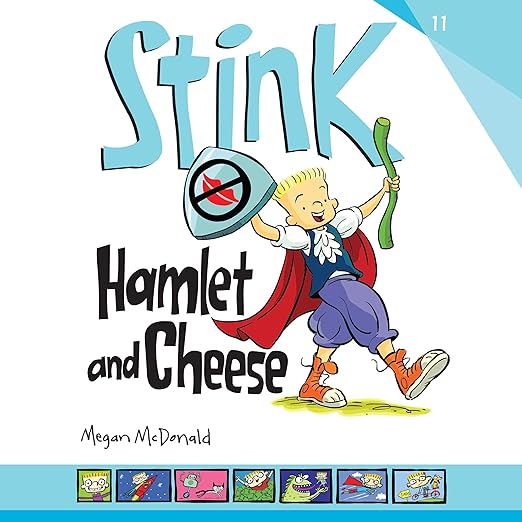
My neighbor’s seven-year-old informed me very seriously last spring that Shakespeare was a person who lived a long time ago and also that his name was basically a joke. She had arrived at this conclusion via Stink: Hamlet and Cheese, and while her literary history was not entirely accurate, her engagement with the material was complete. That, I think, is what Megan McDonald has been doing across the Stink series for years: building entry points into subjects that sound intimidating from the outside and making them feel like Stink’s personal discovery rather than a structured lesson.
This eleventh volume in the series sends Stink Moody to Shakespeare camp over spring break. The setup arrives because his friend Sophie of the Elves has told him there will be swordplay and cursing, both true, in the specifically Elizabethan sense of each, and Stink, whose decision-making is often driven by what sounds like it will be cool, signs up before fully reading the details. The complication that there is only one other boy at camp, and that the other boy is paired with a girl Stink finds challenging in the specific way seven-year-olds find certain other seven-year-olds challenging, is handled with McDonald’s characteristic light touch.
Elizabethan Vocabulary as Comedy
The book’s best running joke is the Shakespearean curse section, Stink learning to say things like Fie upon’t! and How now! and treating them with the solemnity of genuine insults. McDonald clearly has fun with this, and the curses recur throughout with escalating absurdity. For early readers, this is an effective and non-threatening introduction to the idea that language changes over time, that words that sound ridiculous now were once the sharp end of social disapproval. The fake sword-fighting subplot gives the book a physical comedy dimension that works particularly well in audio, where Amy Rubinate’s reading adds performative energy to the stage combat scenes.
Under an Hour of Perfect Pacing
At fifty-five minutes, Stink: Hamlet and Cheese is what I’d call a nap-drive listen, exactly the right length for a journey to grandparents or a school pickup loop. McDonald writes short chapters with clear hooks, which means the book works whether you’re listening in one sitting or picking it up and putting it down across several sessions. There’s no subplot that overstays its welcome, no character beat that requires more context than the book provides. It’s tightly made in the way that experienced children’s authors learn to make things tightly: not stripped down, but with every element earning its runtime.
Amy Rubinate and the Stink Voice
Rubinate has the series’ energy locked down. Stink’s voice in her read is the voice of a child who is perpetually startled by the world being more interesting than he expected. The Shakespearean exclamations get their own timing, she doesn’t rush them, which is the right call, because the comedy comes from the gravity with which Stink deploys them. The supporting characters, particularly Sophie of the Elves and the antagonist Riley Rottenberger, are distinct without requiring elaborate vocal transformations. For a sub-hour listen, the characterization is as complete as it needs to be.
Who This Works For
The Stink series is designed for beginning chapter book readers, roughly five through eight, and this installment probably has slightly more appeal for the older end of that range given the theatrical content. It would pair naturally with any school unit on Shakespeare, though it doesn’t require that context to work. Parents of reluctant readers will find McDonald’s combination of approachable vocabulary and genuinely funny situations doing the work for them. The Stink books are good entry points for kids who haven’t found a series that sticks yet, McDonald keeps the stakes local enough to feel real and keeps the humor warm rather than mean.
Frequently Asked Questions
Do you need to know the Stink series from the beginning to follow this one?
Not at all, each Stink book is standalone. The main things you need to know (that Stink is Judy Moody’s younger brother, that Sophie of the Elves is his friend) are established naturally in the text.
Is this a good choice for a child who is actually studying Shakespeare in school?
Yes, with the caveat that the Shakespeare content is introductory and comic rather than rigorous. It makes the period vocabulary and theatrical traditions approachable and funny, not academically comprehensive.
How does this compare to Stink books set in other subject areas?
The Shakespeare camp setting gives this entry a more theatrical energy than some of the science-themed Stink books. The wordplay is more prominent than usual, and listeners who enjoy puns and made-up curses will be well served.
Is the character of Riley Rottenberger a recurring antagonist in the series?
Riley appears in several Stink volumes as a recurring rival, a girl whose confidence Stink finds particularly irritating, partly because it exceeds his own. She doesn’t need introduction if you’re starting here, but series regulars will recognize her.