Quick Take
- Narration: Mary Pope Osborne narrating her own Magic Tree House entry brings an intimate, grandmother-telling-a-story quality that suits the series’ bedtime-chapter-book origins perfectly.
- Themes: Historical curiosity, Shakespeare’s creative world, performing under pressure
- Mood: Bright and zippy, history delivered as adventure
- Verdict: A forty-two-minute time-travel trip to Elizabethan England that works beautifully as a single-session listen for early chapter book readers.
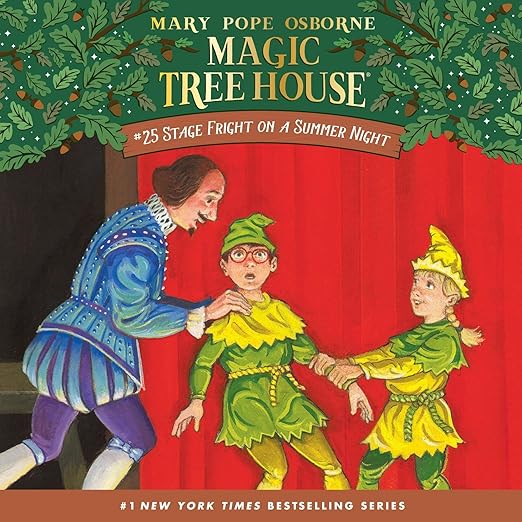
My nephew worked through most of the Magic Tree House series at age six and seven, and I remember him describing Stage Fright on a Summer Night as the one where Jack and Annie met Shakespeare. He had absorbed the essential fact correctly, which is something I have always thought speaks well of how Osborne structures these books. The historical education is never the point in a way that feels didactic; it is always the consequence of the adventure. You go to Elizabethan England, you get tangled up in something, and you come home having learned something about William Shakespeare because you could not avoid it.
At forty-two minutes, this is one of the shorter Magic Tree House entries in audiobook format, which puts it firmly in the range of a car trip, a bedtime routine, or a single rest-time listen. The brevity is not a limitation, it is calibrated to the audience. Early chapter-book readers, roughly kindergarten through second grade, can hold this story in a single sitting without it becoming a commitment that frays attention.
Shakespeare as Adventure Setting
Osborne’s approach to William Shakespeare here is instructive for adults thinking about what makes historical fiction work for very young listeners. She does not introduce Shakespeare as a monument. She introduces him as a person having a problem: some of his actors are difficult, the show is in trouble, and he needs help. Jack and Annie arrive into a specific crisis rather than a biography. One reviewer captures this well: the book introduces children to Shakespeare in a fun and simple way that exposes them to it without it being really about Shakespeare. That is precisely the mechanism. Elizabethan England becomes a texture rather than a lesson.
Osborne’s Own Voice as Narrator
Mary Pope Osborne narrating her own work is a recurring choice across the Magic Tree House series, and it produces a distinctive listening experience. Her voice has a quality of earnest warmth that matches the books’ tonal register exactly: she is telling these stories as someone who wants children to love them, not performing them as literary artifacts. The pacing is slightly more measured than a professional narrator might choose for action sequences, but this actually suits the youngest listeners, who benefit from the additional processing time that a slightly unhurried delivery provides. For children who are just transitioning from picture books to chapter books, Osborne’s familiar authorial voice functions as a kind of reassurance.
The Series Position and What to Expect
Stage Fright on a Summer Night is the twenty-fourth entry in the original Magic Tree House series, before the Merlin Missions expansion. At this stage in the series, Jack and Annie are well-established personalities with a reliable dynamic: Jack wants to understand, Annie wants to leap, and their complementary approaches to every situation have become a comfortable rhythm. New listeners to the series can enter here without confusion; Osborne recaps the essentials economically. But the full pleasure of the Jack-and-Annie partnership is cumulative, and families who have been listening in sequence will feel the warmth of reunion when they arrive at this entry.
Best For, Not For
Stage Fright on a Summer Night is a natural choice for parents who want to introduce Shakespeare to young children without the weight of the actual plays. It works for ages five through eight as a primary audience, with the sweet spot around six and seven. Older children who have outgrown early chapter books will find the forty-two-minute format too brief and the complexity too low. Adults who loved the Magic Tree House series in childhood will find genuine nostalgic pleasure in Osborne’s narration of her own creation.
Frequently Asked Questions
Does a child need to have read previous Magic Tree House books to enjoy this one?
No. Osborne provides enough context within each book to orient new readers. That said, the series reads better in order from a character investment standpoint, and entry at book twenty-four means missing substantial backstory.
Is forty-two minutes really the full length, or is that an abridged version?
Forty-two minutes is the complete audiobook. Magic Tree House books are short chapter books by design, running roughly eighty to ninety pages in print, and they translate to brief audiobook runtimes. This is not abridged.
How much does this audiobook teach children about Shakespeare specifically?
It gives a very accessible introduction. Children will learn that Shakespeare wrote plays, that Elizabethan theater involved real challenges and personalities, and something of the atmosphere of the Globe Theatre era. It is a doorway, not a curriculum.
Is Mary Pope Osborne’s narration of her own books consistent across the Magic Tree House series?
Yes, Osborne narrates many entries in the series herself in this warm, accessible style. Her voice is associated with the series for longtime listeners, and that continuity is part of the comfort of the audio experience.