Quick Take
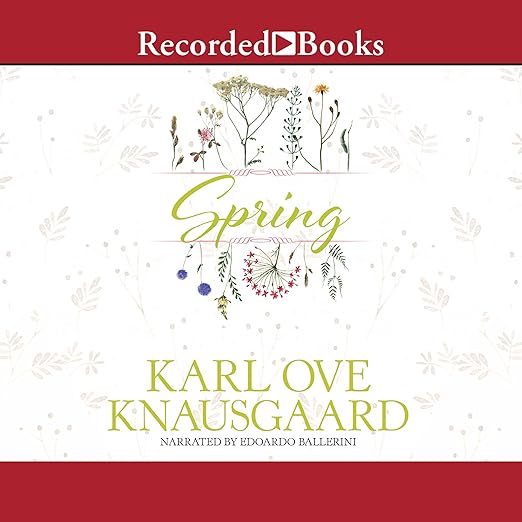
- Narration: Edoardo Ballerini brings exactly the right quality to Knausgaard’s prose, unhurried, precise, with a gravity that honors the text without overperforming its emotion.
- Themes: Parenthood and time, the sacred in the mundane, darkness and its proximity to ordinary life
- Mood: Quiet and penetrating, like a long afternoon that suddenly reveals something true
- Verdict: A short, concentrated listen that rewards the kind of attention we rarely give everyday experience, best approached when you have space for reflection.
I started Spring on a Tuesday evening after a day that had felt relentlessly ordinary, the accumulation of small tasks, the usual minor frustrations, nothing that seemed worth attention or record. By the time Edoardo Ballerini had read me fifteen minutes of Karl Ove Knausgaard’s opening, I was sitting with my coffee gone cold, paying attention to my own hands. That is the particular effect this book produces, and it is not achieved through drama or revelation but through the opposite: a sustained, almost fierce attention to the texture of ordinary experience.
Spring is the first book in Knausgaard’s Seasons Quartet, though it was written last among the four, composed as a letter to his unborn daughter. The structure follows a father and newborn through a single day in April, from sunrise to sunset, with digressions into the world of objects and small phenomena, a spoon, oil on water, chewing gum, the specific quality of morning light, that serve as occasions for extended meditation. The epigraph Knausgaard includes, with its note about the date and time of composition, is not accidental. He is placing the book in real time, reminding you that this was written in a specific moment by a specific person under specific pressures, some of which the book only glances at before looking away.
Our Take on Spring
Knausgaard’s method here is related to his approach in My Struggle but compressed and refined. Where My Struggle sprawls, six volumes, thousands of pages, decades of a life, Spring is almost ascetic in its restraint. The single-day structure is a formal container that forces both author and reader to look harder at what is happening within it. One reviewer described this as being like creative writing exercises in the best sense, what can be found when attention is brought fully to a spoon, a bottle of milk, the particular weight of caring for someone entirely new. That framing captures both the book’s method and its vulnerability. When it works, you see something you had been looking past. When it does not quite work, it can feel like exercises without discovery.
The critical note from at least one reviewer, that this does not reach the pinnacle of Knausgaard’s other writing, is not entirely unfair. This is not My Struggle. It does not have that book’s relentless propulsion or its willingness to implicate the author in uncomfortable ways. Spring is softer, more forgiving, composed in a mode of genuine tenderness. Whether that registers as a limitation or an accomplishment depends entirely on what you are bringing to it.
Why Listen to Spring
Edoardo Ballerini is among the finest literary narrators currently working, and his performance here is among his best. He has a quality that few narrators possess: the ability to trust silence and pacing, to let prose breathe without filling every moment with vocal affect. Knausgaard’s sentences, even in translation, have a measured rhythm that Ballerini honors rather than interprets. He does not tell you how to feel about what you are hearing. He reads it, and lets the words do the work.
At just under five hours, Spring is a short listen that nonetheless occupies more space in memory than its length might suggest. The audio format may actually be ideal for this text, reading Knausgaard’s object meditations silently on a page can occasionally feel like work; hearing them spoken aloud gives them a different relationship to time, one that more closely resembles the sustained attention the book is describing.
What to Watch For in Spring
This is not a plot-driven book, and listeners who need narrative momentum to stay engaged will find it slow. The single-day structure is real, Knausgaard follows the father and daughter through morning, afternoon, and evening without manufacturing incident or drama. The darkness the synopsis references is present, but it hovers at the edge of the book rather than entering it directly. Understanding that Knausgaard composed Spring during a period of significant personal difficulty adds a dimension that the text itself handles with extraordinary restraint.
New readers who want a direct introduction to Knausgaard would be better served by a volume of My Struggle or by his essays. Spring is most rewarding for readers who already know his sensibility and are interested in seeing it work in a compressed, deliberately tender register.
Who Should Listen to Spring
Spring belongs to readers who find deep satisfaction in literary writing about the texture of daily life, who have loved W.G. Sebald, Marilynne Robinson’s Gilead, or Jenny Offill’s Weather, all books that work by heightening attention rather than accumulating event. Fans of Knausgaard’s larger work who want a shorter, more accessible entry point will also find it rewarding, though some may prefer the greater propulsion of My Struggle.
This is not the right audiobook for a commute or for divided attention. It rewards the kind of listening you give a piece of music you want to really hear, not just have on. Find a quiet hour, press play, and let Ballerini read you into a different relationship with your afternoon.
Frequently Asked Questions
Is Spring a good entry point for readers new to Karl Ove Knausgaard?
It works as an introduction to his sensibility, but readers unfamiliar with Knausgaard may get more from starting with the first volume of My Struggle. Spring is a compressed, deliberately tender work that makes more sense in relation to his larger project, though it can be appreciated entirely on its own terms by readers drawn to meditative literary writing.
How does Edoardo Ballerini’s narration handle the meditative, object-focused passages?
With great restraint and care. Ballerini does not editorialize or push the emotional content. He reads at a measured pace that lets the prose’s rhythm come through clearly, an approach that suits Knausgaard’s writing significantly better than more performative narration would.
Where does Spring fit in the Seasons Quartet, should I listen to the other three first?
Spring is technically the first book in the Seasons Quartet, but it was written last. The four books (Autumn, Winter, Spring, Summer) can be read in any order and work independently. Spring is probably the most emotionally concentrated of the four and may be the strongest starting point.
The synopsis mentions darkness alongside the everyday, how heavy does Spring get emotionally?
The darkness is present but handled with extraordinary restraint. Knausgaard wrote the book during a period of serious personal difficulty, and that weight is felt in the text, but Spring does not dwell in it. The tone is genuinely tender, more interested in the light of the newborn’s first day than in the shadows at the edge of it. It is affecting rather than heavy.